Lee-Enfield Rifle No.5 in 7.62mm
See also: ......BSA Lee-Enfield No.5 trials rifle in .22RF ...... - ......Fazakerly Experimental No.5 in .22RF
and the Australian "Jungle Carbine" No.6 Rifle
plus the Canadian No.4 Mk.I* prototype carbine, and the Experimental Shortened SMLE in .22RF
From the Charnwood collection - The 7.62mm NATO calibre No.5 rifle is shown for comparison
beneath a standard Fazakerly manufactured .303" No.5 rifle of 1945.

The barrel, at 21", is 3" longer than a standard .303" Rifle No.5.

Disassembled
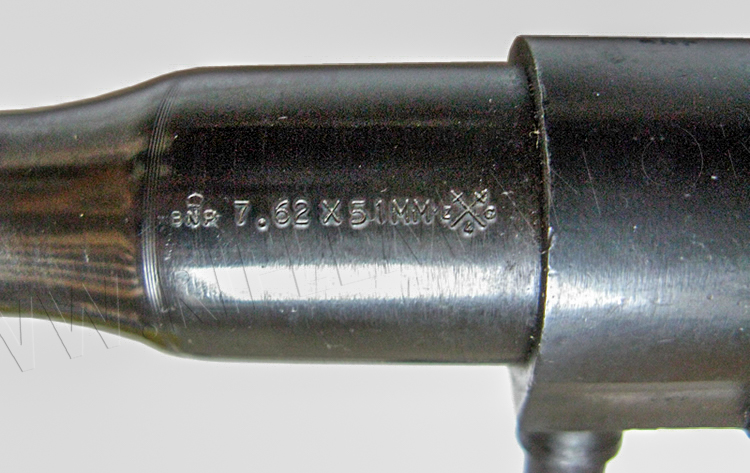
Civilian barrel proof marks are for 1974 (see Date Your Rifle) as the rifle was re-proved at Birmingham because this was necessary when the rifle was sold into the civilian market.
This was barely 3 years after the 1971 conversions of the .303" No.4T Second World War sniper rifles to 7.62mm, in the form of the L42A1 rifle subsequently employed in the Falklands War.
A 7.62mm NATO calibre service rifle was first introduced to British Forces on the approval for issue of the L1A1 Self Loading Rifle in 1959.
The barrel is considerably tapered, and the barrel reinforce is without the lightening scallops seen on the .303" No.5 Rifle, it is probably a re-profiled barrel from a batch manufactured for the post 1960 conversions of the No.4 rifle from .303" to 7.62mm calibre for reserve stocks after the introduction of the NATO cartridge and the new L1A1 service rifle.

The electro-pencilled markings show that the conversion is of a Fazakerly produced No.5 Mk.I rifle of early 1947 manufacture.
"AC" is the serial no. prefix. The number itself has been removed by the machining of the slot for the fitment of the special spring-loaded ejector.
The bolt handle carries the full serial number.

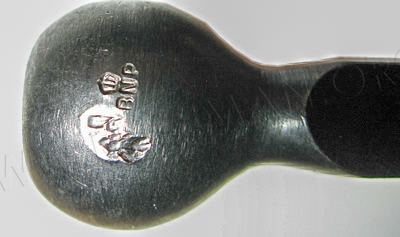

The bolt head is a Fazakerly manufactured item, but carries only the BNP nitro-proof civilian proof mark
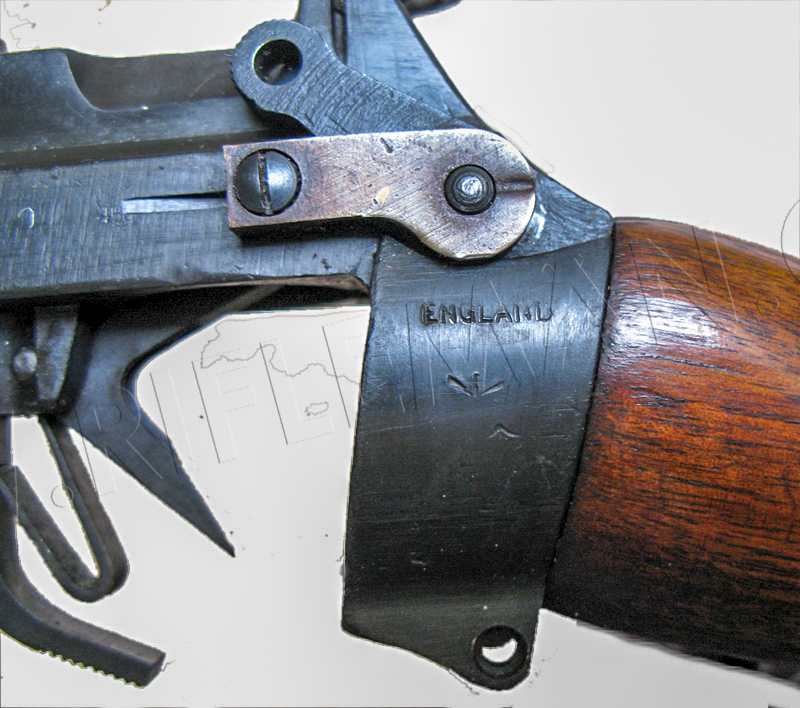
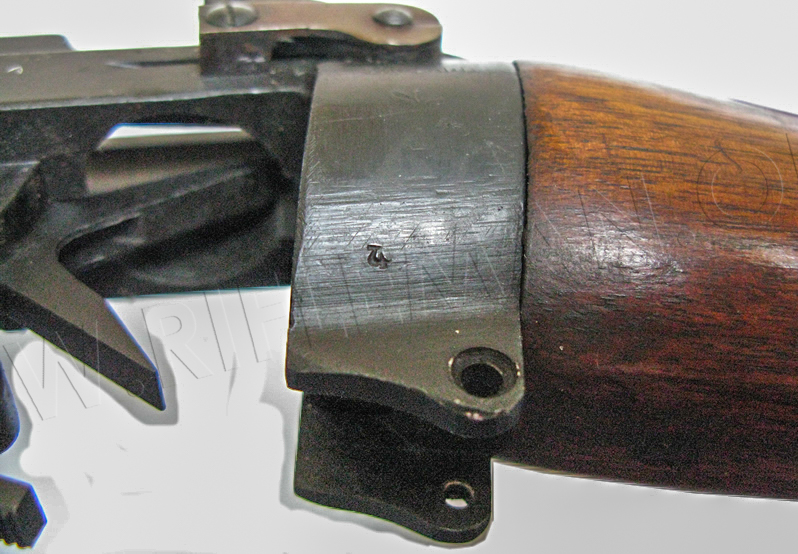
The receiver and ancillary parts, as you would expect, bear a number of military"crown" inspection and "Broad Arrow" acceptance marks.
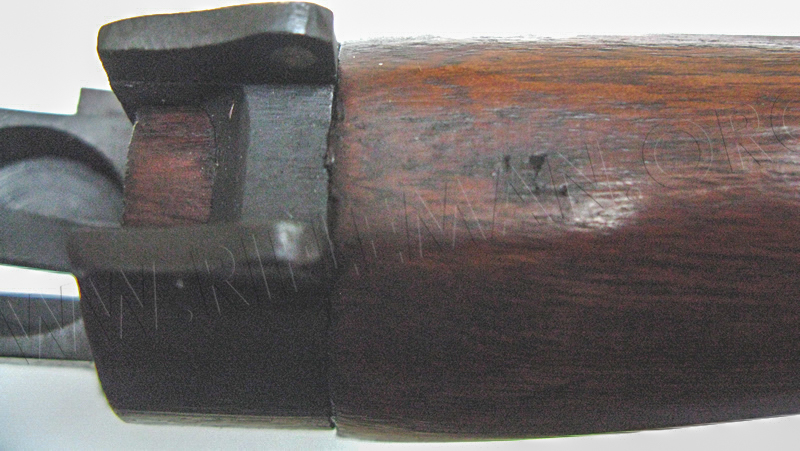

The original crossed pennants military mark, on the rear of the action, is shown above.
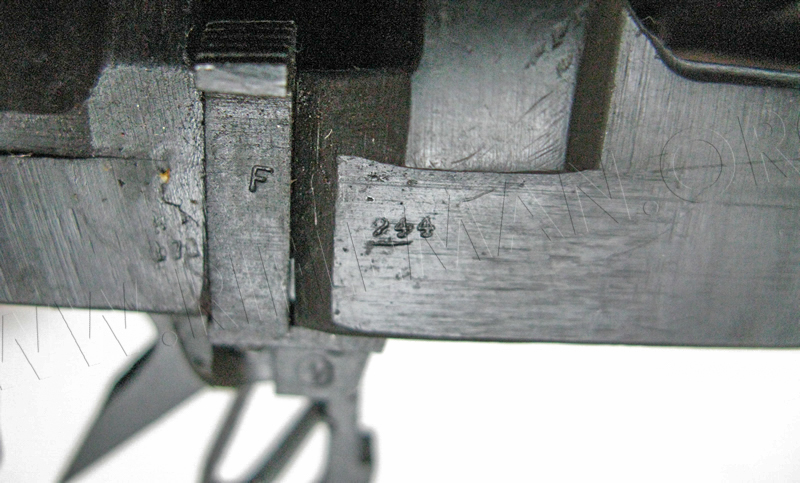
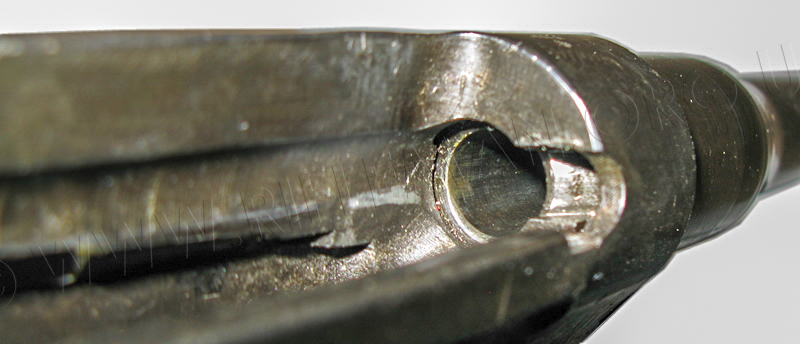
Above: the 7.62 chamber and extractor slot
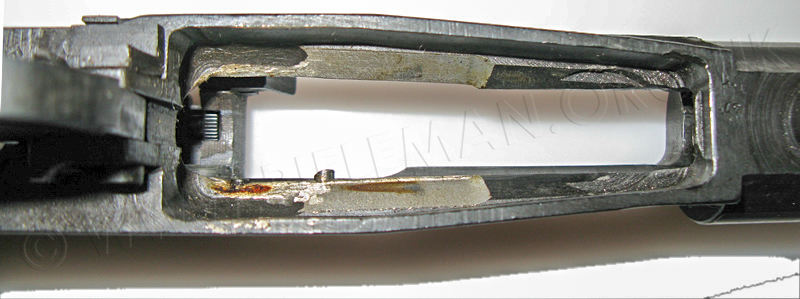
Evident above is the machining of the magazine well to accommodate the special magazine.
The ejector spur can be seen towards the rear of the lower (LHS) of the receiver.
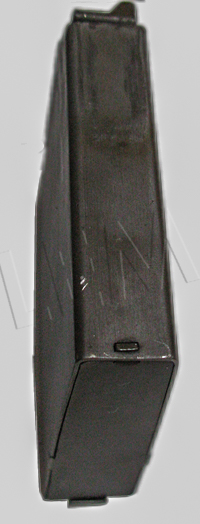
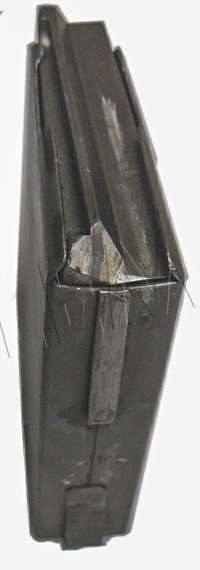
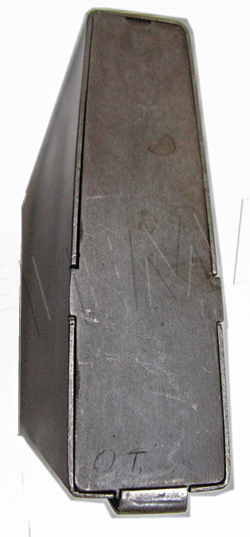
Above and below: the fabricated "in-the-white" 7.62 magazine, to accommodate which the trigger-guard plate magazine-well aperture has been re-profiled.
Should you have any knowledge of what is represented by the initials "O.T.", on the bottom rear corner of the base, please let us know.
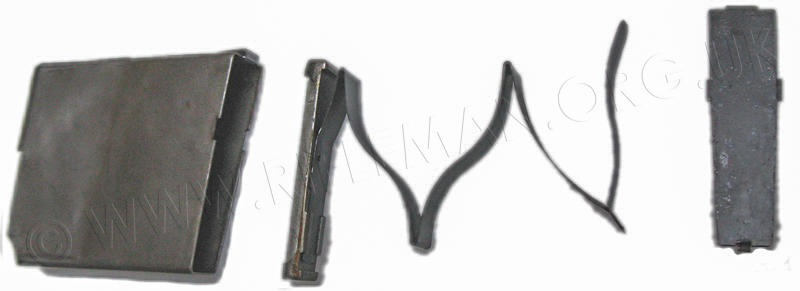
When this rifle was sold out of the Charnwood collection at Bonhams in 1997, the catalogue write-up by an acknowledged expert stated that the magazine was believed to have been a one-off prototype perhaps made by B.S.A. (the Birmingham Small Arms Company), or Parker-Hale. As of August 2024, we have been advised by the contributing owner of a Parker-Hale .308" sporting rifle that "it is built on a .30"/'06 length Mauser-type action: the magazine platform of the No 5 appears identical to that of the Parker-Hale rifle, apart from the fact that the No 5 platform has been shortened at the rear to fit the 7.62mm magazine case. The ejector on the No 5 is similar in principle to that included in the Sterling 7.62mm conversion kit but differs in detail."
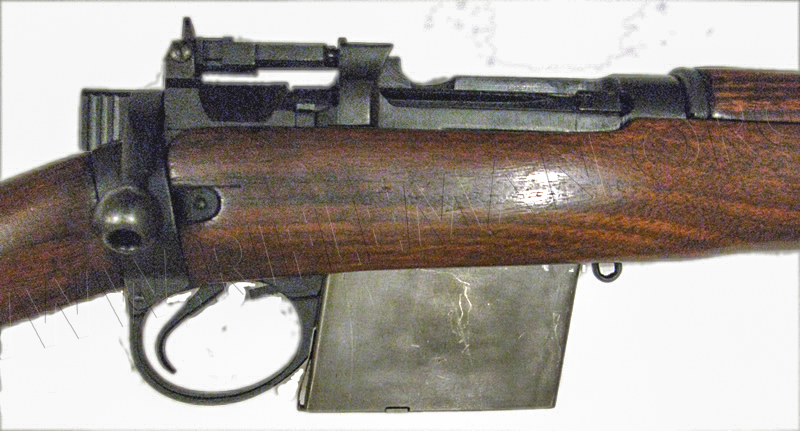

The machined magazine follower can be seen, as can the spring-loaded ejector stud
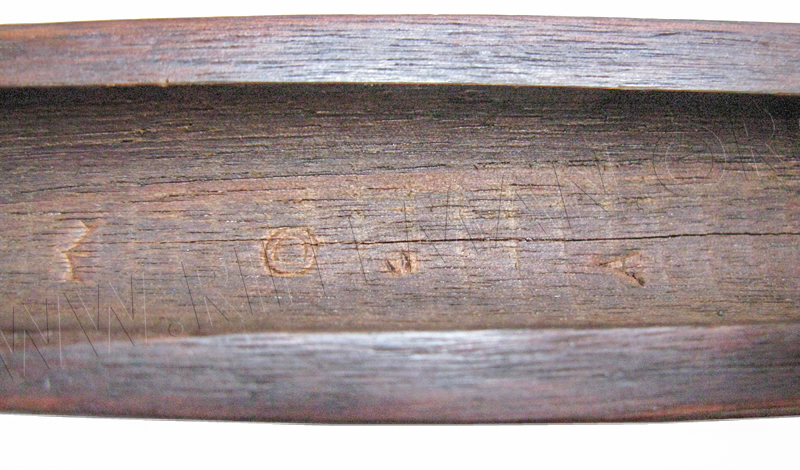
Above: handguard markings

Fore-end mark behind barrel-band
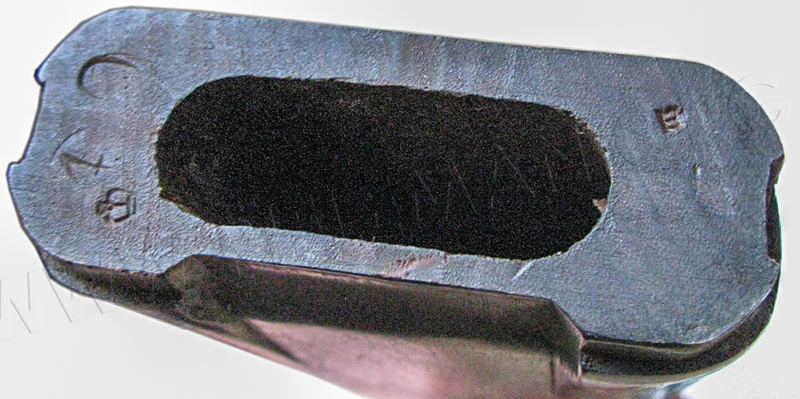
Butt-stock marks
_________________
The .303-inch calibre No.5 rifle was known to have an accuracy problem described as "Wandering Zero" cause by the reduction in strength of the action as a result of the removal of material to lighten the weapon, particularly for use by paratroops and infantry in the jungles of the Pacific theatre.
The subject was covered in a handbook issued in 1963 by the Royal Small Arms Factory at Enfield Lock detailing the conversion of .303" No.4 and No.5 rifles to the NTAO 7.62mm calibre. The section (7) is reproduced below.
The complete handbook can be found at the bottom of the page covering the
7.62mm L39A1 target/sniper version of the No.4 rifle.
THE No. 5 RIFLE CONVERSION
It will be appreciated that in producing a lighter rifle for use in jungle warfare, it proved necessary to lighten the rifle action in every possible way. As a result of this need, the body was lightened behind the locking shoulders, making the weapon slightly weaker at this point than in the No. 4 Rifle. This feature contributed to slightly inferior shooting properties, compared to the No. 4 Rifle, and with the higher chamber pressure of the 7-62 mm. cartridge, it must be expected that the perfor mance of a No. 5 Rifle, converted to 7-62 mm. will not be as good as that possible with a No. 4 Rifle converted to the same calibre. Since these weapons were manufactured however, improvements in local heat- treatment techniques have been developed and the bodies could be specially treated to counteract this condition.
It is strongly recommended that, where practically possible. No. 5 Rifles should be converted by R.S.A.F. Enfield, when the toughness of the cams and surrounding areas can be improved by special methods to enable them to withstand the higher chamber pressure of the 7-62 mm. cartridge.
Attention is drawn to the fact that the No. 5 Rifle has more recoil than the No. 4 Rifle when fired with -303 ammunition and, therefore, it must be expected that the recoil will be even greater when fired with 7-62 mm.
As an adjunct to this page's subject, there was an article in the December 1975 issue of the now defunct "Guns Review" magazine that covered the firearms used by the well-known explorer Major John Blashford-Snell. For many years he carried a No.1 Mk.III .303" SMLE on his expeditions, as well as a BSA Sportsman Five .22RF rifle, stating his preference for bolt-action rifles (and particularly not tube magazines). When seeking a more powerful but lighter and handier full-bore rifle, he approached Fultons gunsmiths at Bisley Camp in Surrey, and to meet his requirements they converted a No.5 carbine to 7.62mm for him, utilising a No.4 rifle butt with a proprietary recoil pad, a Sterling magazine and a target-shooting type wide webbing sling. The flash hider was retained as he felt it helped to better contain muzzle blast.
The rifle went with the Major for his famous Zaire River Expedition in 1973,
which made the first navigation of the more than 2,700 miles of the Zaire River - formerly the Congo.
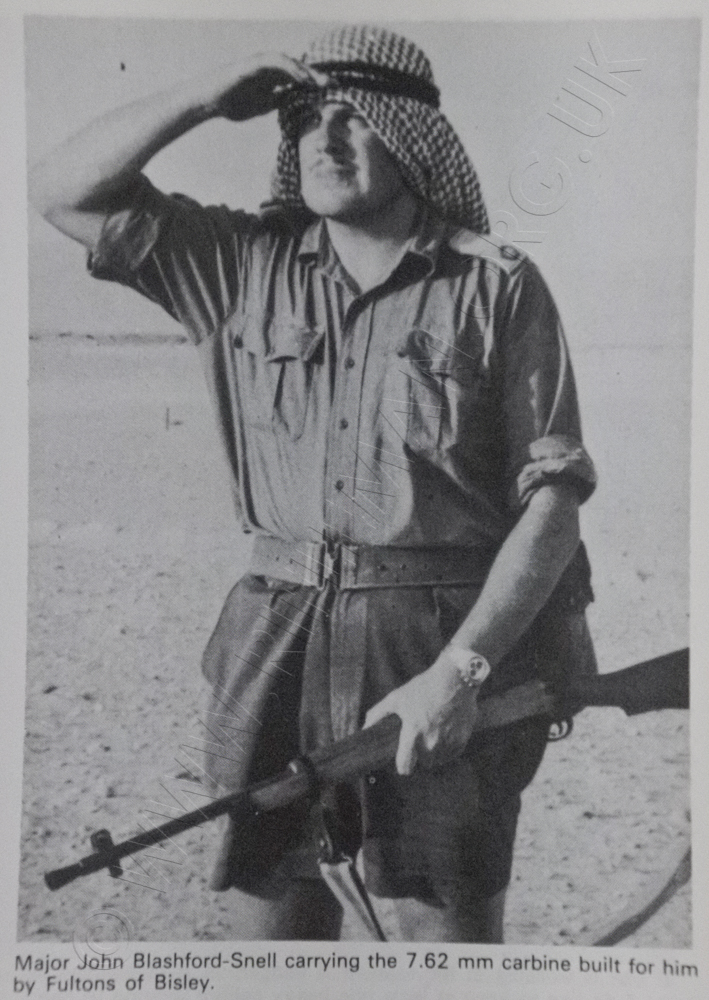
The man himself in something of a T.E. Lawrence pose!
Thank you for taking the time to view this page. We hope it has been of interest
Click here for Chronology of Enfield genre Training Rifles, Adapters & Cartridges