These rifles are latterly .22 Rim-Fire conversions of the Rifle,
Short, Magazine Lee-Enfield ( S.M.L.E.) originally in .303 inch calibre, although some late mark No.2
rifles were built from scratch, particularly in Australia and commercially.
The barrels of these later marks of No.2 rifle were usually newly made solid
components of Birmingham Small Arms Co.,
manufacture.
The earliest conversions were also newly made "small-bore"
barrels, but the need to not interfere with vital production of .303" barrels, at the commencement of the First World War, required alternative means for the
provision of such barrels.
From 1915 these converted rifles' barrels were bored
out .303"CF units, mainly parented by obsolete rifles or those condemned
for Service full-bore use, and sleeved with a .22RF rifled tube in the manner
of Parkerifling.
This
sleeving work was largely contracted to the Parker company, themselves the pioneers
of successful major production of such barrelling.
These rifles are latterly .22 Rim-Fire conversions of the Rifle, Short, Magazine Lee-Enfield ( S.M.L.E.) originally in .303 inch calibre, although some late mark No.2 rifles were built from scratch, particularly in Australia and commercially.
The barrels of these later marks of No.2 rifle were usually newly made solid components of Birmingham Small Arms Co., manufacture.
The earliest conversions were also newly made "small-bore" barrels, but the need to not interfere with vital production of .303" barrels, at the commencement of the First World War, required alternative means for the provision of such barrels.
From 1915 these converted rifles' barrels were bored out .303"CF units, mainly parented by obsolete rifles or those condemned for Service full-bore use, and sleeved with a .22RF rifled tube in the manner of Parkerifling.
This sleeving work was largely contracted to the Parker company, themselves the pioneers of successful major production of such barrelling.
CLICK ON THE ABOVE IMAGE TO VIEW DOCUMENTARY & TRAINING ARCHIVE FILM OF
The Pattern '14 No.3 Rifle, the SMLE
No.1 Rifle and No.2 Rifle,
the No.4 Rifle and the FN-SLR
Rifle and the EM2 Bulldog precursor to the current SA-80
Rifle,
including Service Rifle Target shooting at BISLEY CAMP RANGES Post WWII
The approval for service of the first conversion of the S.M.L.E. to .22RF calibre was in August 1912. These conversions were effected using the Marks II and II* rifles (which .303"CF rifles, from 1926, became known as the No.1 Mks. II and II* with the introduction of a new sytem of nomenclature by rifle number). The converted rifles were fitted with the previously mentioned solid .22RF barrel similar to that especially made for the Rifle, RF Short Mk.I in 1907, and approved as the " .22-in. R.F. Short Rifle, Mark III ".
For purposes of latter-day identification, it should perhaps be borne in mind that such rifles could subsequently have been sleeved, by the Parker or Parker-Hale companies, to lengthen their military service, or when sold out of service into the commercial world.
A wartime need for yet more training rifles led to the approval, in April 1916, for conversions of S.M.L.E. rifles (No.1) Marks II and IV, and of the earlier "Long Lee-Enfields" in their charger-loading Mark I* guise - the C.L.M.L.E (Charger Loading Magazine Lee-Enfield).
These conversions each rather confusingly became "Pattern 1914" rifles, in common with the .303 British designed, but American manufactured, rifle that in 1926 acquired the nomenclature Rifle No.3.
However, confusion was limited by the full designations for these rifles, which, for those converted from Mk.III and Mk.IV S.M.L.E. rifles was the " .22-in R.F. Pattern 1914 Short Rifle No.2", and for those converted from the C.L.M.L.E. Mk.I* , was the " .22-in. Pattern 1914 Long Rifle ". The latter rifle is obviously not a conversion of the S.M.L.E., but is mentioned here because of the significance of its concurrency with those conversions.
Below: the "Enfield" Pattern Room collection, at the Royal Leeds Armouries, carries a converted "Long Lee" which bears a manilla pattern-room label, (which label is marked with the Crown and " E.R.", and is therefore post 1952 and not original pattern labelling) on which is typed the designation " .22 LEE ENFIELD Rifle No.2 "

 This
rifle is not to be found in the Pattern Room Catalogue, and carries one of the
more recently attached clear plastic holders protecting the printed label describing
the rifle as being " EXPERIMENTAL " and of " UNKNOWN PATTERN
". However, at some point, it was apparently suspected that the rifle represented
an example of a Rifle No.2. The mid and front barrel bands appear especially
made, with the fore-end wood protruding through the front band and being rounded
off. There is therefore no bayonet mounting lug.
This
rifle is not to be found in the Pattern Room Catalogue, and carries one of the
more recently attached clear plastic holders protecting the printed label describing
the rifle as being " EXPERIMENTAL " and of " UNKNOWN PATTERN
". However, at some point, it was apparently suspected that the rifle represented
an example of a Rifle No.2. The mid and front barrel bands appear especially
made, with the fore-end wood protruding through the front band and being rounded
off. There is therefore no bayonet mounting lug.
The magazine is the traditional shell used in most training rifles, emptied of its spring and follower, but with the lower tapered section of the body entirely removed, leaving of the order of an inch protruding from, and parallel to, the underside of the fore-end wood. This is an exceedingly rare modification. The only Lee-Enfield training rifle otherwise without means of collecting the empty, fired rimfire cartridge-cases is the Rifle, Short, .22"RF, Mk.I, converted from the Magazine Lee-Metford Mk.I*. That rifle was issued without any magazine at all, the empty magazine-well permitting extracted cases to fall to the ground. It should be noted that the magazine-well in that rifle was radiused for the early rounded nose magazine used in the M.L.M., unlike the square-fronted magazines of all subsequent Lee-Enfield offerings, and as shown in the rifle here illustrated.
 ...........
Note the unusual sling-swivel in front of the trigger-guard, with a double pivot and D-ring.
A screw behind the magazine seems to provide prevention of the magazine's release.
The lug affixed inside the rear of the magazine is of indeterminate use,
and shows no evidence of ever having provided any support for a magazine base, although that is not impossible.

 The fore-sight and front band: left,
and right, a highly unusual folding rear-sight with both windage and elevation adjustment. This sight mounts in place of the rear volley-sight, in much the same way that the B.S.A. No.9 target sight would be have been fitted to a "Long Lee" at that time .
Returning to the later and perhaps more common conversions of the S.M.L.E.,
the following offers proof, if ever it were needed,
of the longevity of service of such training rifles through two World Wars.
Below: Rifle .22RF Mk.III with Cooey rear aperture sight

The Canadian Cooey 10a model rear-sight, patented in 1925 and illustrated above,
used the sight-leaf from the Ross rifle.
This was the Canadian answer to providing a training rear sight for the .22 SMLE to simulate the later aperture-sighted full-bore Service rifles used during the Second World War. At the time of its design, the sight would have offered equivalency to the sighting of the .303 Pattern'14 (Rifle No.3), but later afforded very practical representation of the No.4 rifle in particular. Rifles configured as the example above have also provided quite satisfactory small-bore target rifles over the ensuing years.
As well this folding rear-sight, utilising the leaf from the Ross straight-pull service rifle, the Cooey Machine and Arms Co. also manufactured their own designs of Cooey .22 training rifles and, in addition, made conveyors, along the lines of those used in the ".303 cum .22 " Pattern '18 S.M.L.E., for use with the Boys Anti-Tank Rifle. Such a conversion was also manufactured by Parker-Hale and marketed commercially late in WWII. It was unsurprisingly named the "Adapter .55 cum .22", and was used without an Aiming Tube (or .22 barrel sleeve) to train those charged with the task of tank-killing with that famous and unpopularly heavy and heavy-recoiling anti-tank rifle. The use of the word unpopular needs to be qualified here, because many Allied combatants had good reason to be grateful for the presence of a Boys rifle during engagements, in any number of situations, in which they found themselves.
Incidental to the above connection between the .22 rimfire cartridge and the Boys Anti-Tank Rifle for training purposes, was the arrangement for mounting the .22RF No.2 Mk.IV* Lee-Enfield Rifle alongside the Boys ATR for weapon training. This system also permitted use of the ATR on miniature or indoor ranges, mainly to teach 'lead' (the aiming and firing at a point some distance ahead of a moving target to ensure a hit. Details of this equipment can be found, via the link above, on the page for the Boys Anti-Tank Rifle.
The earlier British equivalent was the "Auxiliary" rear sight introduced in 1917, and originally intended for use with any of the .22RF Short rifle models, but which is most commonly found on the .22 SMLE training rifles. Its purpose was to simulate the rear aperture sight of the .303 CF Enfield No.3 rifle - formerly, and most commonly known as, the P'14. This unit, designated the"Sight, Auxiliary, Aperture, Mk.I" was manufactured by modifiying the volley sight of the Lee-Metford rifle.


The auxiliary rear-sight was
designed for fitment in place
of the rear volley aperture
sight
Below is an image of the sight fitted to a .22RF Mk.IV* S.M.L.E.,
which example is the pattern of that rifle approved in November of 1921
Image courtesy of the Enfield Pattern Room

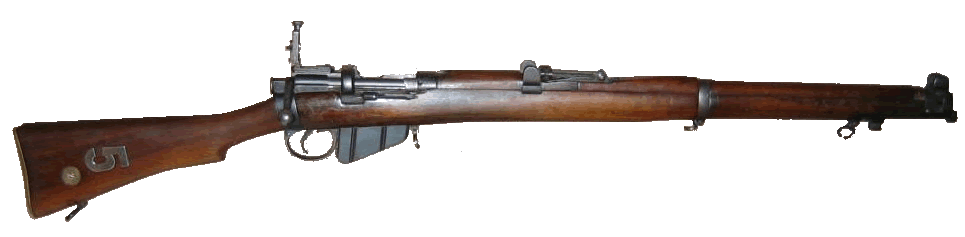
Here follows that last-of-the-line S.M.L.E. conversion, the No.2 Mk.IV* shown below,
simply a change in nomenclature (from No.2 Mk.IV) made in 1926
related to the stamping of " .22 " on the left hand side of the magazine casing.
Above: the Rifle No.2 Mk.IV* - The rifle is marked as "ENFIELD SHT .22 IV* " but dated 1931 -
- possibly either built or refurbished at that date.
These rifles were still manufactured into the 1950s - particularly in Australia, which rifles often used coachwood furniture.
Fitted with the Parker-Hale or other equivalent aperture target sights,
such configured rifles have been used for small-bore target shooting over many years
- and are still in use in Classic rifle competition.
The example below has been fitted with a Parker-Hale Model 5A S.M.L.E. target type rear-sight.

Left:
rear aperture target sight
fitted with their six-hole eyepiece
Subsequent to an enquiry made of us regarding the method of adjusting the foresight on these rifles,
entailed in obtaining the best "zero", we have added a few images to show what is required.
The same principle applies to Lee-Enfield rifles Nos. 1, 2, 3, 4 & 5.
The 'official' method of adjusting fore-sight windage is to use the issued tool for the purpose.
The original tool for the S.M.L.E. ( Nos. 1 & 2) rifles is shown first below left and,
to the right it is shown fitted to the rifle..


Each graduation on the adjuster represents one inch of windage displacement on the target of the point of impact.
For this tool to be used, it is necessary to remove the rifle's nose-cap by removing two screws. Early rifles had solid fore-sight protector wings on the nose-cap, and removal of same was obligatory. Later nose-caps had perforated protector wings, which both saved weight and allowed more light onto the fore-sight.
It conveniently so happens that the later adjuster for the Rifle No.4 can be employed to adjust the fore-sight of an SMLE with perforated protector wings, without removal of the nose-cap, as shown in the image to the right.
Elevation zero adjustment of the fore-sight is achieved by replacement of the fore-sight blade with another of different height.
There is a selection of blade heights available from specialist surplus dealers, and the dimension for each is stamped onto the top of the unit's dovetailed base.
They start from zero, which represents one inch above the bore's centre-line,
and increase in multiples of "15 thou" ( i.e. 0.015") as +15, +30, +45 and +60.
Should an increase in sighting elevation be required, and no replacement fore-sight be available,
then judicious filing of the blade would suffice.
A decrease in elevation would be more problematic.
Remember, with rear-sight windage you wind left to go left; but move the fore-sight left and the P.O.I. ( Point of Impact) moves right.
An image of the adjusting tools for other Rifle Numbers,
along with greater detail of the adjustment of the Lee-Enfield rear and fore-sights for zeroing,
is to be found on the page for Service Sights
Below: the .22"RF chamber cross-section drawing giving dimensions

Below: the rifling dimensions of the 8 groove No.2 rifle barrel, 1 turn in 16" - Right Hand


To view the complete Small Arms drawings (S.A.I.D.)
for the No.2 and No.1 rifles and components
click on either adjacent image
In 1927, a training rifle was considered specifically for the Officers' Training Corps ( O.T.C.).
An experimental model was constructed along the lines of the No.2 Mk.IV* rifle,
but with shortened fore-end, no forward upper handguard, and fore-sight protectors
as used on the "Long Lee" and .22RF Short rifles, but with the wings straightened upright to better represent those of the S.M.L.E. rifle.
This one-off experimental rifle was converted from a B.S.A. manufactured .303 No.1 Mk.III* service rifle.
It carries no markings other than those of the parent arm.
The idea was not further advanced, probably because yet another conversion of the S.M.L.E.
was likely to prove superfluous, and the model was never put into production,
although there is a suggestion that a very small number may have been converted.

Above: the O.T.C. .22RF experimental rifle - Ref: RB388 - (see the catalogue "BRITISH RIFLES").
image by courtesy of the Enfield Pattern Room
Rifles of similar appearance have been noted, particularly from the Antipodes,
but such rifles have themselves usually been converted from No.2 Mk.IV* rifles
and are therefore retrograde modifications or "sporterisations".
Additionally, fore-sight protecting wings, upright as above, but of the pressed-steel clamp type,
using a cross-bolt to lock the wings onto the barrel, have been recently seen offered on auction sites.
These units sometimes carry the stamping "22" on one wing,
and were presumably intended for equivalent modifications.
We illustrate another fine example of a .22RF Lee-Enfield No.2 Mk.IV rifle (SMLE) training rifle
The rifle is in very good condition, with wood furniture better than many of this era.
It is an unusual A.J. Parker conversion
The bore is in fine shooting condition, with particularly little chamber erosion,
and spent cases still extract perfectly.

This rifle is fitted with a contemporary and rare A.J.Parker early model
"Twin Zero" folding rear target aperture sight,
an equivalent of the A.G. Parker "Bisley Works" folding Model 9.
The butt disc is typically stamped "O.T.C. NOTTS"
for the Nottingham Officers Training Corps unit.
An earlier method of providing a .22 Rimfire training rifle at minimum expense was the "Aiming Tube".
This was a logical evolution from the .297/230in. CF calibre "Morris Tube" previously utilised,
originally with the Martini Henry and Martini Enfield rifles, and latterly with the first Lee-Enfield - the "Long" Lee.
The aiming-tube provided .22 rimfire practise for both civilians and the military.
Adaptation sets were available from A.G. Parker & Co.
complete in wooden boxes partitioned for the tube, bolt and accessories.
Ideally, the set would be properly partnered to the parent rifle by means of
the .22RF bolt-head being selected for correct head-spacing with the rifle and tube.
As with the .303 centre-fire bolts, heads were available
with different dimensions between the head face and the shoulder
from which the threaded section started for screwing into the bolt body.
Many civilian shooters or non-regular servicemen with their own .303CF S.M.L.E. rifles
(and indeed Volunteer or Territorial Long Lee rifles still very much in use years after the adoption of the S.M.L.E.
- see page 8 of the BSA Catalogue for 1908-9)
Below is a No.1 Mk.III* .303in. Centre fire calibre rifle fitted both with an aiming tube
and the Lattey Galilean 'sniper' sights adaptation (of which more below).
To fit the Aiming Tube, the bolt is removed, the tube slid in from the breech, and a leather washer ,
brass/bronze washer and knurled nut tighten onto the threaded section of the tube protruding from the muzzle.

The tube must be rotated into the correct position for the sliding chamber extraction sleeve
- just visible in the images below in both rearward and forward positions
- in order that the extractor on the bolt head will withdraw the sleeve,
which is at the same time rotated by virtue of a helical slot cut in it
which engages on a pin fixed to the outside of the chamber section of the aiming tube.
 ............

When fully withdrawn, the semi-circumferential flange on the rear of the sliding sleeve, and with which the extractor engages, rotates clear of the extractor, allowing the bolt to be fully drawn to the rear of the action. To reload, the extraction sleeve must be pushed fully forward over the chamber before the next round can be fingered into the breech. The system is fiddly but effective. Correct functioning, accuracy and grouping are considerably dependent upon careful fitting of the tube. The parent arm must not be too worn in the bore, otherwise the tube can flex within the excessive tolerance. The MPI and grouping will then significantly change as the barrel temperature varies. Do not let anyone tell you that the design was a hopeless non-starter. In good condition and carefully assembled, this system is quite capable of grouping to one inch at fifty yards! See also the equivalent conversion unit for the German K98 service rifle.
Left: the Lattey fore-sight objective lens and mount, which clamps into the aperture in the nosecap casting. The muzzle of the .22RF Aiming tube can clearly be seen with its knurled bronze fastening nut and washer with the underlying leather washer to prevent overtightening, which could separate the Aiming tube barrel from its chamber section to which it is affixed.
For the inquisitive amongst our readers, no, the foresight lens arrangement has nothing to do with the aiming tube. It just so happens that the rifle which best accommodates this particular tube also carries a set of Lattey "Galilean" First World War sniper sights. Sights of this type were designed early in WWI to improve the sight picture for the British and Commonwealth Armies' sharpshooters. Initially, "sharpshooters" or unit marksmen were only issued with rifles carrying the standard open service sights, and many took it upon themselves to fit target aperture rear sights to their rifles to improve accuracy. Such sights are poor in low light levels, and further improvements were sought and devised, often by those whose task it was to employ such equipment.
The Lattey sight set consisted of the objective lens fitted to the nose-cap in front of the fore-sight,
and the correcting lens fitted immediately to the rear of the "V" or "U" notch on the tangent rearsight leaf.
The magnification afforded is little more than 2X.

This system had other equivalents such as the "Neill" and "Martin" and "Gibbs" sights,
not to mention an optical arrangement manufactured by BSA.
Some early set-ups utilised a foresight lens and merely a rear aperture sight;
usually a proprietary target sight (such as the BSA No.9 folding rear-sight) as previously mentioned.
See also much more of the LATTEY sights
and the equivalent WW1 Galilean sights by GIBBS and the Birmingham Small Arms Co.
Almost any option was tried until the first purpose-made sighting telescopes were eventually fitted to sharpshooters' rifles.
Below in a video clip is a British Pathe Newsreel of Enfield rifles shown in training.
Thank you for taking the time to view this page. We hope it has been of interest
Click here for Chronology of Enfield genre Training Rifles, Adapters & Cartridges