The Canadian Ross Model 1910 straight-pull
.280 & .303 calibre Service and sporting rifles
Please be aware that some specialist imagery may take time to load.
This site is for dedicated researchers and is best viewed on desk or laptop.
See: ...ENFIELD SERVICE & TRAINING RIFLES .... - ....SMALL-BORE TARGET RIFLES
See also: THE ROSS CADET RIFLE MODEL 1912
----------------------------------------------------------------------------------------------------------------------
This page is intended simply as a resource for documentation on Ross rifles
The Ross rifles were originally designed and manufactured in Canada in Ross's own .280-inch calibre.
It is worth here noting that the round designed by Charles Ross proved accurate and fast, up to 3,000 fps, with a comparatively flat trajectory compared with the then current British .303-inch calibre rimmed cartridge. Thus, when the British Enfield designed prototypes and trials rifles preceding the rifle latterly known as the Pattern 1914 (P'14), the development of that rifle was initially held up while the merits of the .280 round were seriously considered.
In fact, the first developed Enfield prototype was indeed built in .280 (.276) calibre as the Pattern 1913 rifle, from which a batch of trials rifles were manufactured. These rifles were excellent performers, but the urgent need for service rifles at the outset of the First World War necessitated rifles in a standard calibre for which ammunition was readily available; hence the final production rifle, built in the U.S.A. as production facilities in the Great Britain were already overstretched, brought the .303-inch Pattern '14 into being. It was officially given the nomenclature Enfield Rifle No.3 (note that this was not a Lee-Enfield). America later built the rifle for their own use as the Pattern 1917 in .30-06 calibre.
The significance of the .280 round was also borne in mind when the Enfield design team were tasked with producing a new automatic assault rifle in the early 1950s. Their bull-pup prototype and trials rifles were also built in that calibre, initially as the 7mm Enfield Rifle No.10 that successively became the EM-1 and EM2 rifles.
___________________
In 1908, the Canadian Evening Chronicle carried a report by "Experts"
which gave a none-too creditable view of the then submitted Ross service rifle. It read ....
Ottawa, May 11 - According to additional papers recently brought down in the House of Commons with reference to the Ross Rifle, the chief at Woolwich, England, reported in July 1906, that the bolt and body of the rifle were strongly constructed and serviceable, but the lock bolt was defective inasmuch as it does not withdraw. As primary extraction depends upon the momentum obtained in the first movement of bolt extraction, it appears to be somewhat weak, being made of sheet material.
The magazine is poorly constructed and is made of sheet steel, depending on the woodwork mainly for its support. The cut-off is simple and clean but unsatisfactory. The construction of the back sight is decidedly weak, the leaf being made of thin sheet metal pressed up to form a rib in imitation of the Mausers. The slide is poorly fitted throughout and the main object in this sight appears to have been [Ed: "not only"?] cheapness of construction, but one that could be cheaply made. The sliding trap in the butt plate is not likely to be very durable as any blow on the plate would fix it. The stocking of the ge .. [Ed: ?].. tion is very rough and the fitting poor.
However, this opinion almost certainly relates to a very early example,
and it is acknowledged that the later models were extremely well designed and built to demanding engineering principles, using fine materials, often of necessity imported from the U.S. , and tight tolerances. Indeed, those tight tolerances possibly resulted in some of the criticisms of the M10's performance in the far from ideal conditions in the field.
Jammed actions were not unusual, with difficulties in unlocking and opening the bolt, and tight chambers resulting in fired cases preventing extraction. It has been said that the rifles had always performed well with Ross's own designed cartridges, manufactured either at his own factories, or by the Canadian Dominion Ammunition Company to his specification. Problems reportedly arose chiefly because British made ammunition issued in the field did not meet the fine tolerances required by the rifles. But the rifle's accuracy was never in doubt, as competition successes even internationally at such venues as Bisley in England.
The company advertised the pre-WW1 successes of the Canadian Rifle Team at Bisley,
which included a World's Record score of 73 ex.75 in the Kings Norton match at 1,200 yards.
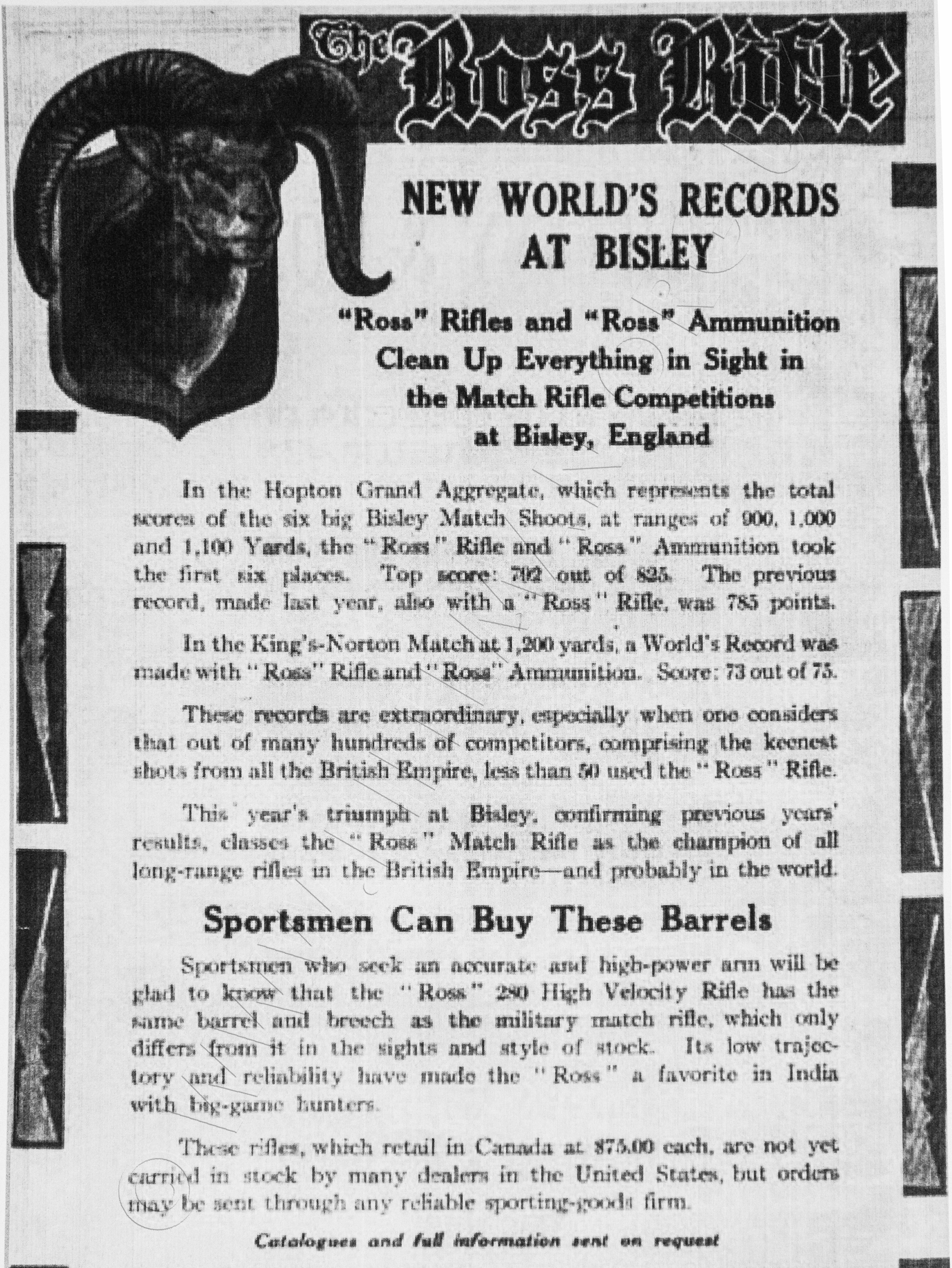
The contemporary belief, indicated in the above advertisement, that a small calibre high velocity round at 3,000feet per second was an effective one for large animals, such as elephant and rhinocerous, was proven to be in error after a number of hunters of large game were killed when beasts shot with such ammunition continued unhindered in their charges. The return into use of large calibre express rifles with expanding ammunition confirmed the unsuitability of a high velocity jacketed .280 round; even those with a soft nosed bullet.
One complaint from the servicemen who had to tote the Ross rifle in restricted and narrow trenches, apart from difficulties with the ingress of mud and grit, was that it was over-long and unwieldy compared with the Short Magazine Lee-Enfield Rifle.
One often reported anecdote of a particularly tragic incident served to severely damage the reputation of the Ross rifle in the trenches. One freezing and thickly fogged early morning, a German attack on an allied trench found the troops carrying Ross rifles being over-run when they could not open their rifle bolts, the damp having frozen in the locking threads, leaving them stamping on the bolt handles and hitting them with bayonets and shovels in the attempt to reload.
________________
Col. Townsend Whelen, in his 1918 book “The American Rifle” ,
wrote of both the Ross Model 10 military and sporting models.
THE ROSS, MODEL 10, STRAIGHT-PULL RIFLES
This is a Canadian rifle, manufactured by the Ross Rifle Company of Quebec. It is largely advertised and sold in the United States. It is a bolt action rifle, but differs considerably from the ordinary Mauser type
in that in operating it it is only necessary to pull the bolt straight to the rear, no turning up or down of the bolt handle being necessary. The Ross bolt consists of two distinct portions : the bolt itself ; and the bolt sleeve, carrying the bolt handle and the safety bolt. The bolt is a steel cylinder about 4½ inches long. On the bolt head are the two locking lugs in the shape of interrupted screw threads. These lugs are 3/16-inch deep - from the top of the lug down to the bolt. Into the lugs
are cut portions of an interrupted thread, 3/32-inch deep. The bottom lug, when the bolt is in its locked position, has three cuts in it, making four segments of the thread to lock into the receiver. The opposite lug has two cuts, making three of the thread segments. In the receiver walls are cut corresponding sections of threads into which these bolt head sections lock firmly when the bolt is revolved. The main locking shoulders of the lugs turn down against shoulders in the receiver, forming an additional lock similar to the ordinary system of bolt locking.
Along the rear three inches of the bolt spindle are cut two helicoid ribs, terminating at the rear in sections of an interrupted screw. These ribs, working in corresponding grooves in the bolt sleeve, form the means by which the Ross bolt is revolved. Between the two locking lugs of the bolt is cut a gas escape hole, through which gas may escape in the case of a punctured primer.

The Ross .280 sporting rifle, Model 10
The bolt sleeve is a hollow cylinder carrying the extractor, the bolt handle, nd at its rear end the safety bolt. It is about 5½ inches long. Along either side run the guide grooves which engage ribs in the receiver and make the sleeve run perfectly true and smooth: These ribs prevent the sleeve from turning. Inside the sleeve works the bolt proper, the spiral — helicoid — ribs on the bolt spindle engaging in corresponding grooves on the inside of the sleeve. When the sleeve, carrying the bolt, is pushed forward until forward motion of the bolt is stopped by the head of the receiver, the sleeve continues forward, and its grooves, acting on the ribs of the bolt, compel the bolt to revolve, engaging the locking lugs in their corresponding cuts in the receiver.
Thus a straight pull backward and forward of the bolt sleeve causes the bolt to revolve into and out of its engagement with the locking threads in the receiver. When the bolt and sleeve are drawn together to the rear the extractor on the side of the sleeve, engaged with the head of the shell, draws the empty shell to the rear until the ejector can strike it on the left side of the head, ejecting the shell out on the right side of the receiver. A familiar application of this straight pull system is the spiral screw-driver, in which a push forward on the handle compels the blade of the tool to turn, driving in or turning out the screw.
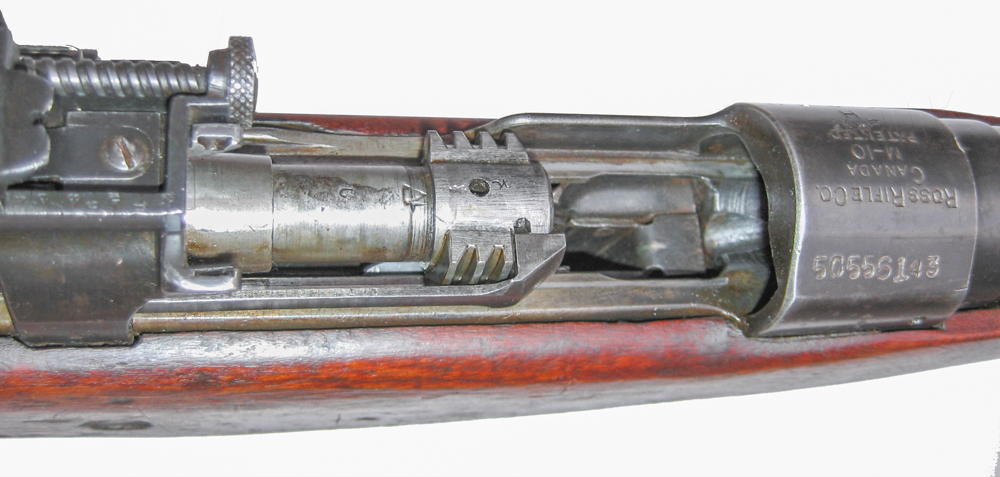
The action with bolt part open,
showing the interrupted thread bolt-head locking arrangement.
The magazine is almost exactly the same as the familiar Mauser magazine. When the bolt is fully pulled to the rear, the top cartridge in the magazine rises slightly and is thus presented in front of the bolt head, so that the bolt in moving forward pushes it from the magazine into the chamber. There is a magazine cut-off on the left side of the receiver which operates exactly like the cut-off on the U. S. Model 1903 (Springfield) rifle. When the cut-off is turned down, the magazine is cut off and held in reserve, and the rifle can then be used as a single loader with no reference to the cartridges in the magazine.
When the cut-off is turned up, the cartridges feed from the magazine into the chamber as the bolt is worked back and forth. When the cut-off is placed half way between " on " and " off," the bolt can be pulled to the rear completely out of the receiver.
The trigger pull mechanism is very simple and ingenious. There is
the usual safety pull seen in most bolt action rifles, the trigger moving to the rear about ⅛ inch against the pressure of the sear spring. After this is taken up the trigger has a very clean pull of about 3 pounds, absolutely free from creep. In fact I consider the trigger pull on the Ross the best of all the bolt action rifles, as it always comes from the
factory in excellent shape and does not require any refining as do almost all other bolt action triggers.
Many persons have thought the Ross action unsafe because the bolt pulled straight to the rear to open the action, without the familiar turn up and down motions. An examination of the mechanism will show that there is absolutely no foundation for such a belief. There is absolutely no tendency for pressure on the bolt head to unlock the bolt.
In fact it is a mechanical impossibility so to unlock it. On account of the size of the various parts, the distribution of metal in the bolt and receiver, and the interrupted screw system of the locking lugs, I consider the Ross to be the safest and strongest action on the market today so far as ability to withstand the explosion of the cartridge is concerned.
The Mauser system of turning up and down of the bolt causes the first opening movement of the bolt, and its final closing movement, to be actuated by a powerful cam. This cam motion gives great force to the final insertion, and first extraction of a cartridge into and out of the chamber. Should the cartridge stick in the chamber, or should there be a little dirt in the chamber, this power will adequately take care of it and no trouble will be found in the insertion or extraction of cartridges. The Ross action is not as powerful in this respect, and therein lies its one fault — its lack of power to insert and extract oversized cartridges, or cartridges that stick. In the two Ross rifles that I have owned I have experienced considerable trouble from this source. Both of these rifles have been .280 caliber. The .280 fired shell seems to stick firmly in the chamber at times, and then one has considerable trouble in opening the rifle,
due to the lack of ability to apply the same power that can be applied by the Mauser system with its powerful cams.
The Ross is an extremely quick action. It can be operated almost twice as fast as the ordinary bolt action, and it is very easy to
operate it while retaining the rifle at the shoulder in rapid fire. In .303 caliber it works easily and very smoothly, as the .303 shells do not seem to have the same tendency to stick in the chamber that the .280 shells do.
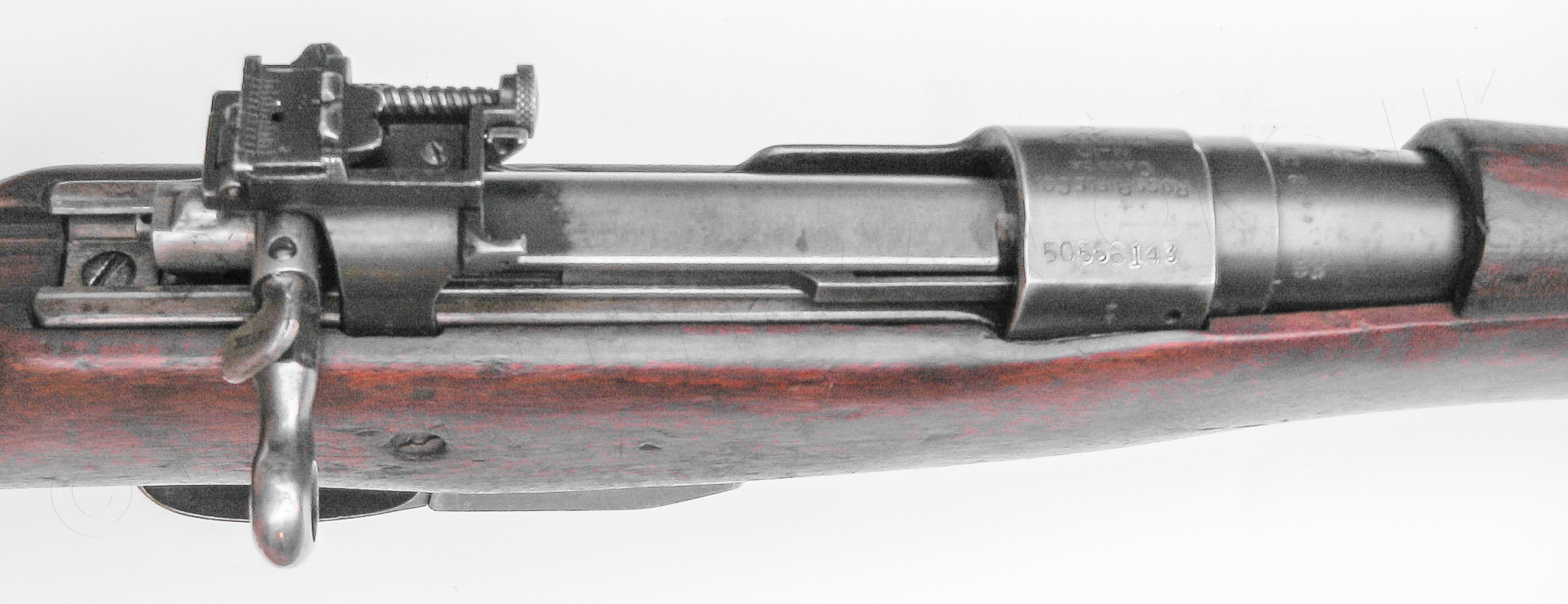
Angled view of the Ross rifle action, bolt closed.
This rifle is generally made in two calibers : the .280 Ross, and the .303 British. A few rifles have been made for the .30-caliber Model 1906 and .35 Winchester center fire cartridges. The .280 Ross, particularly, is a cartridge of extremely high velocity, about 3050 feet per second, and of very flat trajectory. It is loaded with a 142 grain, pointed, copper-tube, expanding bullet for big game shooting, and with a 180 grain, pointed full-jacketed bullet for long range target shooting. The long-range target cartridge has a velocity of about 2800 feet per second and is very accurate, and a most satisfactory cartridge for military target shooting, combining accuracy, flat trajectory, and the minimum of wind deflection. The sporting cartridge is not a particularly accurate one, groups running from 8½ to 12½ inches at 200 yards. This is to be greatly regretted as its great killing power, very flat trajectory, and high velocity make it very desirable, particularly for long range game shooting.
A large amount of attention has been devoted to the exterior shape and dimensions of the .280 Ross barrel. Effort has been made to make its whip or movement when fired such that it will discharge a cartridge with a slight under-charge of powder at a slightly higher barrel elevation, or higher point in its flip, than it does a normal cartridge. The idea is to start a bullet flying at a slightly smaller velocity from the muzzle at a very slightly greater elevation so as to compensate for the lower point of impact. In practice it is found that practically all cartridges may vary as much as 20 feet over or under in velocity, notwithstanding the fact that the powder charges weigh exactly the same, and this the Ross Company have endeavored to allow for in the shape and peculiar vibration of their barrels. The manufacturers claim superior accuracy from this arrangement. I have never seen this actually proved in tests, but at any rate it does not injure the accuracy.
At the beginning of the Great War the Canadian troops were all armed with the Ross .303 rifle. These rifles have now been all displaced by the Enfield among the Canadian troops in France, the Ross only being used for the purpose of training the troops in Canada before they are sent to Europe. There were several reasons for thus displacing the Ross : First, and probably foremost, was the desire, in fact the necessity, of having all the troops of the
English Empire armed with one rifle in order to simplify the matters of supply, repair, and issue of small parts. It is said that the Ross
did not stand up well in the trenches in comparison with the Enfield. The bolt is rather difficult to take apart for cleaning, and the whole rifle itself is rather more difficult to keep clean and in smooth working order than the Enfield. This was of considerable importance in trench warfare where the rifles were at almost all times subjected to the maximum of dirt and mud. The power exerted by the mechanism to insert or extract oversized or slightly deformed cartridges, or to operate the action when it was dirty, did not compare favorably with the Enfield. In theory the action is fine, but in practice, particularly under the severe conditions of military service, it could not stand up with the ideal Mauser type of action.
It is, however, as powerful and as reliable as any of the lever action rifles, and practically the only trouble with it in the hands of sportsmen has arisen from the tendency of fired shells in .280 caliber to stick very tightly in the chamber on occasions. For example, in the firing of 100 rounds of .280 cartridges on the target range under the most favorable conditions, six shells stuck tightly enough to bother one a lot in rapid fire, and four stuck so tightly that it was necessary to place the butt of the rifle on the ground and open the breech by means of the heel of the shoe applied to the bolt handle.
______________________
Returning to the main subject rifle of this page,
the example below is a Mk.III British service model in .303-inch calibre.

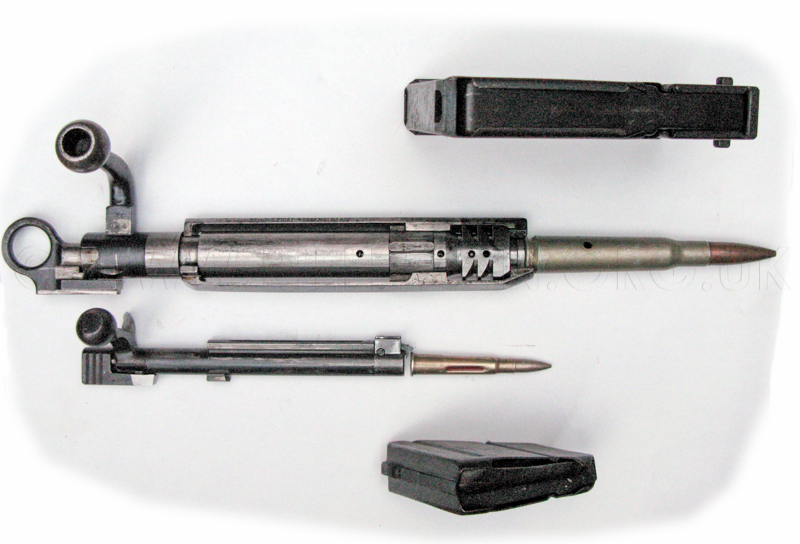
It is also worth comparing the bolt-head of the 'straight-pull' Ross rifle with that of the Boys Anti-tank rifle, which is similarly configured with an interrupted-thread forward bolt-locking arrangement.
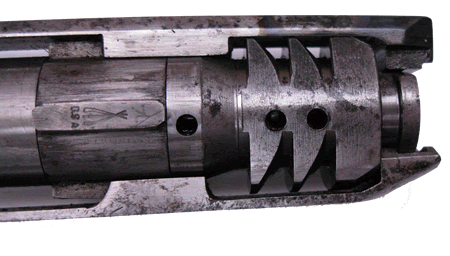
Below are shown the Boys' bolt, with a .50 calibre Browning round held in the extractor, and a Lee-Enfield No.4 rifle bolt with a .303in. drill-purpose round for comparison. The magazines for both rifles are also at top and bottom of the image. The large ringed cocking-piece permits a good pull to be applied by a finger to counter the considerable weight of the striker spring. It is just large enough to accommodate the finger of a lightly gloved hand, along the lines of the Schmidt-Rubin Swiss service rifle.
The Illustrated War News of April 1916 showed a Ross rifle in use as a sniping weapon.
The fore-end appears to have been shortened to the middle band,
making the barrel seem to be of exceptional length.
The rifle has also been fitted with a lengthy plain-tubed telescopic sight.
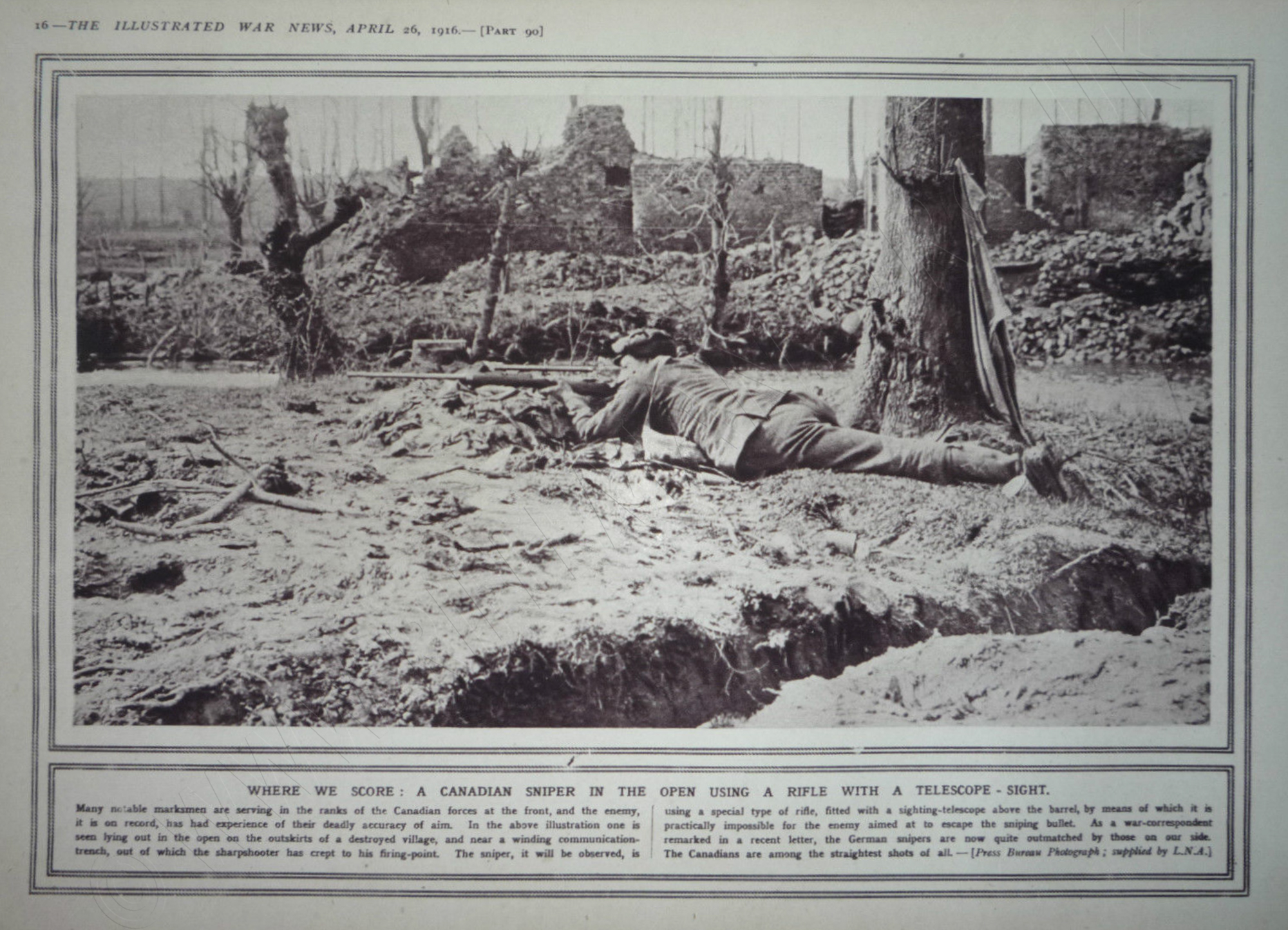
The caption text reads .......
WHERE WE SCORE: A CANADIAN SNIPER IN THE OPEN USING A RIFLE WITH A TELESCOPE SIGHT
Many notable marksmen are serving in the Canadian forces at the front, and the enemy, it is recorded, has had experience of their deadly accuracy of aim. In the above illustration one is seen lying out in the open on the outskirts of a destroyed village, and near a winding communication-trench, out of which the sharpshooter has crept to his firing point. The sniper, it will be observed, is using a special type of rifle, fitted with a sighting telescope above the barrel, by means of which it is practically impossible for the enemy aimed at to escape the sniping bullet. As a war-correspondent remarked in a recent letter, the German snipers are now quite outmatched by those on our side. The Canadians are among the straightest shots of all.
(Press Bureau photograph supplied by L.N.A.)
_______________________
WE ILLUSTRATE A 1906 ROSS FACTORY 34-PAGE LARGE FORMAT BROCHURE
It gives great detail of the setting up of the company and factory,
and comprehensive illustration of the design and manufacture of the straight-pull action,
showing the early plain 90 degree rotating twin-lug system
prior to its development into the interrupted-thread bolt-head.
These text-searchable documents can be viewed with vertical scrolling
or as flip-pages by clicking the appropriate icon.
Depending upon the number of pages they may take a few moments to load.
Double tap tablet or click  for full page display.
This particularly comprehensive four-part history of Charles Ross and his rifles
was published in the now defunct Guns Review Magazine in early 1966.
These text-searchable documents can be viewed with vertical scrolling
or as flip-pages by clicking the appropriate icon.
Depending upon the number of pages they may take a few moments to load.
Double tap tablet or click for full page display.
Another three-part article was published in Guns Review magazine in 1968
entitled "ROSS FACT - ROSS FANCY" discussing the merits and criticism of the rifles.
The various ammunition types were also covered in detail.
These text-searchable documents can be viewed with vertical scrolling
or as flip-pages by clicking the appropriate icon.
Depending upon the number of pages they may take a few moments to load.
Double tap tablet or click for full page display.
The material on this page would not be complete without the various manuals.
Here is the 1907 Handbook, that was reprinted by the Canadian Ottowa authorities in 1917.
The fold-out sectioned drawing was too wide for a PDF file,
and is shown separately beneath the window.
These text-searchable documents can be viewed with vertical scrolling
or as flip-pages by clicking the appropriate icon.
Depending upon the number of pages they may take a few moments to load.
Double tap tablet or click for full page display.
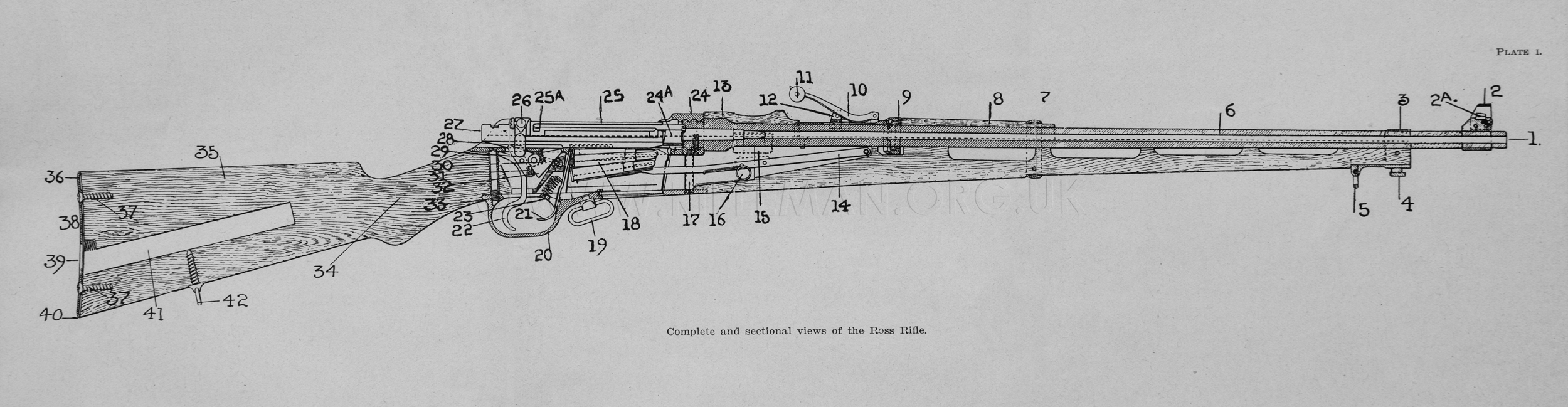
Here is the zoomable full-width sectional drawing of the Mk.II rifle
with numbering relating to the Handbook's text.
Hover over or Click image to bring up hi-res file and magnifier
Next, the compact serviceman's manual of 1914 for the Ross Model 1910 Service Rifle
entitled "MUSKETRY EXERCISES for the ROSS RIFLE".
These text-searchable documents can be viewed with vertical scrolling
or as flip-pages by clicking the appropriate icon.
Depending upon the number of pages they may take a few moments to load.
Double tap tablet or click for full page display.
The British Textbook of Smallarms of 1909 carried a section describing the then Ross Service rifle,
providing drawings and contemporary detail of the design and action type.
These text-searchable documents can be viewed with vertical scrolling
or as flip-pages by clicking the appropriate icon.
Depending upon the number of pages they may take a few moments to load.
Double tap tablet or click for full page display.
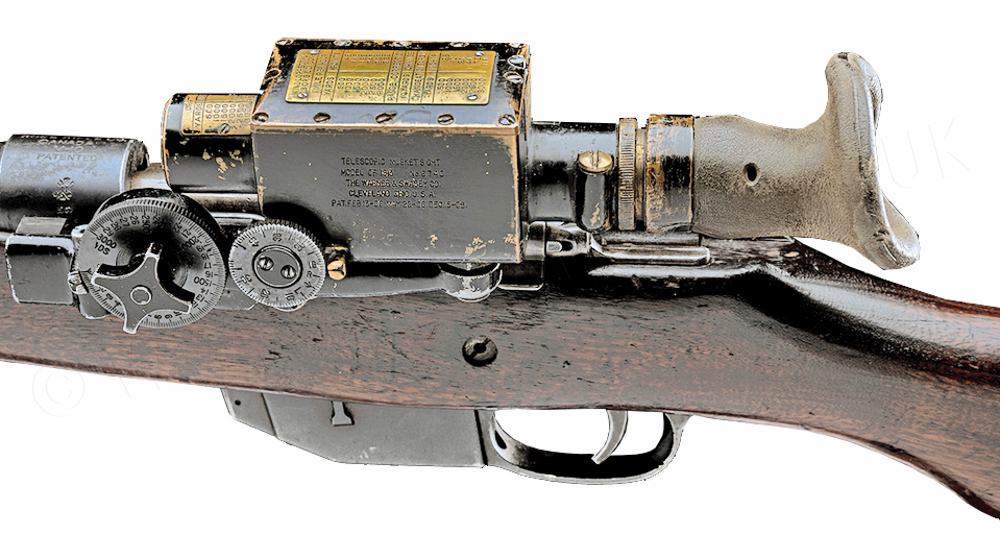
The Ross M10 service rifle, as its acknowledged accuracy justified, was developed as a formidable sniper's rifle
using either the 1908 or 1913 model of the unusually configured Warner & Swasey telescopic sight.
The manual for the sight is illustrated here.
The Warner and Swasey telescopic sight
_____________________________________________________________
Two reports in the Outdoor Life magazine respectively in 1922 and 1927
relate detail of a Ross rifle blowing up, and the firing of the rifle before the bolt is closed.
There is also a section covering the aforementioned recommendation for the .280 Ross
as a Big Game rifle in the day, and further dismissal of the idea.
Large calibre express type rifles are shown to have been most suitable for the safety of the hunter.
N.B. These articles are over a hundred years old,
and do not reflect either current, or Rifleman's opinions.
The articles' texts are legible, but not as distinct as we would like,
despite considerable processing work.
In relation to the unpleasant subject of bolt blow-back, the October 1910 issue of the American Rifleman
carried a brief piece telling of the history of an M10 sporting rifle in .280 calibre - such as illustrated here earlier - that was supposedly, for unknown reasons, gifted to its original owner by Charles Ross himself. The rifle eventually found its way into the hands of a former president of the U.S. N.R.A., who, when he retired, left it in the Association's offices where it was accompanied many others. A colleague and collecting friend later thinned out the numbers, and the Ross was passed to the National Firearms Museum for posterity.
The rifle still carried an old, darkly faded, stringed manilla tag that bore
a handwritten warning from its original owner for any future holder. It read .......
This rather indicates that certain of Ross's straight-pull rifles did have a justifiably poor safety reputation
________________________
Here, the long out of print booklet on "Sir Charles Ross and his Rifles" by Phillips & Knap,
- originally published by the no longer active Museum Restoration Service of Ottawa.
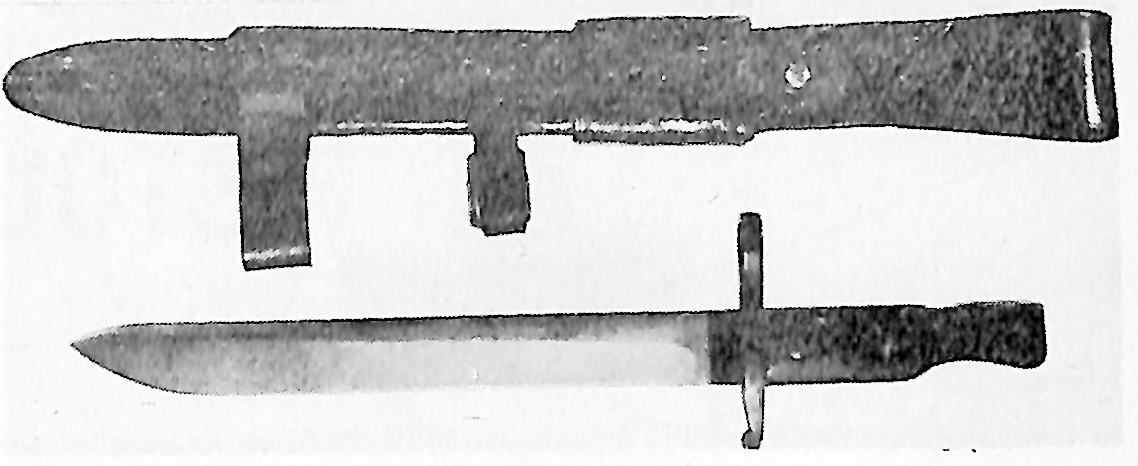
A lesser known aspect of the Ross rifle's accoutrements was the contract awarded by the British Government to the Canadians for a bayonet for the Mk.II rifle. In 1981, J.A. Carter wrote an explanatory piece for the Guns Review magazine. He wrote ........
"THE BRITISH CONTRACT Ross bayonet is easily identified. It is essentially a late production Mk.II with the original blade form of a hatchet point. Though bayonets for Canadian issue had blades with a polished bright finish until March 1916. These British examples have a dull matt-grey finish similar to Parkerising produced by a phosphate coating. The steel parts of the hilt are blued. Canadian bayonets always had the mark and the date of production on the left-hand-side of the pommel, but the only hilt marking on the British contract bayonets is the maker's mark stamped on three lines on the right side of the pommel -" Ross Rifle Co./Quebec/Patented 1907". The right side of the blade has a British broad arrow above an Enfield inspection stamp of a small crown over HI over E. A similar inspection mark is stamped into the leather on the back of the Mk. II scabbard's belt frog. Though made by Hugh Carson Co. Ltd of Ottawa the British examples were not stamped with the trademark, date and mark as were the Canadian examples."
Perhaps a fitting conclusion to this page is the record of considerable correspondence relating to the withdrawal of the Ross Rifle from service with the Canadian Army Corps in 1917.
Another little known training arrangement for Canadian use of the Boys ATR was the adaptation of two obsolete .303 service rifles to replicate the ATR. The first rifle so adapted was the Canadian's own design of straight-pull Ross rifle the bolt action of which bears a realistically close relation to that of the Boys ATR - each being of straight-pull action with a helically operated rotating bolt-head utilising a forward-locking interrupted thread. The second rifle so adapted was the Magazine Lee-Enfield - otherwise long out of service on either side of the Atlantic Ocean.
Again, these training rifles would have permitted comparatively realistic practice on standard military ranges either at the very few hundred yards at which the real ATR would be employed, or on the short 30 yard practice ranges. The use of these converted obsolete rifles would also have prevented the retention of genuine Anti-Tank rifles for training when they were urgently needed elsewhere. This is a factor that, early in the War, may have played a part in the fairly restricted employment of both the .22 adapters and the proposed .55/.303" CF practice round discussed further down this page.
Below is a facsimile of the drawing for the Ross rifle's adaptation, with apologies for the poor and distorted reproduction - reconstructed from a badly torn and crumpled document, and on which we eventually hope to be able to improve.
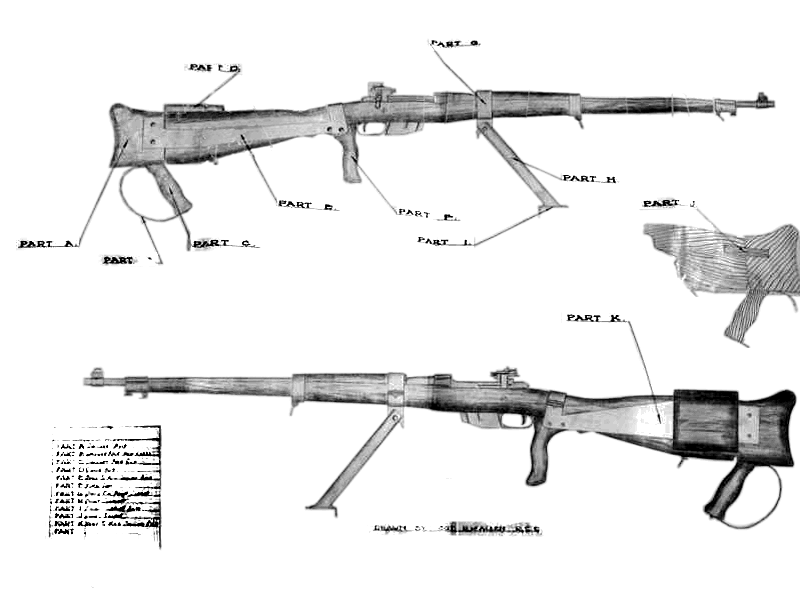
Above, the .303 Ross Service rifle has been given a butt-extension with a curved butt-plate akin to that of the .55 calibre Boys ATR. A bridled sheet-steel support plate for the extension also carries the required pistol-grip behind the trigger-guard of the Ross. A Boys style wooden cheek-piece has been added over the support plate on the left-hand side of the butt-stock, the new extension for which has the hand-hold for the firer's left hand bolted underneath. A Boys-like mono-pod has been fitted to an additional barrel-band forward of the barrel reinforce. Regrettably, the sighting arrangements are not entirely clear in the drawing, and may, or may not, accommodate the left-hand offset to be found on the issued .55" Boys ATR, on which the large top-mounted Bren style magazine interferes with an over-bore sight-line.
A separate cross-sectional side-elevation of the butt, on the right of the drawing, shows "part J" as being a glued wood joining-piece locating the butt-stock extension to the Ross's original butt.
N.B. - THIS PAGE REMAINS IN BUILD