Lee-Enfield Rifle No.5
the "Jungle Carbine" in .303-inch calibre
Please be aware that some specialist imagery may take time to load.
This site is for dedicated researchers and is best viewed on desk or laptop.
See also: ......BSA Lee-Enfield No.5 trials rifle in .22RF ...... - ......Fazakerly Experimental No.5 in .22RF
or the Lee-Enfield No.5 Rifle in 7.62mm calibre and the Australian "Jungle Carbine" No.6 Rifle
plus the Canadian "No.4 Mk.I* prototype carbine, and the Experimental Shortened SMLE in .22RF
The Lee-Enfield Rifle No.5 was designed as a lightweight version of the No.4 Rifle for airborne use by parachute troops, and for use in confined areas, such as jungle environments. Hence its informal name of "Jungle Carbine".
Conceived during 1943 after experience using the long rifle in the Pacific theatre, the carbine was trialled in early 1944 and adopted in September of that year. It remained in manufacture through to 1947, and was still in use around the World up to the early 1960s.
The No.4 action was lightened with chamfered cuts to the upper edges of the action body sides towards the rear, and material removed from the base of the butt-socket adjacent to the trigger-guard mount. Additionally, the butt-stock mounting bolt was waisted along about two-thirds of its length, and the knob of the bolt-handle was faced flat and drilled out. The overall weight saving, including the reduced amount of wood-furniture, was just under two and a quarter pounds.
The barrel was shortened by just under four inches, and the reinforce had a sculpted groove cut either side of its upper periphery. The shortened barrel produced a significant muzzle flash on firing, and a coned flash-hider was fitted that incorporated the front sight with high outward-curved protective wings. The modifications reducing the weight of the carbine increased the recoil to an uncomfortable level, so a rubberoid pad fitted in a steel casing was added to the butt. However, the area of the pad was less than that of the No.4 butt-plate, and it lacked curvature, meaning that the contact area was reduced. The nett result was that the recoil strike on a shooter's shoulder was not really reduced to an acceptable level.
The front sling swivel-loop was fitted to the front barrel band in the usual way, but it was decided that the under-butt sling-loop of the No.4 was likely to interfere with the anticipated way in which the carbine would be slung, and a wide tapered groove was machined into the right-hand-side of the butt, permitting the standard issue webbing sling to be looped through a fitting on the side of the butt-pad's steel casing.
This Royal Ordnance Factory Fazakerly-made carbine
is in "as manufactured" original configuration
without the square fronted steel protective nosecap sometimes added.
The .303-inch calibre service carbine is here shown in a zoomable multi-view image.
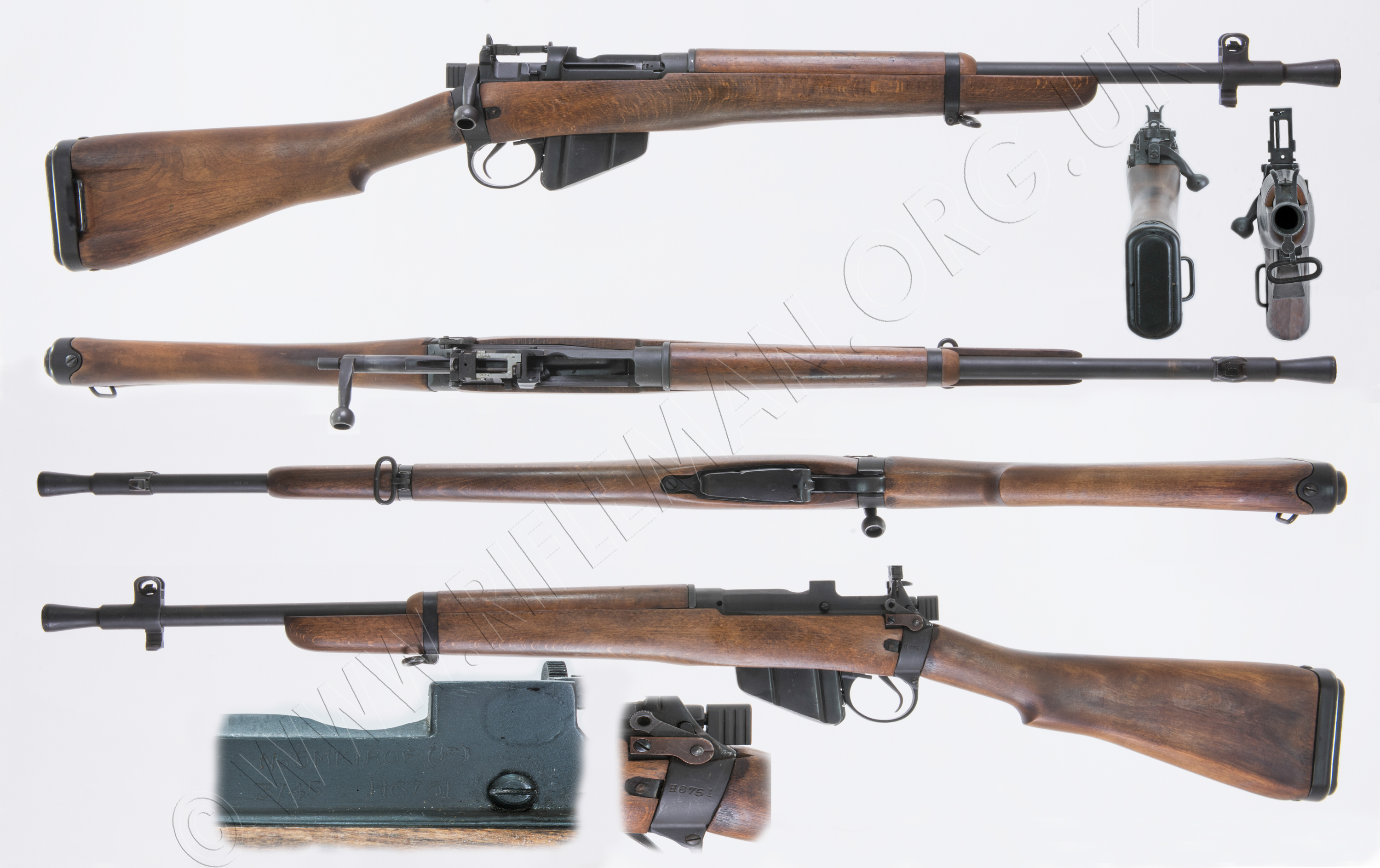
Rifle No.5 , .303in.CF ....- ...by the R.O.F. Fazakerly
This carbine came out of the Charnwood collection many years ago, an early 1945 example,
on which the nomenclature is unusually electro-pencilled on the left-hand-side of the action body,
for the Royal Ordnance Factory - Fazakerly.
No.5 Mk.1 ROF (F)
3/45 H6751
______________________________
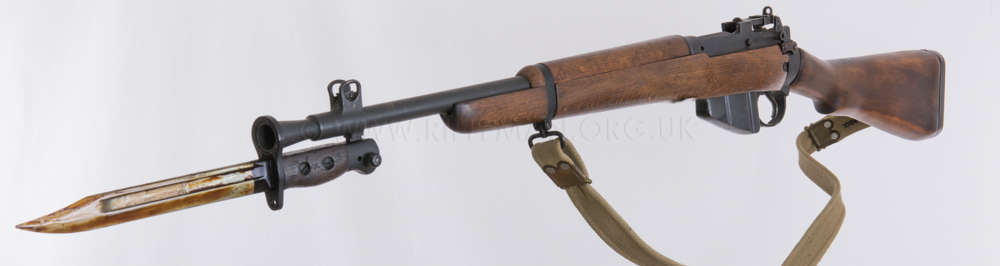
The carbine is next shown with its bayonet fitted. The blade still has its Cosmoline protective coating.
These bayonets fitted no other rifle or carbine, as the muzzle ring was of the larger diameter needed for the flash-hider.
There was, though, one other equivalent for the Australian No.6 prototype/trials carbines,
but which had a different profile to the under-barrel bayonet locking lug,
requiring a different locating channel design in the bayonet's pommel.
____________________
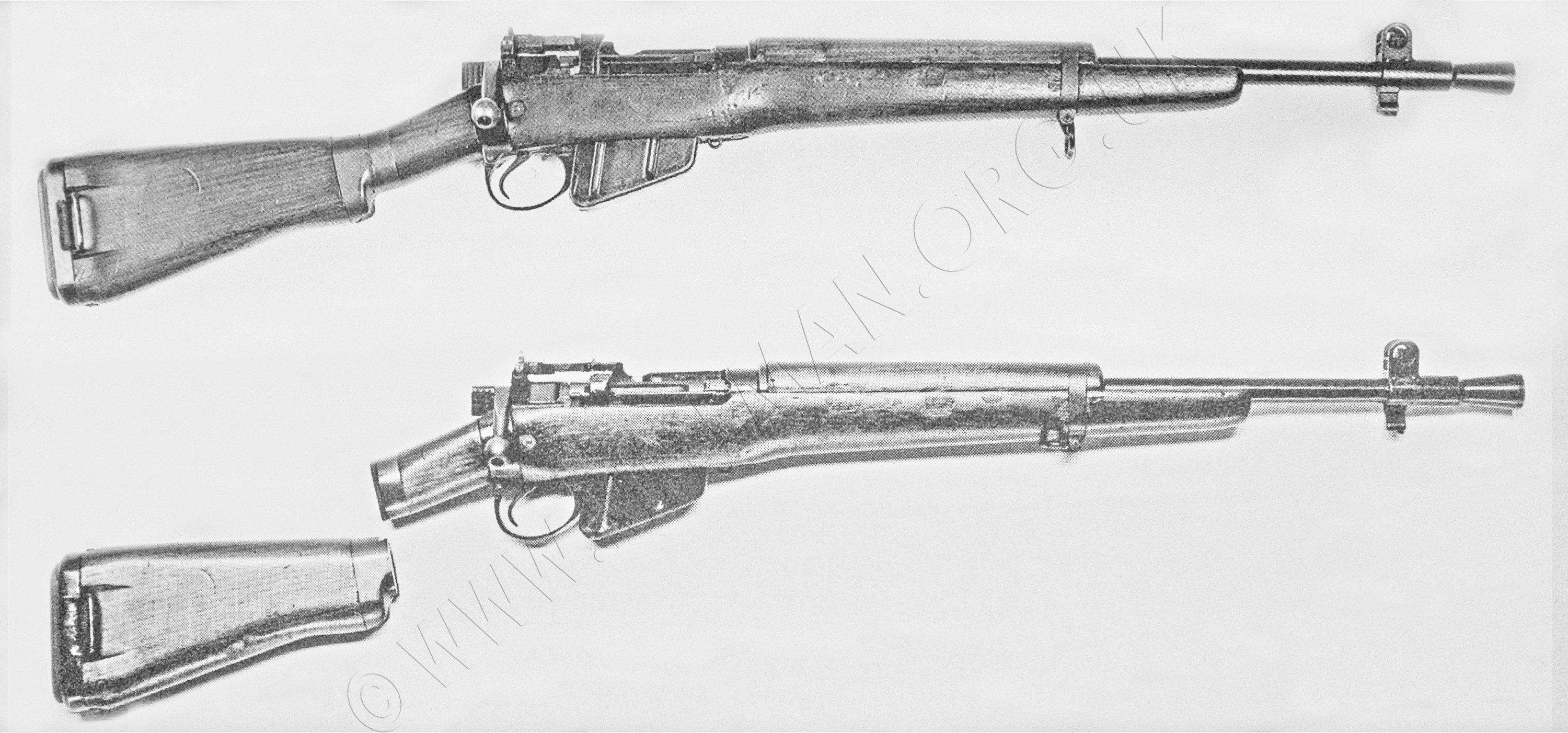
The No.5 rifle was also experimentally prototyped in a specific "Airborne Paratroop" configuration, with a detachable butt. Only five of these rifles were believed to have been built, with the butt-stock wrist separated, and each section faced with an aluminium casting, the two pieces dovetailing into one another with a sprung locking detent. The rifle was never put into production, with one of the concerns being that one or the other of the two take-down parts could be lost during a parachute drop. It was also suspected that the dovetail joint and its locking mechanism could become loose after a period of service.
One of these exceptionally rare carbines was sold out of the Charnwood collection at auction in 1997 by Bonhams (lower image below), and a second in 1999 (upper image below).
Another experimental take-down No.5 carbine was prototyped in Australia. Twenty of these were produced with a plain tubular alloy section in the butt wrist that parted with a large nut that holds the butt-stock when screwed into the tube. One of these rifles is shown on the website of the Australian War Memorial as REL 23792.
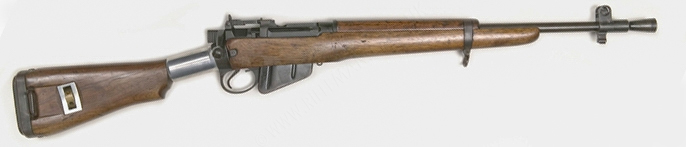
The frankly agricultural design of these rather loses the aesthetically pleasing lines and comfortably practical hold of the original carbine.
See also: ......BSA Lee-Enfield No.5 trials rifle in .22RF ...... - ......Fazakerly Experimental No.5 in .22RF
or the Lee-Enfield No.5 Rifle in 7.62mm calibre and the Australian "Jungle Carbine" No.6 Rifle
plus the Canadian No.4 Mk.I* prototype carbine, and the Experimental Shortened SMLE in .22RF
See this website's Raison d'être