.
Excerpt from "Modern Rifle Shooting in Peace, War and Sport" - by L.R. Tippins 1906
Excerpt on Target-shooting Groups & Group Diagnosis by W.H. Fuller from his book "Small-bore target Shooting" - 1963
Excerpt on - Instruction on Miniature Ranges - from The Imperial Army Series - Musketry Manual 1915Extract from "Rifle & Carton" - by Ernest Robinson (1914), on Rapid Shooting.
Article from target Sports "Old but still favourite" - by Chris Smith - 2001
Excerpt from The Book of the .22 - by Richard Arnold 1962 - HISTORICAL OUTLINE
Excerpt from "Rifle Shooting" by P. Fargher of the Melbourne Rifle Club - ca. 1908-14.
Excerpt on "Miniature Rifles" from "Modern Sporting Gunnery" by Henry Sharp - 1906.
Excerpt on Miniature Rifle Ammunition - Military specification .22-inch Mk.1 (from the Textbook of Smallarms 1929)
Excerpt from Modern Rifle Shooting - by L.R. TIPPINS - 1906 - Miniature Practice
Excerpt from Rifles and Ammunition - by Ommundsen and Robinson - 1915
Excerpt from Random Writings on Rifle Shooting - by A.G. Banks (1934) referring to competitions held in 1908.
Article from "The Rifleman" Offhand - by A.G. Banks - submitted Summer 1946 - advice for the Standing competitor (BEST on BROADBAND )
Interview from "The Rifleman" 'Scope Sights on .22 and Value of Marksmanship - with Brigadier-General Merritt Edson
Article Champions of Civilian Marksmanship - by Philip Bourjaily on the origins of the British miniature rifle clubs
Written for "The Rifleman" - Journal of the Society of Miniature Rifle Clubs - "The Parable of Boy Jones" - by Ruyard Kipling - 1910
Extract from Encyclopædia Britannica relating to the Morris Tube, miniature rifles and rifle clubs - 1911
A tale relating a trip To Bisley with a Blunderbuss - 1999 - anon
A second extract, from " Random Writings on Rifle Shooting" by A.G. Banks, relates many aspects of small-bore shooting in the early years of the Society of Miniature Rifle Clubs. It also gives a fascinating insight into the first and second years in which the "Queen's Cup" ( Queen Alexandra Cup) competition was held.
"Questions Answered about Rifle Shooting" by BRIG. GEN. A. F. U. GREEN, C.M.G., D.S.O ., 1945
"A Few Hints on Rifle Shooting" - pamphlet by the Society of Miniature Rifle Clubs ca 1945
Excerpt from - The Imperial Army Series - Musketry Manual 1915
INSTRUCTION ON MINIATURE RANGES - INCLUDING RANGE FIELD PRACTICES Section 70 - General Remarks.1. Instruction on Miniature Ranges.--(i) Instruction on miniature ranges is in no sense a final training, but it is a useful and economical preparation for service shooting--especially useful where range accommodation is distant or altogether lacking. It should be commenced during.the recruit's training, when frequent visits should be made to the miniature range, and the lessons of aiming, pressing the trigger, declaring the point of aim on discharge, etc., should be illustrated practically by firing at elementary targets .
(ii) Object of Instruction.-Instruction should be carried out on the same principles as on open ranges. It should be progressive, and may with advantage precede instruction on open ranges. Instruction and firing may be carried out throughout the year; but if this work on miniature ranges is done during the winter months it will prove a useful preparation for subsequent practice on open ranges and for held training in the spring and summer months (see Drill and Field Training of this series, Sec. 29, para. I).
2. Scope of Training.--The instruction, which may be carried out with the Solano target and Landscape Targets is more or less identical in scope with that which can be carried out on open ranges. It must be remembered, however, that the effects of varying light, wind, and other atmospheric influences are absent on miniature ranges, that instruction in judging distance is not possible. [see Sec. 72, para. 2 (iii)], that firing with sights adjusted for different ranges can only be carried out to a limited extent, and that the general conditions under which training takes place are artificial and easier as compared with training on open ranges.
3. Rifles. - The rifles used should be service pattern, .22-inch R.F., or aiming or Morris tubes used in service rifles with regulation sights. Service rifles must be used, so that the firer may become accustomed to the weight, length, bolt action, and sighting of the weapon he will use in war. Unless this principle is adhered to, practice on miniature ranges cannot be regarded as satisfactory preparation for service shooting. Rifles must be " harmonised " both for firing at TARGETS direct or with elevation in landscape practices according to the directions laid down in Appendix, V. Rifles must also be cleaned after every ten to fifteen rounds, otherwise they become inaccurate.
4. Windgauge. - The windgauge may be used to represent wind, and the firers taught to aim off so as to correct the deflection given, acting sometimes on their own judgment, sometimes according to orders for fire direction.
5. Cover.--Cover of various kinds can be improvised at the firing-point with sandbags, screens, or other available material.
6. Empty Cases. - Empty cartridge-cases and lead should be collected, and may be sold at market rates.
7. Precautions. - (i) As the .22 cartridge used on miniature ranges has considerable power, every precaution must be taken to insure safety. Rifles must be laid down at the firing-point unloaded and with the breech-action open, and firers must stand clear whenever it is necessary for anyone to be in front of the firing-point.
(ii) A non-commissioned officer will be placed in charge of each range, and will attend whenever any practice takes place. Firing will take place only during the hours fixed by the commanding officer.
(iii) No person, except the officer or non-commissioned officer in charge, or the marker, is to pass from the firing-point up to the target during practice. Should it be necessary to stop firing, the same precautions are to be taken as at rifle practice.
(iv) Every possible precaution must be taken to avoid accidents, the strictest order and discipline being maintained at the firing-point When practice takes place on a classification range, the same orders for safety, etc., are to be observed as when service ammunition is used.
(v) In practices combining firing and movement, the non-commissioned officer in charge of the range will examine the rifles to see that they are not loaded before movement is commenced.
Return to: SITE MAP or MENU PAGE or TOP of PAGE
Excerpt from "Modern Rifle Shooting in Peace, War and Sport" - by L.R. Tippins 1906
THE simplest and best way to learn to use the Service rifle is to follow up the practice of position, aiming and let off by a systematic course of miniature practice. It is not possible to describe in this book all the methods nor all the details of miniature practice. The writer has done this with practical completeness in his book, "Miniature Rifle Shooting." But a short sketch of the chief methods will be given here, because there is no sort of doubt that miniature practice is real economy of time and money and a great help to real efficiency.
The cheapest form of miniature practice is with an air rifle. There are many patterns, but the best is the B.S.A. rifle, costing 50s. It is about capable of hitting an inch bull at 20 yards, and call be had with various patterns of sights. It can be obtained with stock adapted for prone shooting, but the ordinary form is adapted for standing only. Riflemen should, of course, buy that which can be used prone. Slugs cost 1s. 6d. per thousand. The use of such a weapon is proved to be of considerable value to beginners, and competition with it is amusing and instructive, and forms a good addition to the attractions of drill. Twelve yards is quite sufficient range for air gun work, but for all other miniature practice 25 yards is the best range. Many air-guns are smooth bore, and no use to riflemen.
Practice with miniature rifles is also useful, but its value depends a good deal on the type of rifle and of the sights. The cheapest cartridge to use is the .22 rim-fire short, and it is very accurate up to 25 yards, and costs little more than a shilling per 100. It is a mistake to use rifles for miniature work which use cartridges costing four or five shillings per 100, and yet not more accurate at miniature distances than the .22.
But whatever rifle is used, the sights on it should be open, not aperture. For the use of aperture sights is almost no training for open sights, and is a waste of time to a man who wishes to learn to use any Service rifle. But many miniature rifles are too small for men, and do not allow of the use of the sling.
The rifleman learning to use the Service rifle, or desirous of more practice with it, will find several methods open to him. The best and cheapest in use is the use of a regulation pattern rifle fitted with a .22 barrel. Such a rifle costs, new, five guineas, but an old rifle can be converted for 55s. The bolt head and the striker are modified, but the rest is exactly the Service pattern. The short cartridge is good enough for 25 yards, but the "long rifle" .22 cartridge ran be used up to 100 yards.
A similar rifle taking the 297/230, or "Morris" cartridge, costs the same price new, and slightly less for conversion. The cartridges, however cost about twice as much as the .22's, and are certainly not more accurate, and as issued by Government are much less accurate. But the long 297/230 can, be used fairly well at 200 yards especially some of the smokeless loads.
The actual Service rifle can be used for miniature practice by the insertion of a tube in the barrel, so that it takes a small cartridge, This is the "Morris Tube" invented about 1881 by Colonel Morris. Tubes are sold to take the 297/230 cartridge, and also others to take the .22 cartridge, but the same tube will not take both. The tube for .22 can only be used after modifications of the bolt, but is cheaper in use. the tube alone costs 25s. and the 297/230 cartridges from 2s. to 2s.9d. per 100.
A rival method of using the Service rifle is by means of a "chamber bush", or "adapter," which fills up the greater part of the rifle chamber, so allowing a short small cartridge be fired. The bullet, however, fits the bore, and follows the grooves in the actual barrel. There are several forms of adapter, but the differences are of no great importance. The cartridges cost about 4s. per 100, and the adapters about 4s.6d. each. They are very little use beyond 25 yards.
There are two systems of practice which use cases of the regulation size. Gaudet's reloads are fired cases crimped and loaded with a small charge of black, or of bulk smokeless powder and usually a nickel-based bullet. They can be fired but once. They cost 40s. per 1,ooo, and shoot well at 100 yards. Trask's reloads consist of a steel case outwardly the same size as the regulation cartridge. The powder charge is inserted in the base of this case from the breech in the form of a blank cartridge, and the bullet is put in the front end of the steel case. Reloading is simple and quickly done, with no chance of serious error. The shooting is good at 100 yards, and the cost is 15s. per 1,ooo for reloads and 6d. for the steel case.
Ordinary fired cases can be reloaded with small charges for miniature work, but special tools are needed, and the job has risks in the hands of the inexperienced. It has charms of its own, and is instructive in various ways. The cost, apart from the labour, is from 20s. to 30s per 1,000. At 25 yards a degree on the vernier with leaf up makes a quarter inch difference on the target; at 20 yards a degree makes 1-5th of an inch difference. Many men find it quite possible to set up a little miniature range of their own for practice. The essentials are simply space, light, and a stop for the bullets. Though it is an offence at law to fire within 50 feet of the centre of a road, the target itself may be nearer the road. If noise is a nuisance to neighbours, it can be greatly minimised by the use of the smokeless brands of .22 short cartridges and a soft stop for the bullets, such as a bag of hay or sawdust, or malt culms. But the stop must be efficient and kept efficient.
The TARGETS should be card copies of the Bisley TARGETS reduced to scale for the distance used. They can now be bought very cheaply, or made at home. The "500 yards" target should be raised up some 6 inches or so above the target aimed at, and the sight raised so that the bullets strike it. The 600 can be raised a bit higher.
The great drawback to miniature practice is that it may be carried out in lazy fashion, and so teach bad habits. This will be avoided by men who are really determined to make the most of their life; but often the introduction of the element of competition keeps men keen. At drill halls especially, competitions are of great use, and help recruits as well as old hands. Certainly, miniature practice is of much more value to Volunteers, and even to Regulars, than eternal drudgery at the same old manual, or even squad drill. Volunteers can hardly be expected to appreciate continued practice of movements which are of not the slightest value in war, and in striving for uniformity which is no use when obtained. Miniature work at moving TARGETS has considerable value, but details cannot be given here.
In the Army a saving of tens of thousands of pounds every year, and practical doubling of efficiency could be obtained, by revision and improvement of the methods and appliances for miniature work.
There is an incidental gain in miniature practice at home, in that it does not take a man away from his home, and can often be shared by his family, especially the boys. It is good for the boys to learn with and from their father, and he will often have to hurry up to keep ahead of them. One real difficulty in Volunteer work is that it takes a man so much away from home-life, even in the time of respite from work. Miniature work reduces the time necessarily spent on the range, and especially in getting to and returning from it
Return to: SITE MAP or MENU PAGE or TOP of PAGE
We here include this extract from a chapter of "Rifle & Carton" by Ernest Robinson (1914), on Rapid Shooting. This is not intended to make any adjustment to our present League rules, which are unified to limit differences between classes and disciplines. The content is still relevant, and the piece could easily have been written yesterday! MANY a man who can shoot well deliberately comes to grief when he has to shoot a rapid. As most of the important miniature aggregates contain a rapid shoot it follows that the good rapid shots are the men whose names are usually to he found at the top of the Iist. Almost all the rapid shooting is done at the green secondary target, and the time limit is 90 seconds. The time allowance is ample, but most men find the target a difficult one in all but the very best light.
A young shot just starting to visit the open meetings is painfully aware of the difficulty of the " 10 shots in 90 seconds on the secondary target at 50 yards " that figure in all the S.M.R.C. championship shoots, and he is also alive to the necessity of scoring well on it. As a consequence, he probably does a deal worse than there is any necessity for. He may be told that there is no necessity to practise the rapid shooting and that no amount of practice will assure him of a good shoot. This may be true, but practice is always useful, and a good deal of practice will tell the aspiring marksman exactly how much time he can afford to spend over the aim. The S.M.R.C. Rules require the cartridge to be in the fingers and the butt off the shoulder until the word " get ready." The rifleman is given time to get into a perfectly comfortable position before the warning command is given, and he will find it most expedient to be waiting with the cartridge just resting in the breech. At the command "get ready`" the cartridge is pushed home and the breech closed, in a flash the butt comes to the shoulder with the same movement, and the aim should be ready and steady when the command " commence " comes three seconds later. (Not for you! - Ed)
The art of rapid shooting consists in taking as little time as possible in loading and all this is required in aiming. In S.M.R.C. competitions it is usual to call out every ten seconds so that the marksman has an absolute knowledge of the time he has to spare. If the first shot is got off steadily at the word "commence," as it very well can be, then one shot each succeeding 10 seconds will leave ten seconds to spare.The great "tip" is to keep position all through the shoot, particularly with the left elbow and the body. If these do not move the right elbow can be left to take care of itself.
The sight described in the article on foresights, a broad blade, is the best in the writer's opinion for rapid shooting, as it allows the object to be picked up with certainty. A three-bladed sight might perhaps be better, but nothing that blocks out much of the field of vision is advisable for rapid shooting. Everything that wastes time should be eliminated in a rapid shoot, and any uncertainty in picking up the object is fatal to good shooting. Rapid shooting at the green target at 100 yards is exciting sport, and a fine test of rifle, ammunition and man. At this range at the secondary target anything over 95 is very good. There are, of course, men who can put on 98's and 99's but they are very lucky if they get them in open competitions.

A good "98" made in 90 seconds on the old time-limit target.
Spotting is usually forbidden in rapid shooting, so that it pays a man to know the exact elevation and direction zero for the foresight he is using. Most men have a tendency to shoot "right" rapid on the green target, partly due, no doubt, to "pulling" because of the speed. In making the change from the ring foresight to the broad blade, if the rifleman does it, he must not forget to make the necessary corrections on his back sight. If he is shooting where he is not allowed sighting shots he will have to take an unlimited ticket, or perhaps two, before he has got his sighting right. At 25 yards there are three figures on the secondary target. It is a good plan to put four shots on the middle one. Not less than three shots must be on any of the figures. It pays to aim at the object always. Keep cool and keep steady, don't lose position, load "like greased lightning," and remember there is time enough for a just aim even when all the shots have to go in 90 seconds. It is better for your score to take 85 seconds than 75. Nothing is gained by hurrying.
Many of the best rapid shots seem to get a regular rhythm into their movements like the beat of a pendulum They will be found to take the same amount of time almost to a second for each series of ten shots. Rapid shooting requires some knack, and the knack comes with experience and practice.
Return to: SITE MAP or MENU PAGE or TOP of PAGE
target Sports article "Old but still favourite" by Chris Smith - 2001
Historic .22''s at the Essex County Championships.If you live and shoot in Essex you will know perfectly well that all smallbore shooting is not prone - unlimited sighters and twenty to count, wearing a jacket that would do very nicely in a bondage movie and pumping enough iron (and wood) to satisfy an Arnold Schwarzenegger. Why, because if you had gone to the Essex County Smallbore Championships at Basildon (13 May 2001) you would have seen the first class array of classic and historic .22 rifles put together by members of the NRA's Historic Arms Resource Centre.
They, and other members of the Royal British Legion Mersea Island Rifle Club for whom the occasion was an open day, brought out their collections to both show and shoot. A constant stream of visiting shooters took time out of their normal pumpin' iron target shooting to have a go with any of over eighty .22" rifles on show.
There were prone and standing events for the standard classic competitions and classes: Veteran, Classic, and Service; these were deliberate 50 yard prone shoots. In addition, there were standing classes for pump action and self-loading, any sights, including contemporary telescopic sights, shot against the clock - two series of 5 shots in 20 seconds for pump or manual action and 10 seconds for semi-auto .22 rifles, as well as a deliberate target rifle class. The great plus to this was the six-foot wide landscape target.
For those who've never seen one, the landscape target is a good six feet wide showing a battle ground scene as a soldier of the first half of the 20th century would have recognised. One does not shoot such a work of art to pieces however. Rather, there is a blank white target above the painted battlefield scene and it is on this that shots and groups are recorded. To shoot this, one ideally uses a No.7 or No.8 rifle with the 'H' marked harmonisation sight. By setting your sights on 'H' to shoot on this 25 yard target, one's shots - aimed at a particular strong-point or barbed wire entanglement on the battlefield, strike the plain sheet 27" above. Using the target converter - a 27" pointer with scoring rings - the "target" is marked and the intended fall of shot compared with the actual shot hole above. This pairs competition excited much interest, shot as pairs I'm not altogether sure it encouraged club harmony, since many participants were not used to shooting freestyle, but did their best and enjoyed themselves no end. It is quite a sight to see a thoroughly mature and long standing traditional target shooter giggling like a youngster , at the results of their intended and recorded TARGETS (scores ?) on this Somme like battlescene.
As with all the rifles on display, the Enfield No.7 and No.8 rifles were exhibited and loaned by members of the HARC Miniature Rifle Section.
Other rare and interesting sights - in addition to the look-alike No.4 , but in .22 (the No.7 rifle) - included a Swiss Schmidt-Rubin 1889 rifle converted to a .22 trainer in 1911 pattern, this racked next to a Russian T-1935 training rifle. The comparisons were quite stark, the beautifully engineered Swiss compared with the almost brutal simplicity of the Russian trainer. For engineering perfection, one had only to examine the Ross straight-pull in .22, a fine and really quite rare example of this type of rifle; interestingly, it had the fairly standard BSA type mid sight, which is adjusted by rotating an outer ring for elevation, in addition to the rear peep sight which could be swivelled out of the way.
In keeping with the theme of the collection, there were both Models A and B Swift training rifles. This novel rifle, designed in Czechoslovakia before WW2 was patented in the UK in 1941 and manufactured in Oxford. Never an official army issue, it was on charge with the RAF and in use for Cadet training up to the 1960's and later. Some army units did also use them and a number of Home Guard units acquired them for training. The great thing about the Swift is that you can use it anywhere, since it "fires" two captive pins, which strike a target on a frame set a fixed length from the end of the rifle. The shape and location of the round and rectangular holes punched in the target indicated whether the rifle was canted, properly aimed, held tight into the shoulder etc., mirroring the effect of a real, full-bore service rifle. No doubt ACPO would approve of this rifle.
The display covered sporting, target and military training rifles of over 100 years. A number of Martini conversions were on show, including a Martini-Metford carbine fitted with a Morris tube in .297/.230" calibre. This was next to a cut down Long Lee - officially done over 80 years before anyone started having palpitations over vandalism. They were cut down to emulate the SMLE, and fitted with a .22 barrel. To this was added a most emphatically over-engineered magazine which slotted into the standard .303 magazine and allowed the bolt to be worked in the normal manner and with pretty well normal bolt travel and movement - even to the extent of heavy springs requiring similar force to counteract as the cocking of the .303" rifle. This Hiscock-Parker magazine is a very rare item indeed. It was a real pleasure to shoot these training "Rifles .22 RFShort Mk.l and Mk.ll". Apart from the lack of bang and recoil from both these and the .22" Pattern 18, (known as the ".303-cum-.22" conveyor rifle), it felt just like handling the real thing.
There were any number of BSA Martinis, including Models 2, 4, 6, 8, 10,12, 13, 15 - including the Centurion variant and, of course, the ubiquitous 12/15 together with their Remington and Winchester counterparts. However, of interest was a prototype BSA Mk.lll International. One of only 5 made, it carried a steel forend hanger. In production, to reduce weight, the steel was replaced with aluminium, with all the subsequent problems. However, in the trials batch, steel was used, which no doubt explains its accuracy, such that this particular rifle won a whole sheaf of U.K. and European medals during 1963 including the British Championship for the "Roberts" and then made its way to the 1964 Tokyo Olympics.
I initially passed by a little BSA pump action until a second glance revealed the "Gnomet" 2½ x "OIGEE - BERLIN" scope fitted to it. Consequently, I just had to try it on the 50 yard sporting rifle timed shoot. The results say more than I care to recognise about my shooting, than about the scope which is now getting on for seventy years old and still shooting straight. A modern scope will no doubt have better light capturing capacity, but the clarity in decent light was quite a surprise.
Spanning the Second World War was the unusual self-loading BSA Ralock rifle, which loaded through the butt and, being a tidy sort of rifle, retained all the empty cases in the mechanism until emptied by the shooter. Initially designed just before the war, it was brought into production after 1946, lasting only a few years. Generally rather over-engineered, it was a take-down rifle that threw back to the days of machined components rather than stampings, and couldn't compete with the post war generation of cheap .22 semi-autos.
I was only dimly aware that Vickers had made .22" TARGET RIFLES in the 1920s and 30s, yet here was a pretty well complete collection of this Martini style rifle, from the Mkl with the receiver mounted folding rear-sight (but also fitted with a Parker-Hale target- scope sight) along side the Specials (in different barrel and stock configurations) the, Jubilee, Empire and Champion Models. This was probably the largest collection in captivity - and there were still more that the several HARC and RBLMIRC members had not brought with them!
Underlever fans - eat your heart out. An underlever rifle that worked what was in effect a straight-pull bolt, in the very short lived Barnett design rifle of the 1950s. Very few were ever made, probably little more than 300, and this example is really in very good condition and quite smooth to operate.
I've saved the best 'til last. This was a Stevens 44½/52. A fairly standard single shot falling block action; but fitted with a heavy barrel, set triggers and engraved action, it was a really fine example of the American Schutzen discipline. I Shot standing at 50 yards, and this is not as easy as one thinks, although the weight of the rifle does help keep it steady. You can see this discipline being shot in competitions in its own right as well as at the Bisley Historic Arms meeting during the Imperial, and at the Trafalgar meeting in October. Growing in popularity, members of the HBSA are carving out quite a niche for themselves in this quite fascinating area of collecting and shooting.
Now generally speaking, I can get quite sniffy about .22" rifles and shooting - although anything which goes bang must be all right. However, I've never seen such a collection of .22" historic rifles on display, with the choice of competitions and disciplines giving me a new insight into this still relatively cheap part of our sport. With the emphasis on the enjoyment and bringing back into commission the rifles of our fathers and grandfathers, shooting and collecting historic and classic small bore rifles is a discipline open to all and should be encouraged by the Associations if shooting sports are to flourish.
Return to: SITE MAP or MENU PAGE or TOP of PAGE
Excerpt from THE BOOK OF THE ·22 Richard Arnold 1962 HISTORICAL OUTLINE
Alongside the development of the ·22 rifle and its ammunition there have been inventions,
some excellent, some useful, some downright impractical, relating to the · 22 as a training
arm, as an ancillary weapon, or as an accessory to it. Two remarkable developments standout: one perfected in the United States and one in Great Britain. The first, the floating chamber principle, was the invention of Marshall Williams, who devised it whilst serving a sentence in a United States penitentiary for an offence during the days of Prohibition. For sometime the American forces had been using the Colt ·45 semi-automatic pistol for training their personnel, but the cost of ammunition presented problems. The use of a ·22 pistol, built like the ·45, did not solve the problem. Smaller calibre ammunition made it more economic but without the buck of a heavy pistol in recoil, the use of a ·22 did not assist much in preparing a nervous recruit to handle the heavier handgun. Williams devised the floating chamber in which the gas produced from the fired cartridge of a ·22 was allowed to escape at the front of the chamber. This gas thrust against the area of the cartridge base plus the considerably larger area of the chamber front. The backward action of the gases was therefore considerably increased, the thrust of the weapon in recoil greater in consequence. The net result was that a ·22 pistol was built giving the same recoil as the larger ·45.
The next step was the incorporation of the floating chamber using the ·22 long rifle cartridge into the Browning machine-gun. In addition to building floating ·22 chambers for many semi-automatic rifles, Williams designed the short-stroke piston for the Garand automatic carbine, but that is outside the scope of a brief historical survey of the ·22.
Improvements have been made on the original Morris tube invention - ·22-calibre adapters have been made to insert into the barrels of shotguns, whilst Parker-Hale Ltd of Birmingham brought out a really first-class adapter for the Webley and Scott ·455 calibre service revolver. This, though it did not incorporate any floating chamber principle to increase recoil, was none the less a great aid in training the pistolmen in shooting. It was made in two patterns, as a single-shot adapter, in which the cylinder was removed from the pistol so that it was fired in skeleton form, or complete with a special cylinder chambered for the ·22 rim-fire cartridge. This adapter was also manufactured for the ·38-calibre Enfield Service Revolver
These adapters are still in use today and used fairly extensively. They do not affect the accuracy of the revolvers and are guaranteed to shoot into a 3/4 - inch group at 20 yards, which is better than the handler can claim.
The most remarkable development was, however, the principle, derived from the Morris Tube, by Mr. A. T. C. Hale in introducing the system which he called 'Parker-rifling'. In this, worn barrels are bored out and a new rifled tube is inserted. Nor is this confined to worn barrels, for many larger bores, such as ·303 service rifles, can be converted to ·22 rifles by this process. It is an economical way of making a first-class sporting arm from an obsolete military one. It is not suitable for military cartridges, nor for high-power sporting cartridges, though Parker-rifling is suitable for the ·22 Hornet. It seems strange that many a useless high-power, large-calibre weapon should become a small ·22-calibre arm capable of extremely accurate shooting, yet there it is. Commonplace the ·22 may be, yet its history is colourful and proud: whatever the future may hold in the development of firearms and ammunition, the little ·22 occupies an important position in the history of firearms as a whole. Large-bore riflemen may hold it in contempt, but most successful riflemen start with this weapon, while for military purposes its utility in training has been proved time and time again.
From the standpoint of the ordinary shooter, the ·22-calibre rifle is the most important in the world and there is a lot to be said for their attitude. Perhaps, speaking of Great Britain alone with its growing numbers of riflemen, one could parody the old song and say: 'Four thousand rifle clubs can't be wrong!'
Return to: SITE MAP or MENU PAGE or TOP of PAGE
MINIATURE RIFLE AMMUNITION - Mk.I Military specification (from the Textbook of Smallarms 1929) The service miniature rifle cartridge is the ·22-inch rim fire Mark I. There is however no exact design for this cartridge, and the specification governing its manufacture is worded so as to allow of small variations in construction, sufficient to admit the use of similar trade patterns. The chief requirement is accuracy, and it is essential that the cartridge should function satisfactorily in the ·22-inch service short rifle.
The term ' rim fire ' signifies a cartridge without a cap, the flange or rim of the case being hollow and filled with cap composition. In a rim fire rifle the striker is placed eccentric to the axis of the barrel, and when the rifle is fired the striker pinches the hollow rim and thus fires the charge.
The case of the Mark I cartridge is solid drawn and is usually made of copper, though the use of brass or cupro-nickel is permitted. The rim is usually primed with about 0·1 of a grain of cap composition, the ingredients of which are identical with those used in the ·303-inch Mark VII cartridge.
The bullet is made of an alloy of lead, and weighs 40 grains. Three cannelures are provided, usually lubricated with beeswax. The bullet is secured into the case by coning, indenting or crimping.
The charge may consist either of cordite, or rim neonite, or other nitrocellulose powder, the most common form of charge being about 1·2 grains of rim neonite. No wad is provided.
The accuracy of the ammunition must be such that when fired from a service ·22-inch short rifle, mounted in a fixed rest it must be capable of putting 95 per cent. of the bullets into or cutting a three quarter-inch circle at 25 yards, the rifle being cleaned not oftener than once in 60 rounds. The cartridges must also be free from hangfires: missfires, split cases and blowbacks, and must load and unload freely in the rifle. This is the only service small arm cartridge the inspection of which is carried out on a percentage basis. Although in the case of other types of small-arm ammunition, a complete inspection of every round is essential, there are reasons why in the case of the rimfire cartridge this is not so. It is practically impossible to manufacture a round which is dangerous either to the firer or to the weapon, and under these circumustances the presence of an occasional defective round is not so serious as it would be in the case of ordinary ball ammunition, since the rim fire cartridge is used exclusively for training purposes. The cost of a complete inspection would also be prohibitive.
For service purposes these cartridges are packed head and tail in cardboard boxes, each holding 100 rounds. Ten of these cardboard boxes are enclosed in a tin lining with a tear-off lid, and ten such tin linings are in turn packed in a wooden box, which thus holds 10,000 rounds. The characteristic symbol on the distinguishing label is a green target on a white ground, overprinted with the figure I in black.
Return to: SITE MAP or MENU PAGE or TOP of PAGE
EXCERPT FROM "MODERN RIFLE SHOOTING" by L.R. TIPPINS - 1906 - Miniature Practice THE simplest and best way to learn to use the Service rifle is to follow up the practice of position, aiming and let off by a systematic course of miniature practice. It is not possible to describe in this book all the methods nor all the details of miniature practice. The writer has done this with practical completeness in his book, "Miniature Rifle Shooting." But a short sketch of the chief methods will be given here, because there is no sort of doubt that miniature practice is real economy of time and money and a great help to real efficiency.
The cheapest form of miniature practice is with an air rifle. There are many patterns, but the best is the B.S.A. rifle, costing 50s. It is about capable of hitting an inch bull at 20 yards, and call be had with various patterns of sights. It can be obtained with stock adapted for prone shooting, but the ordinary form is adapted for standing only. Riflemen should, of course, buy that which can be used prone. Slugs cost 1s. 6d. per thousand. The use of such a weapon is proved to be of considerable value to beginners, and competition with it is amusing and instructive, and forms a good addition to the attractions
of drill. Twelve yards is quite sufficient range for air gun work, but for all other miniature practice 25 yards is the best range. Many air-guns are smooth bore, and no use to riflemen.
Practice with miniature rifles is also useful, but its value depends a good deal on the type of rifle and of the sights. The cheapest cartridge to use is the .22 rim-fire short, and it is very accurate up to 25 yards, and costs little more than a shilling per 100. It is a mistake to use rifles for miniature work which use cartridges costing four or five shillings per 100, and yet not more accurate at miniature distances than the .22.
But whatever rifle is used, the sights on it should be open, not aperture. For the use of aperture sights is almost no training for open sights, and is a waste of time to a man who wishes to learn to use any Service rifle. But many miniature rifles are too small for men, and do not allow of the use of the sling.
The rifleman learning to use the Service rifle, or desirous of more practice with it, will find several methods open to him. The best and cheapest in use is the use of a regulation pattern rifle fitted with a .22 barrel. Such a rifle costs, new, five guineas, but an old rifle can be converted for 55s. The bolt head and the striker are modified, but the rest is exactly the Service pattern. The short cartridge is good enough for 25 yards, but the "long rifle" .22 cartridge ran be used up to 100 yards.A similar rifle taking the 297/230, or "Morris" cartridge, costs the same price new, and slightly less for conversion. The cartridges, however cost about twice as much as the .22's, and are certainly not more accurate, and as issued by Government are much less accurate. But the long 297/230 can, be used fairly well at 200 yards especially some of the smokeless loads.
The actual Service rifle can be used for miniature practice by the insertion of a tube in the barrel, so that it takes a small cartridge, This is the "Morris Tube" invented about 1881 by Colonel Morris. Tubes are sold to take the 297/230 cartridge, and also others to take the .22 cartridge, but the same tube will not take both. The tube for .22 can only be used after modifications of the bolt, but is cheaper in use. the tube alone costs 25s. and the 297/230 cartridges from 2s. to 2s.9d. per 100.
A rival method of using the Service rifle is by means of a "chamber bush", or "adaptor," which fills up the greater part of the rifle chamber, so allowing a short small cartridge to he fired. The bullet, however, fits the bore, and follows the grooves in the actual barrel. There are several forms of adapter, but the differences are of no great importance. The cartridges cost about 4s. per 100, and the adapters about 4s.6d. each. They are very little use beyond 25 yards.
There are tmo systems of practice which use cases of the regulation size. Gaudet's reloads are fired cases crimped and loaded with a small charge of black, or of bulk smokeless powder and usually a nickel-based bullet. They can be fired but once. They cost 40s. per 1,ooo, and shoot well at 100 yards. Trask's reloads consist of a steel case outwardly the same size as the regulation cartridge. The powder charge is inserted in the base of this case from the breech in the form of a blank cartridge, and the bullet is put in the front end of the steel case. Reloading is simple and quickly done, with no chance of serious error. The shooting is good at 100 yards, and the cost is 15s. per 1,ooo for reloads and 6d. for the steel case.
Ordinary fired cases can be reloaded with small charges for miniature work, but special tools are needed, and the job has risks in the hands of the inexperienced. It has charms of its own, and is instructive in various ways.The cost, apart from the labour, is from 20s. to 30s per 1,000
At 25 yards a degree on the vernier with leaf up makes a quarter inch difference on the target; at 20 yards a degree makes 1-5th of an inch difference.
Many men find it quite possible to set up a little miniature range of their own for practice. The essentials are simply space, light, and a stop for the bullets. Though it is an offence at law to fire within 50 feet of the centre of a road, the target itself may be nearer the road. If noise is a nuisance to neighbours, it can be greatly minimised by the use of the smokeless brands of .22 short cartridges and a soft stop for the bullets, such as a bag of hay or sawdust, or malt culms. But the stop must be efficient and kept efficient.
The TARGETS should be card copies of the Bisley TARGETS reduced to scale for the distance used. They can now be bought very cheaply, or made at home.
The "500 yards" target should be raised up some 6 inches or so above thetarget aimed at, and the sight raised so that the bullets strike it. The 600 can be raised a bit higher.
The great drawback to miniature practice is that it may be carried out in lazy fashion, and so teach bad habits. This will be avoided by men who are really determined to make the most of their life; but often the introduction of the element of competition keeps men keen. At drill halls especially, competitions are of great use, and help recruits as well as old hands. Certainly, miniature practice is of much more value to Volunteers, and even to Regulars, than eternal drudgery at the same old manual, or even squad drill. Volunteers can hardly be expected to appreciate continued practice of movements which are of not the slightest value in war, and in striving for uniformity which is no use when obtained. Miniature work at moving TARGETS has considerable value, but details cannot be given here.
In the Army a saving of tens of thousands of pounds every year, and practical doubling of efficiency could be obtained, by revision and improvement of the methods and appliances for miniature work.
There is an incidental gain in miniature practice at home, in that it does not take a man away from his home, and can often be shared by his family, especially the boys. It is good for the boys to learn with and from their father, and he will often have to hurry up to keep ahead of them. One real difficulty in Volunteer work is that it takes a man so much away from home-life, even in the time of respite from work. Miniature work reduces the time necessarily spent on the range, and especially in getting to and returning from it
SUMMARY
I. Miniature practice is the best method of learning shooting.
2. Can be carried out with
a. Air rifle.
b. Miniature rifle.
c. Service rifle, either
(1.) With small calibre barrel.
(2.) With tube in barrel.
(3·) Adapter in chamber.
(4·) Reduced loads.
3· Provides instruction and recreation for all classes of riflemen.
Return to: SITE MAP or MENU PAGE or TOP of PAGE
H. Ommundsen won the King's Prize at Bisley in 1901 as a Corporal. Between 1913 and 1915, as a most successful and experienced shot he wrote, in partnership with E.H. Robinson, "Rifles and Ammunition" , which was one of the most comprehensive text books of the day on rifle-shooting. Ommundsen sadly did not long survive after commencement of the First World War. The death was reported, in the London Illustrated News of September 9th. 1915, of Lieut A. N. V. H. Ommundsen, Hon. Artillery Company. He was an analytic and inventive soul, and had been responsible, in conjunction with E.J.D. Newitt, for the design of the Remington Negative-Angle Battle Sight. This design principle was patented by them in March 1911 (No.8038), and the final product design in December of that year (No.28,194). The sight permitted aiming a fixed distance below the the target, and was intended to "enlarge the danger zone under skirmishing conditions" to enhance the chance of a hit. Ommundsen's co-author of the book, Ernest Robinson (himself a King's Prize winner in 1923), later wrote a number of small training books, e.g. Rifle Training for WarExcerpt from RIFLES AND AMMUNITION by Ommundsen and Robinson - 1915
In 1902, there were already many criticisms from military men that the shooting experience gained on rifle ranges was not of the kind likely to be of value from a military point of view. Though many of the civilian rifle clubs were at that date of a semi-military character, that is to say, they indulged in drill and were taught by ex-military men, the rifles they used were extremely unlike the ordinary military pattern. Towards this, the N.R.A. rule limiting the weight to below 8 Ib. had some considerable influence, and it was only when the majority of shooters, through the Society of Miniature Rifle Clubs, brought pressure to bear on the parent association that the weight of the miniature rifle was extended so as to include any reasonable design.
But to return to the criticisms of 1901 and 1902. We have heard these criticisms many a time, and it is interesting to see how little they have varied during the passage of years. In 1901 an Army officer wrote to a morning paper saying that if the men were to be taught to handle the rifle so as to use it efficiently in time of need, they must be taught with the kind of weapon they were likely to have to use in war. Efficient use came only with familiarity, and there was no possible excuse for making each man familiar with a light and childish weapon when he would have to use one very consider-ably heavier when he came to fight.
The answer to such criticism was obviously to adapt the Service rifle to fire the reduced bore cartridge, and in February, I902, Messrs. Buck & Co. put on the market the now familiar Service rifle bored for the ;22 rim-fire cartridge. In 1904 the Birmingham Small Arms Company were manufacturing a similar weapon, and since that date it has been possible to get the successive types of Service rifle constructed to shoot the low-power cartridge.
During the present war very many thousands of recruits have had their first introduction to a Service rifle through the medium of these .22 Service weapons, and there is no doubt at all that as a quick introduction to the full-charge weapon nothing can equal the same pattern barrelled and bored to take the miniature cartridge. A man can be taught to shoot with any rifle, and if he only goes far enough it will not subsequently matter what class of rifle he takes up he will be quite at home with it within a few minutes. But when a man has to be taught quickly to shoot, there is nothinglike letting him stick to the type of weapon he is to use.
The first Miniature Rifle Prize meeting held in Great Britain took place at the Crystal Palace from March 23 to April I, 1903. The meeting was opened by General Sir Ian Hamilton, supported by Earl Grey. The programme included twenty-five competitions, thirteen for individuals and eleven for teams. For the prizes over one thousand nine hundred and seventy-one competitors entered, representing forty-eight rifle: clubs. The shooting was conducted at two ranges, the shortest being 20 yards and the longest 50 yards. The TARGETS were adaptations of the N.R.A. dimensions. The bull's-eye at. 20 yards was a black of 7/8 in. diameter scoring five masks, with a central ring scoring six marks. The inner was a in. in diameter, and the rest of the 6-in. square target counted as the outer. At 50 yards the black scoring five was 1-3/4 in. in diameter. At this range there was also the central, counting six. The 50 yards target was It in. square. The standing position was adopted for the to yards range, the prone position for the 50 yards range. This rule applied to all competitions except the Championship, where shots were fired both standing, kneeling, and prone at both ranges.
One of the chief results of this meeting was the prominence which it gave to the unreliable character of shooting from the Morris tube. So unsatisfactory were the results obtained that it was determined at future meetings held by the Society of Working Men's Rifle Clubs a separate class would have to be-made for it as it was quite unfit, except in specially lucky circumstances, to compete against the much cheaper and less complicated Belgian and American rifles made to fire the .22 cartridges .
The shooting at this meeting was nothing like the class which we have now learned to expect of the miniature rifle, but it must be remembered that aperture sights and orthoptic spectacles were not permitted, and both rifles and ammunition were in an undeveloped state. The champion- ship was won by the well-known Service rifle-shot, A. J. Comber.
Return to: SITE MAP or MENU PAGE or TOP of PAGE
Extract from "Random Writings on Rifle Shooting" by A.G. Banks (1934) referring to competitions held in 1908.
Judged by our present standards, the shooting was amazingly bad. The championship of the Manchester meeting in 1908 was won with a score of 385 (" through the ranges," plus a " rapid " at 50). Top score in the winning International team at the same meeting was 291! But such shooting was not considered bad then, and, looking back, I have grave doubts whether our ammunition could be guaranteed to hold the one-inch carton at 50 yards, or even the half-inch one at 25 with certainty.
Meetings in those happy days were certainly carried out in a more free-and-easy and less desperately serious manner than they are to-day, when you know perfectly well that even though you make 300 through the ranges in a competition, you are more than likely to tie with two or three others and get counted out on the gauges, or the dotted line! I remember seeing fellows then, after shooting black-powder ammunition, sitting about on the firing points pulling-through their barrels between shoots. (The pull-through was a much used weapon of barrel-destruction in those days.)
The first Sharpshooter competitions were carried out at pot eggs at 100 yards, instead of the breakable discs which soon supplanted them. Those eggs, with rifles and ammunition of such variability, were hit more by good luck than good marks-manship ; and the three-minute time-limit was often reached with some still standing. The same applied in slightly less degree to the 2-inch discs, and many a time I have seen teams vainly blazing away at a clinging fragment for minutes on end, the odds being heavily against any accurately fired shot ever hitting it, though a lucky fluke might.
Amazing things sometimes happened, owing to this element of luck, the existence.of which we hardly realised at the time. Thus in a Skirmisher competition (at 50 yards, as now) I find the following note: " Won with a record score of 14 hits by the Southport team, consisting of three men only, to their opponents' four," It was a great battle, I remember, but would be an utterly impossible result to-day, when every accurately fired shot is sure of " getting there," and teams sometimes get 14 hits from one of their four members. It is, of course, no longer permissible to enter these competitions a man short, the authorities very rightly regarding such stunts as a waste of their time, under modern conditions.
Return to: SITE MAP or MENU PAGE or TOP of PAGE
Where might the small-bore rifle have fitted into the British, Commonwealth and allied Service rifle scene if the second World War had continued? Well, such rifles had already been issued to personnel who had been chosen as would-be members of the British resistance in the event of a succesful German invasion. These home-guard "guerrilla" style resistance units were intended to create havoc amongst a German occupying force by selecting important TARGETS and eliminating them with a significant degree of stealth. DeLisle even designed and prototyped a small-bore version of his silenced SMLE based commando carbine for the British Special Forces. Additionally, some rifles issued at home are believed to have perhaps been .22RF versions of the No.4T sniper rifle. Such rifles do exist, and were used Post-War for sniper training and stored at Warminster. Their whereabouts now are unknown - unless you know better?
Such use of small-bore rifles has even been considered for jungle type arenas. Their light weight, comparative silence ( almost complete when moderated ) and great accuracy at short range were ideal qualifications where stealth was required. An article was written on the subject relating an interview with
Brigadier-General Merritt Edson (of the U.S. Marine Corps) in "The Rifleman", journal of the Society of Miniature Rifle Clubs, as it was at the time.
We copy the article below. It must be taken into consideration, in these politically correct times, that what is said must be taken in the context of the period. Immediately post the second World War, there was much to consider from the recent past and more to be taken into consideration for the future. The World was still not perceived as an entirely peaceful place, and the possibilty of further conflict was still very much in the mind of those whose duty it would be to deal with any new threat. Return to: SITE MAP or MENU PAGE or TOP of PAGE
'Scope Sights on .22 and Value of Marksmanship
TELESCOPE SIGHTS
" The outstanding troops on Tarawa were our scout-sniper platoons. These were made up of expert riflemen, expert scouts, working in carefully organized, carefully trained teams. They were armed with Marine sniper rifles ; Springfields, with telescope sights. Those scopes might surprise you. Lots of them were long, target-type, eight-power instruments, with wide fields. Some were hunting scopes. In either case they were damned effective ! Those boys didn't waste a lot of ammunition ; they held and squeezed. When they fired, Jap rifles stopped cracking. That's better, even, than scoring a V-on the range ! But scoring Vs on the range is the way to learn to do it!: " There has been a lot of discussion, pro and con, about our carbine. In my opinion it's a good weapon for the use for which it is intended. It can't replace the rifle ; it hasn't the long-range accuracy,'nor the penetration. But it's fast handling, and it will get a bullet into a Jap in a hurry, at close ranges. That counts, in close fighting." I don't think much of the carbine as an officer's weapon. I don't think an officer needs a weapon, other than a strictly self-defence weapon. His job is to command. When he starts showing the boys how well he can shoot, his efficiency as a commander suffers.
" I'd say, arm officers with pistols. Other men whose basic weapon is not the rifle might better be armed with pistols, too ; such men as machine gunners. A machine gunner has a load to carry. Sling a rifle or a carbine over his shoulder and it handicaps him in the transportation and handling of his basic weapon. When the going gets tough he's apt to discard that extra burden. The pistol isn't in his way, yet it's there when he needs it. It would be even better if the pistol were carried in a Shoulder holster. You get in pretty deep sometimes in the jungle ; it's good to have your equipment high up on your person. Ay and out of the way. "Any weapon that will kill that fits a specific need is valuable. I can see plenty of places where the .22 calibre rifle could be used very effectively in jungle fighting, as a sniper's weapon. Ranges aren't apt to be long, in the jungle, and for those ranges the .22 scope-sighted would be superlatively accurate. It makes little flash, little noise. A sniper armed with it would be hard to locate. And it would do the job. I've heard, unofficially, that one of my junior officers killed a Jap on Tulagi with a Colt Woodsman. It doesn't surprise me in the least."
COMBAT ESSENTIALS
"The Jap, he's no superman by any means. He's no better woodsman than our men, except when he's been trained longer ; and he isn't even potentially as good a rifleman.
" That's bad- for him, because the individual rifleman is the back- bone of every army. Everything else - the tanks, the planes, the artillery, even the Navy - are supporting arms to back up or pave the way for the man with the rifle : the man who goes in on his own two feet, to take and hold the ground.
" It is rifle fire that ultimately takes ground, and it is rifle fire that holds it after it's taken, by throwing back enemy counter-attack. The man with the rifle is the man who wins wars ; and accurate fire from individual riflemen is the most effective factor on any battlefield. We've proved that, on Guadalcanal, at 'the Ridge', at Tulagi, at Tarawa, and everywhere we've gone into action, in this war and in wars past.
., " Lots of people have wrong ideas about training men for combat shooting. They stress fire power above accuracy, and they look for some
short cut by which they teach men to be good combat shooters without teaching them the good old fundamentals of basic marksmanship - to hold and squeeze and hit TARGETS at known ranges. In my .opinion that's wrong. Fire power is important, but it is effective only in so far as it is accurate - and the more accurate it is, the less fire that's needed. Teach basic marksmanship first. Given that, a man can devote his whole mind to the meeting of combat conditions without being in doubt of his ability to kill his enemy, once the enemy is met.
" Teach target marksmanship at known ranges first. Then teach the man to estimate his own ranges. Teach him to shoot at indistict TARGETS , at moving TARGETS . Teach him to scout: to take cover properly, to move properly, to use his eyes to see before being seen. Teach him then to work as a part of a team : to support his teammates and to make use of the support they give him. But, above all else, give him a knowledge of and a confidence in his weapon and in his ability to use it ! Given that, he'll learn the other things quickly. Lacking that, a man goes into battle mentally unarmed. His weapons are small comfort to him because he has no faith in them.He is handicapped, because he isn't sure what he can do when he meets the enemy. Give him confidence in his gun and his ability to use it, and he can devote his efforts to taking care of himself and making contact with the enemy, knowing that when that contact is made, he can make the most of it.
"Too, having faith in his weapons, a man will take care of those weapons. Lacking faith in them, he takes poor care of them, with the frequent result that they don't function properly when he needs them. We saw plenty of that in the Islands. Mud and salt water and coral sand don't improve automatic and semi-automatic weapons, and unless a man loves and trusts his weapons, when he's dog-weary he's apt not to. bother to clean them. Give him supreme confidence in that gun as the thing that will stand between him and death, and he'll clean it ! He'll clean it first, and worry less about his own ills for having done it.
" Teach him to shoot before he ever goes into the service. Teach him to shoot again, after he's in. Teach him to shoot, again and again, every chance you get. Give him refresher courses. ' Frequent application of the seat of the man to the seat of the saddle' is a good way to make a rider ; frequent practice is the only way to make a good shooter. Teach men to correct errors made in battle by means of target-range practice, and pretty soon they'll be using target-range skills in battle. Once you get them doing that, you've got an army !"And finally, we copy a letter, following the interview recorded in "The Rifleman", written by Major-General Julian C. Smith, from the Office of the Commanding General, Fleet Marine Forces (U.S.), Pacific, and originally addressed to the "American Rifleman"
"THE SCORE IS THE PROOF"
Office of the Commanding General,
Fleet Marine Forces, Pacific.
Editor,
I was talking to Colonel Murray, who commanded a battalion of the Sixth Marines at Tarawa and Saipan. He also fought at Guadalcanal, and was wounded at Saipan. I asked him what training he would stress for his battalion to prepare it for the next battle. We have so many weapons in an infantry battalion nowadays that I was really curious to get his reaction.
He said," I would spend more time teaching them rifle marksmanship than anything else."
He found that Japs were very good shots at short, range. He also found that automatic weapons, such as machine guns and BAR'S,
often fail to hit individuals at 250 yards and beyond, whereas his good rifle shots could pick them off. He said, "I would like to have my
men all able to pick off individual Japs at about a hundred yards farther than the Jap riflemen can pick us off."
Murray's battalion cleared up the remainder of Tarawa Atoll after Betio had been captured. The Japs all withdrew to the northern end
of the atoll and made a final stand. The ranges in the last steps of the attack were very short and the Japs, who were among the best
trained Japanese troops, were unexpectedly good shots. Quite a number of our men were shot through the head when they lifted their
heads looking for the enemy. Also, an amazingly large number were shot through the right arm or shoulder while in the act of throwing
grenades. However, the better shooting of the Marines showed up in the fact that they buried 156 .Japs, with the loss of about 80 of his own
men killed and wounded.
Major-General JULIAN C. SMITH.
The whole article finished with an advertisement for a new publication.
A new book. Rifle Shooting for Cadets, by Lieut.-Colonel E. R. Godfrey, is published by Messrs. Gale and Polden Ltd. at Is. 8d. post free.
" That every boy in the Empire for the next hundred years should be a marksman is a form of national insurance we dare not neglect,"
says Colonel Godfrey. He deals with many individual problems in a way both practicaland interesting.
We make no apology for including these, only partially relevant, passages in this page allotted to the British small-bore training carbines of the period. Please draw your own inferences and conclusions. It is not our wish to put words into the mouths of others.
Return to: SITE MAP or MENU PAGE or TOP of PAGE

This article originally appeared in the June 1989 edition
of the American RIFLEMAN
and is here reproduced with their, and the author's, kind permission.
Rudyard Kipling and Arthur Conan Doyle both witnessed the lethal fire that Boer farmer-riflemen rained on British troops in 1899. They returned home to promote civilian marksmanship through the expansion of rifle clubs in England.
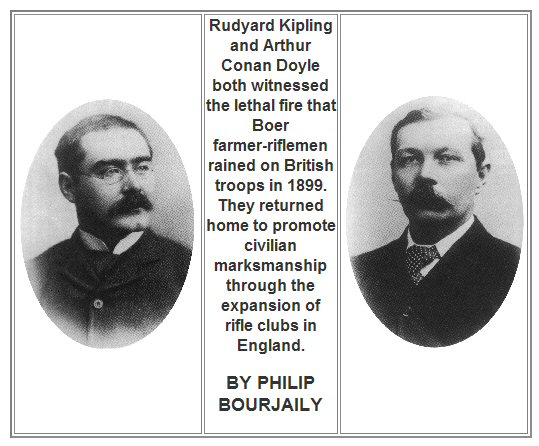
BY PHILIP BOURJAILY THE civilian rifle club movement in England grew out of the disasters of the first months of the Anglo-Boer War late in 1899. The British Army suffered a series of reverses at the hands of outnumbered civilians unlike anything the nation had witnessed in the prior years. One of the shocking revelations of the war was the poor standard of marksmanship in the army compared to that of the Boers. The Boers grew up hunting and riding; each burgher provided his own horse and rifle when he joined his commando. These expert game shots, partial to the bolt-action Mauser repeater, took a heavy toll on British troops often ordered to advance in long lines as if fighting lightly armed tribesmen.
Two men who would later found rifle clubs early in the movement were among the many who followed the course of the war with great anxiety: Rudyard Kipling and Arthur Conan Doyle.
Kipling, the poet laureate of the British Army, was appalled to read in the papers how the regulars he had glorified in his stories and poems were mauled repeatedly by a handful of farmers. He tried to help on the home front, first by a failed attempt to start a volunteer company in the resort town of Rottingdean where he lived, then by writing ``The Absent Minded Beggar."
The poem was critically reviled but extremely successful in its purpose of raising money for the wives and families of soldiers serving in South Africa. Finally on Jan. 20, 1900, Rudyard Kipling left for Cape Town to see the situation firsthand.
Sherlock Holmes creator Dr. Arthur Conan Doyle had been turned down by the Middlesex Yeomanry when he applied for a commission early in the war, but he was subsequently offered a position on the staff of a private field hospital due to leave for the front in the spring of 1900. In the intervening months, Conan Doyle experimented with an idea: since the Boers often fought from trenches, why not drop bullets on their heads via "high angle" rifle fire? Conan Doyle made and tested a prototype high angle sight and wrote several letters to the War Office promoting his idea, which was rejected as impractical.
The tide of the war had already turned in favor of the British when Conan Doyle arrived at Lord Roberts` headquarters in the city of Bloemfontein on April 2, 1900. Kipling, who had just spent six weeks working on the staff of the military newspaper The Bloemfontein Friend, returned to Cape Town on April 3. Although the two authors were mutual admirers and casual friends--Conan Doyle had been a house guest of the Kiplings in Vermont in 1894--apparently they just missed one another in South Africa.
Dr. Conan Doyle and the staff of the Langman Hospital were soon swamped by a massive outbreak of typhoid fever among the troops after the Boers cut off the city`s fresh water supply. Nevertheless, Conan Doyle found time to go briefly into combat with the army during its advance on the town of Brandfort. He was as impressed with the scale of the modern battlefield and the range of the weapons as Kipling had been when he witnessed the battle of Karee Siding in March. At one point during the fighting, Kipling wrote: ". . . (we) move(d) forward to the lip of a large hollow where sheep were grazing. Some of them began to drop and kick. `That`s both sides trying sighting shots` said my companion. `What range do you make it?` I asked. `Eight hundred at the nearest. That`s close quarters nowadays. You`ll never see anything closer. Modern rifles make it impossible. ` ``
Although the Boer War offered firsthand proof to the British that accurate rifles had changed the nature of warfare, a tremendous enthusiasm had surrounded the rifle since the authorization of the volunteer rifle companies in 1859. The volunteers, a Victorian fad for amateur soldiering, were popularized by periodic rumors of a French ironclad battle fleet. The National Rifle Association of Great Britain was founded in 1859 as well, to promote a national taste for rifle shooting and thereby sustain interest among the volunteers between invasion scares. The association`s stated aim was to make the rifle "what the bow was in the days of the Plantagenets"--a national weapon. For the history-conscious Victorians, the parallels between the rifle, a weapon requiring far more skill and practice than the smoothbore musket it replaced, and the longbow, were irresistible.
Queen Victoria, whose reign stretched into the Boer War, fired the opening shot at the British NRA`s first meeting at Wimbledon on July 1, 1860. The British NRA`s birth preceded the American NRA`s by 12 years.
"What the `clothyard shaft and grey goose-wing` effected, when guided by an English eye and an English hand at Crecy and Agincourt, the rifle bullet will do in any future contest...." wrote Hans Busk in The Rifle and How to Use it.
The London Times went so far as to editorialize: "The change from the old musket to the modern rifle has acted on the very life of the nation, like the changes from acorn to wheat and stone to iron are said to have revolutionized the primitive races of men."
Despite the NRA`s best efforts during the previous 40 years, the war in South Africa demonstrated clearly that England was not yet a nation of marksmen. In May 1900 Prime Minister Lord Salisbury called for the formation of civilian rifle clubs to redress the shortcoming. In a speech to the Primrose League, he stated his goal was no less than that "a rifle should be kept in every cottage in the land." In response the NRA formulated its guidelines for the affiliation of civilian clubs. Ninety-two were formed that first year, among them Rudyard Kipling`s club at Rottingdean and Arthur Conan Doyle`s Undershaw Rifle Club.
Kipling had returned home to Rottingdean convinced that the English people had grown too soft and complacent to defend their empire. Not only had the regular army had a difficult time with the Boers, it had compared poorly to its colonial allies; the Australians and New Zealanders had adapted easily to the irregular warfare of their opponents. Kipling was then at the height of his fame and popularity, and he was determined to use his status as a platform for moral leadership, both through his writing, and in the summer of 1900, by example.
The first task facing Kipling as he started the rifle club was in many ways the most difficult: securing space for a 1000-yd. range. On a small island nation such space was at a premium; even the royally supported NRA had been forced to move its annual meeting from Wimbledon to Bisley when stray bullets began striking the Duke of Cambridge`s property. Nothing less than a full-size range would do for Kipling, however, and in July he was able to write to his American friend Dr. James Conland: "... the bulk of my efforts have been in trying to get a rifle range over these open downs. At last I think I have succeeded and after untold bothers the landowners have given their consent to our putting up TARGETS and butts. It was a weary business corresponding with lawyers and land-agents and generally making oneself agreeable to everyone--but now [that] we have started a village rifle club I begin to see a reward for my labors."
It was not the Boer War that motivated Kipling but the continental war with Germany that he already foresaw. He threw himself into club activities, serving as president, personally paying for new TARGETS to replace the old windmill type, presenting the club with a Nordenfeldt gun that had been used in South Africa and taking his turn as musketry instructor, familiarizing club members with the .303 Enfield service rifle. ". . . my real work this summer has been connected with our new rifle range," he wrote to Dr. Conland in December. "The men are just as keen as can be and turn up every week to put in their firing. Can you imagine me in corduroy clothes and a squash hat with the Club ribbon around it in charge of a firing party of four on the ground; an hour of standing over the rifles with one eye on the TARGETS and the other on the men (Some of `em have queer notions about shooting)."
President Kipling oversaw the construction of a drill shed for winter training. Although Kipling spent the winter of 1900- 01 in Cape Town, the instructions he left behind testify to his seriousness about the club`s activities:
Instructions for the use of shed during my absence:Men to have two evenings a week for MT (Morris Tube) practice and such other evenings as the Sergeant shall see fit for
Gardner Gun Drill
Signalling
Guard Drill, etc.
Boys to have two evenings a week. One for MT practice and one for gymnastics.
Boys evenings are not to be Monday and Wednesday.
Men and Boys evenings to be kept separate.
Men to be instructed in gym work if Sergeant thinks fit.
Fatigue parties must be told off to clear up the shed, every night as there will be no allowance for caretakers.
All damage must be paid for by offender.
The Rifle Club may hold meetings and concerts in the shed under Sergeant`s supervision. No intoxicating drinks under any circumstances.
Smoking is permitted.
Cst. Gd. Wells is to be in charge of the Gardner Gun with right of way and free entry into shed for that purpose.
Rudyard KiplingArthur Conan Doyle drew a different lesson from the Boer War than did Rudyard Kipling. Recognizing the English peoples` aversion to conscription, and opposed to compulsory service himself, Conan Doyle saw the war as proof that civilian marksmen could effectively resist invasion. He founded the Undershaw Rifle Club and explained his purpose in a letter to the Glasgow Evening News entitled ``Burghers of the Queen" in December of 1900. Conan Doyle wrote: ". . . the idea I am working with is simply riflemen drawn from the resident civilians. The men are quite eager to pay for their own cartridges which, with the Morris Tube system, can be sold at three for a penny. I made ranges for them at 50, 75 and 100 yds., the latter representing 600 yds. without the Morris Tube system . . . on Holidays I will give them a prize to shoot for . . . the whole expense of TARGETS (5), mantlets, rifles (3), with tubes is not more than £30.``
For the pragmatically minded Conan Doyle, the "miniature`` or .22 rimfire smallbore range seemed a more practical solution to the problem of space than a full-size 1000-yd. range like the one at Rottingdean. (The Morris Tube was a barrel insert for the service rifle that allowed it to chamber the .297/.230 short or long, a center-fire equivalent of the .22 rimfire.)
"Miniature Club" .22 rimfire or .297/.230 center-fire rifles were favored by Arthur Conan Doyle for marksmanship training because the requirements for ranges were more easily met than for large bores.
Conan Doyle further proposed that all men between the ages of 16 and 60 (not coincidentally the age limits for Boer soldiers) should train in rifle clubs. Those reaching a certain level of proficiency would be awarded a distinctive broad-brimmed hat and a rifle and bandolier to keep at home, a "uniform" remarkably like that worn by the Boers.
When the military correspondent for the Westminster Gazetteer criticized his ideas, Conan Doyle responded: "I have stood all day today marking for our own corps of civilian riflemen. Gentlemen, shopboys, cabmen, carters and peasants were all shooting side by side. The prize, at a range which was equivalent to 600 yds., was taken by a top score of 83 out of 90; 82, 81 and 80 were next. Fifty men spent their bank holiday at my butts, and the scene was like a village competition in Switzerland. Conceive the stupidity that would refuse military material such as that when all it will ever ask of its country is a rifle and a bandolier!"
By January 1901, Conan Doyle was ready to pronounce the club a success, and he wrote to the local paper, the Farnham, Haslemere and Hindhead Gazette: "I hope to see similar clubs started at Headley, Churt, Tilford, Witley, Chiddingfold and especially at Haslemere. If any gentleman desires to organize one, and so help in what is a very urgent public duty, I will be happy to furnish him with full information as to the methods by which we have brought our own success. "
At the end of that summer, Kipling also had reason to be pleased with the results of his work. He wrote again to Dr. Conland: ". . . the end of the season shows we have forty very fair shots and about thirty men who at least know something of shooting. We`ve won every match so far (six in all) that we`ve shot against outside teams; and some of the teams were fairly strong ones.``
Unfortunately, we have no better account of Kipling`s marksmanship other than that he shot "adequately" despite his poor eyesight and that he scored a bullseye at the opening ceremonies of the Winchester Drill Hall. He was, however, a fierce competitor, shooting in all of the club`s matches, serious to the point of surliness. When a member of the visiting Newhaven Volunteers expressed his interest in meeting the great man at a match in Rottingdean, Kipling snapped "Well, now you can see the animal on his own ground."
Kipling eschewed special treatment, insisting that everyone must "muck in together" in the important business of preparing for war. Unfortunately his celebrity drove him away from the resort town of Rottingdean and the rifle club. Curious sightseers continuously invaded his privacy, and a local tour bus line made his house one of its most popular stops. Late in the summer of 1902, the Kiplings moved to a house in the country. The Islanders was published shortly thereafter. In the scathingly sarcastic poem, Kipling made plain his scorn for the English people he felt would rather play games than prepare for war, and ridiculed the Duke of Wellington`s notion that wars were won on the playing fields of Eton:
Will ye pitch some white pavillion and lustily even the odds
With nets and hoops and mallets, with rackets and bats and rods?
Will the rabbit war with your foeman-- the red deer horn him for hire?
Your kept cock pheasant keep you-- he is master of many a shire
Arid, aloof, incurious, unthinking, unthanking, gelt
Will ye loose your schools to flout them, till their brow beat columns melt?
Kipling`s proposed solution was simple and true to form:
Each man born to the Island, broke to the matter of war
Soberly and by custom taken and trained for the same
Each man born to the Island entered at youth to the game
As it were almost cricket, not to be mastered in haste.Although by then Kipling`s hands-on work with the rifle club movement had ended, he continued to support any cause that he believed would promote strength and readiness. He wrote the "Patrol Song" for Boer War hero Baden-Powell`s newly formed Boy Scouts and spoke out on behalf of the National Service League`s efforts to implement conscription. "The Parable of Boy Jones", written by Kipling in 1910 for The Rifleman, official organ of the Society of Miniature Rifle Clubs, gave a detailed fictional account of rifle club shooting indoors and out.
Arthur Conan Doyle, knighted in 1902 for his wartime service as a doctor and two books, The Great Anglo-Boer War and The War in South Africa: Its Cause and Conduct, left the healthy Undershaw Rifle Club in other hands and turned his attentions elsewhere. In 1905, however, he was prompted to write again on the subject of miniature rifle clubs in support of Lord Roberts, who had become the president of the Society of Miniature Rifle Clubs.
Writing to the London Times in June 1905, Sir Arthur Conan Doyle presented his case, making the inevitable comparison to the Middle Ages: "The first point which is worth insisting upon is that a man trained at a miniature range (whether Morris Tube or otherwise) does become an efficient shot almost at once when he is allowed to use a full range. What with the low trajectory and absence of recoil in a modern rifle the handling of the weapon is much the same in either case. I am speaking now of an outdoor range where a man must allow for windage and raise his sights to fire . . . It was skill at the parish butts which made England first among military powers during the fourteenth century. My suggestion is that the parish butts be restored in the form of the parish miniature range."
The renewed appeal helped to bring about a large increase in the number of rifle clubs. By 1906 there were 302 miniature and 307 full-range clubs affiliated with the NRA. The government forgave the excise tax on firearms purchased for all but sporting use, and the Conan Doyle Cup was presented by Dr. Langman of the Langman Hospital to be shot for with the miniature rifle at Bisley. The rifle club movement peaked during the years 1914-18 with more than 1,900 affiliated clubs, most of them miniature clubs.
At the beginning of the Great War, Lord Roberts wrote in his president`s message to the Society of Miniature Rifle Clubs: "Proud as I am of rifle clubs I shall be prouder still if, when the war is over, it can be said they helped to win the victory we know is certain." It is difficult to judge what effect the membership of 1,900 clubs may have had in a war that ultimately saw 5.7 million men serve in the army.
Before the end of the First World War, Kipling already warned of a second war with Germany. Although subsequent events proved Kipling right, the after math of the "War to End All Wars" saw instead an understandable spirit of pacifism and a corresponding drop in rifle club activity. The government, alarmed by acts of postwar violence and the large number of surplus weapons brought into the country, reversed its previous course of encouraging the private ownership of rifles and passed the Firearms Control Act of 1920. In 1938, on the eve of the Second World War, only 471 rifle clubs remained.
The author wishes to thank members of the Kipling Society who were kind enough to help him with his research.
Posted: 11/29/2001
The link below is to the American N.R.A.'s - Institute for Legislative Action
from whom approval to copy this article has kindly been given after permission was granted by the author - Philip Bourjaily.
NRA-ILA - (USA)
Return to: SITE MAP or MENU PAGE or TOP of PAGE
*******************************************
The Parable of Boy Jones
by Ruyard Kipling
1910 The long shed of the village rifle club reeked with the oniony smell of smokeless powder, machine-oil, and creosote from the stop-butt, as man after man laid himself down and fired at the miniature target sixty feet away. The instructor’s voice echoed under the corrugated iron roof.
“Squeeze, Matthews, squeeze! Jerking your shoulder won’t help the bullet. . . . Gordon, you’re canting your gun to the left. . . . Hold your breath when the sights come on. . . . Fenwick, was that a bull? Then it’s only a fluke, for your last at two o’clock was an outer. You don’t know where you’re shooting.”
“I call this monotonous,” said Boy Jones, who had been brought by a friend to look at the show. “Where does the fun come in?”
“Would you like to try a shot?” the instructor asked.
“Oh - er - thanks,” said Jones. “I’ve shot with a shotgun, of course, but this” - he looked at the miniature rifle - “this isn’t like a shot-gun, is it?”
“Not in the least,” said the friend. The instructor passed Boy Jones a cartridge. The squad ceased firing and stared. Boy Jones reddened and fumbled.
“Hi! The beastly thing has slipped somehow!” he cried. The tiny twenty-two cartridge had dropped into the magazine-slot and stuck there, caught by the rim. The muzzle travelled vaguely round the horizon. The squad with one accord sat down on the dusty cement floor.
“Lend him a hair-pin,” whispered the jobbing gardener.
“Muzzle up, please,” said the instructor ( it was drooping towards the men on the floor ). “I’ll load for you. Now - keep her pointed towards the target - you’re supposed to be firing at two hundred yards. Have you set your sights? Never mind, I’ll set ’em. Please don’t touch the trigger 'til you shoot.”
Boy Jones was glistening at the edges as the instructor swung him in the direction of the little TARGETS fifty feet away. “Take a fine sight! The bulls-eye should be just sitting on the top of the fore-sight,” the instructor cautioned. “Ah!”
Boy Jones, with a grunt and a jerk of the shoulder, pulled the trigger. The right-hand window of the shed, six feet above the target, starred and cracked.
The boy who cleans the knives at the vicarage buried his face in his hands; Jevons, the bricklayer’s assistant, tied up his bootlace; the Fellow of the Royal Geographical Society looked at the roof; the village barber whistled softly. When one is twenty-two years old, and weighs twelve-stone-eight in hard condition, one does not approve of any game that one cannot play very well.
“I call this silly piffle,” said Boy Jones, wiping his face.
“Oh, not so bad as that,” said the instructor. “We’ve all got to begin somehow. Try another?” But Boy Jones was not practising any more that afternoon. He seemed to need soothing.
“Come over to the big range,” said the friend. “You’ll see the finished article at work down there. This is only for boys and beginners.”
A knot of village lads from twelve to sixteen were scuffling for places on the shooting-mat as Boy Jones left the shed. On his way to the range, across the windy Downs, he preserved a silence foreign to his sunny nature. Jevons, the bricklayer’s assistant, and the F.R.G.S. trotted past him - rifles at the carry.
“Awkward wind,” said Jevons. “Fish-tail!”
“What’s a fish-tail?” said Boy Jones.
“Oh! It means a fishy, tricky sort of a wind,” said the friend. A shift in the uneasy north-east breeze brought them the far-away sob of a service rifle.
“For once in your young life,” the friend went on, “you’re going to attend a game you do not understand.”
“If you mean I’m expected to make an ass of myself again.......” Boy Jones paused.
“Don’t worry! By this time I fancy Jevons will have told the Sergeant all about your performance in the shed just now. You won’t be pressed to shoot.”
A long sweep of bare land opened before them. The thump of occasional shots grew clearer, and Boy Jones pricked his ears.
“What’s that unholy whine and whop?” he asked in a lull of the wind.
“The whine is the bullet going across the valley. The whop is when it hits the target - that white shutter thing sliding up and down against the hillside. Those men lying down yonder are shooting at five hundred yards. We’ll look at ’em,” said the friend.
“This would make a thundering good golf-links,” said Boy Jones, striding over the short, clean turf. “Not a bad lie in miles of it.”
“Yes, wouldn’t it?” the friend replied. “It would be even prettier as a croquet-lawn or a basket-ball pitch. Just the place for a picnic too. Unluckily, it’s a rifle-range.”
Boy Jones looked doubtful, but said nothing till they reached the five-hundred-yard butt. The Sergeant, on his stomach, binoculars to his eye, nodded, but not at the visitors. “Where did you sight, Walters?” he said.
“Nine o’clock - edge of the target,” was the reply from a fat, blue man in a bowler hat, his trousers rucked half-way to his knees. “The wind’s rotten bad down there!” He pointed towards the stiff tailed wind-flags that stuck out at all sorts of angles as the eddy round the shoulder of the Down caught them.
“Let me try one,” the Sergeant said, and reached behind him for a rifle.
“Hold on!” said the F.R.G.S. ” That’s Number Six. She throws high.”
“ She’s my pet,” said Jevons, holding out his hand for it. “Take Number Nine, Sergeant.”
“ Rifles are like bats, you know,” the friend explained. “They differ a lot.”
The Sergeant sighted.
“He holds it steady enough,” said Boy Jones.
“He mostly does,” said the Friend. “If you watch that white disc come up you’ll know it’s a bull,”
“Not much of one,” said the Sergeant. “Too low - too far right. I gave her all the allowance I dared, too. That wind’s funnelling badly in the valley. Give your wind-sight another three degrees, Walters.”
The fat man’s big fingers delicately adjusted the lateral sight. He had been firing till then by the light of his trained judgment, but some of the rifles were fitted with wind-gauges, and he wished to test one.
“What’s he doing that for?” said Boy Jones.
“You wouldn’t understand,” said the friend. “But take a squint along this rifle, and see what a bull looks like at five hundred yards. It isn’t loaded, but don’t point it at the pit of my stomach.”
“Dash it all! I didn’t mean to!” said Boy Jones.
“None of ’em mean it,” the friend replied. “That’s how all the murders are done. Don’t play with the bolt. Merely look along the sights. It isn’t much of a mark, is it?”
“No, by Jove!” said Jones, and gazed with reverence at Walters, who announced before the marker had signalled his last shot that it was a likely heifer. ( Walters was a butcher by profession.) A well-centred bull it proved to be.
“Now how the deuce did he do it?” said Boy Jones.
“By practice - first in the shed at two hundred yards. We’ve five or six as good as him,” said the friend. “But he’s not much of a snap-shooter when it comes to potting at dummy heads and shoulders exposed for five seconds. Jevons is our man then.”
“Ah! talking of snap-shooting!” said the Sergeant, and - while Jevons fired his seven shots - delivered Boy Jones a curious little lecture on the advantages of the foggy English climate, the value of enclosed land for warfare, and the possibilities of well-directed small-arm fire wiping up ..... “spraying down” was his word .... artillery, even in position.
“Well, I’ve got to go on and build houses.”, said Jevons. “Twenty-six is my score-card .... sign please, Sergeant.” He rose, dusted his knees, and moved off. His place was taken by a dark, cat-footed Coastguard, firing for the love of the game. He only ran to three cartridges, which he placed .... magpie, five o’clock; inner, three o’clock; and bull. “Cordery don’t take anything on trust,” said the Sergeant. “He feels his way in to the bull every time. I like it. It’s more rational.”
While the F.R.G.S. was explaining to Boy Jones that the rotation of the earth on her axis affected a bullet to the extent of one yard in a thousand, a batch of six lads cantered over the hill.
“We’re the new two-hundred-ers,” they shouted.
“I know it,” said the Sergeant. “Pick up the cartridge-cases; take my mackintosh and bag, and come on down to the two hundred range, quietly.”
There was no need for the last caution. The boys picked up the things and swung off in couples - scout fashion.
“They are the survivors,” the friend explained, “ of the boys you saw just now. They’ve passed their miniature rifle tests, and are supposed to be fit to fire in the open.”
“And are they?” said Boy Jones, edging away from the F.R.G.S., who was talking about “jump” and “flip” in rifle-shooting.
“We’ll see,” said the Sergeant. “This wind ought to test ’em!”
Down in the hollow it rushed like a boulder-choked river, driving quick clouds across the sun: so that one minute, the eight-inch Bisley bull leaped forth like a headlight, and the next shrunk back into the grey-green grass of the butt like an engine backing up the line.
“Look here!” said the Sergeant, as the boys dropped into their places at the firing-point. “I warn you it’s a three-foot wind on the target, and freshening. You’ll get no two shots alike. Any boy that thinks he won’t do himself justice can wait for a better day.”
Nothing moved except one grin from face to face.
“No,” said the Sergeant, after a pause. “I don’t suppose a thunder-storm would shift you young birds. Remember what I’ve been telling you all this spring. Sighting shots, from the right!”
They went on one by one, carefully imitating the well-observed actions of their elders, even to the tapping of the cartridge on the rifle-butt. They scowled and grunted and compared notes as they set and reset their sights. They brought up their rifles just as shadow gave place to sun and, holding too long, fired when the cheating cloud returned. It was unhappy, cold, nose-running, eye-straining work, but they enjoyed it passionately. At the end they showed up their score-cards; one twenty-seven, two twenty-fives, a twenty-four, and two twenty-twos. Boy Jones, his hands on his knees, had made no remark from first to last.
“Could I have a shot?” he began in a strangely meek voice.
But the chilled Sergeant had already whistled the marker out of the butt. The wind-flags were being collected by the youngsters, and, with a tinkle of spent cartridge-cases returned to the Sergeant’s bag, shooting ended.
“Not so bad,” said the Sergeant.
“One of those boys was hump-backed,” said Boy Jones, with the healthy animal’s horror of deformity.
“But his shots aren’t,” said the Sergeant. “He was the twenty-seven card. Milligan’s his name.”
“I should like to have had a shot,” Boy Jones repeated. “Just for the fun of the thing.”
“Well, just for the fun of the thing,” the friend suggested, “suppose you fill and empty a magazine. Have you got any dummies, Sergeant?”
The Sergeant produced a handful of dummy cartridges from his inexhaustible bag.
“How d’you put ’em in?” said Boy Jones, picking up a cartridge by the bullet end with his left hand, and holding the rifle with his right.
“Here, Milligan,” the friend called. “Fill and empty this magazine, will you, please?”
The cripple’s fingers flickered for an instant round the rifle-breech. The dummies vanished clicking. He turned towards the butt, pausing perhaps a second on each aimed shot, ripped them all out again over his shoulder. Mechanically Boy Jones caught them as they spun in the air; for he was a good fielder.
“Time, fifteen seconds,” said the friend. “You try now.” Boy Jones shook his head. “No, thanks,” he said. “This isn’t my day out. That’s called magazine-fire, I suppose.”
“Yes,” said the Sergeant, “but it’s more difficult to load in the dark or in a cramped position.”
The boys drew off, larking among themselves. The others strolled homewards as the wind freshened. Only the Sergeant, after a word or two with the marker, struck off up the line of firing-butts.
“There seems to be a lot in it,” said Boy Jones, after a while, to his friend. “But you needn’t tell me,” he went on in the tone of one ill at ease with himself, “don’t tell me that when the hour strikes every man in England wouldn’t - er - rally to the defence of his country like one man.”
“And he’d be so useful while he was rallying, wouldn’t he?” said the friend shortly. “Imagine one hundred thousand chaps of your kidney introduced to the rifle for the first time, all loading and firing in your fashion! The hospitals wouldn’t hold ’em!”
“Oh, there’d be time to get the general hang of the thing,” said Boy Jones cheerily.
“When that hour strikes,” the friend replied, “it will already have struck, if you understand. There may be a few hours - perhaps ten or twelve - there will certainly not be more than a day and a night allowed us to get ready in.”
“There will be six months at least,” said Boy Jones confidently.
“Ah, you probably read that in a paper. I shouldn’t rely on it, if I were you. It won’t be like a county cricket match, date settled months in advance. By the way, are you playing for your county this season?”
Boy Jones seemed not to hear the last question. He had taken the friend’s rifle, and was idly clicking the bolt.
“Beg y’ pardon, sir,” said the marker to the friend in an undertone, “but the Sergeant’s tryin’ a gentleman’s new rifle at nine hundred, and I’m waiting on for him. If you’d like to come into the trench?” - a discreet wink closed the sentence.
“Thanks awfully. That ’ud be quite interesting,” said Boy Jones. The wind had dulled a little; the sun was still strong on the golden gorse; the Sergeant’s straight back grew smaller and smaller as it moved away.
“You go down this ladder,” said the marker. They reached the raw line of the trench beneath the TARGETS , the foot deep in the flinty chalk.
“Yes, sir,” he went on, “here’s where all the bullets ought to come. There’s fourteen thousand of ’em this year, somewhere on the premises, but it don’t hinder the rabbits from burrowing, just the same. They know shooting’s over as well as we do. You come here with a shotgun, and you won’t see a single tail; but they don’t put ’emselves out for a rifle. Look, there’s the Parson!” He pointed at a bold, black rabbit sitting half-way up the butt, who loped easily away as the marker ran up the large nine-hundred-yard bull. Boy Jones stared at the bullet-splintered framework of the TARGETS , the chewed edges of the woodwork, and the significantly loosened earth behind them. At last he came down, slowly it seemed, out of the sunshine, into the chill of the trench. The marker opened an old cocoa box, where he kept his paste and paper patches.
“Things get mildewy down here,” he explained. “Mr. Warren, our sexton, says it’s too like a grave to suit him. But as I say, it’s twice as deep and thrice as wide as what he makes.”
“I think it’s rather jolly,” said Boy Jones, and looked up at the narrow strip of sky. The marker had quietly lowered the danger flag. Something yowled like a cat with her tail trod on, and a few fragments of pure white chalk crumbled softly into the trench. Boy Jones jumped, and flattened himself against the inner wall of the trench. “The Sergeant is taking a sighting-shot,” said the marker. “He must have hit a flint in the grass somewhere. We. can’t comb ’em all out. The noise you noticed was the nickel envelope stripping, sir.”
“But I didn’t hear his gun go off,” said Boy Jones.
“Not at nine hundred, with this wind, you wouldn’t,” said the marker. “Stand on one side, please, sir. He’s begun.”
There was a rap overhead - a pause - down came the creaking target, up went the marking disc at the end of a long bamboo; a paper patch was slapped over the bullet hole, and the target slid up again, to be greeted with another rap, another, and another. The fifth differed in tone. “Here’s a curiosity,” said the marker, pulling down the target. “The bullet must have ricochetted short of the butt, and it has key-holed, as we say. See!” He pointed to an ugly triangular rip and flap on the canvas target face. “If that had been flesh and blood, now,” he went on genially, “it would have been just the same as running a plough up you. . . . Now he’s on again!” The sixth rap was as thrillingly emphatic as one at a spiritualistic stance, but the seventh was followed by another yaa-ow of a bullet hitting a stone, and a tiny twisted sliver of metal fell at Boy Jones’s rigid feet. He touched and dropped it. “Why, it’s quite hot,” he said.
“That’s due to arrested motion,” said the F.R.G.S. “Isn’t it a funking noise, though?”
A pause of several minutes followed, during which they could hear the wind and the sea and the creaking of the marker’s braces.
“He said he’d finish off with a magazine full,” the marker volunteered. “I expect he’s waiting for a lull in the wind. Ah! here it comes!”
It came - eleven shots slammed in at three-second intervals; a ricochet or two; one on the right-hand of the target’s framework, which rang like a bell; a couple that hammered the old railway ties just behind the bull; and another that kicked a clod into the trench, and key-holed up the target. The others were various and scattering, but all on the butt.
“Sergeant can do better than that,” said the marker critically, overhauling the target. “It was the wind put him off, or ( he winked once again ), or ..... else he wished to show somebody something.”
“ I heard ’em all hit,” said Boy Jones. “But I never heard the gun go off. Awful, I call it!”
“Well,” said his friend, “it’s the kind of bowling you’ll have to face at forty-eight hours’ notice - if you’re lucky.”
“It’s the key-holing that I bar,” said Boy Jones, following his own line of thought. The marker put up his flag and ladder, and they climbed out of the trench into the sunshine.
“For pity’s sake, look!” said the marker, and stopped. “Well, well! If I ’adn’t seen it, I wouldn’t have credited it. You poor little impident fool. The Sergeant will be vexed.”
“What has happened?” said Boy Jones, rather shrilly.
“He’s killed the Parson, sir!” The marker held up the still kicking body of a glossy black rabbit. One side of its head was not there.
“Talk of coincidence!” the marker went on. “I know Sergeant ’ll pretend he aimed for it. The poor little fool! Jumpin’ about after his own businesses and thinking he was safe; and then to have his head fair mashed off him like this. Just look at him! Well! Well!”
It was anything but well with Boy Jones. He seemed sick.
A week later the friend nearly stepped on him in the miniature-rifle shed. He was lying at length on the dusty coir matting, his trousers rucked half-way to his knees, his sights set as for two hundred, deferentially asking Milligan the cripple to stand behind him and tell him whether he was canting.“No, you aren’t now,” said Milligan patronizingly, “but you were.”
Return to: SITE MAP or MENU PAGE or TOP of PAGE
*******************************************************
Extract from Encyclopædia Britannica - 1911- relating to the Morris tube, miniature rifles and rifle clubs Miniature Rifles.In 1905 a War Office miniature or cadet rifle for instruction purposes was officially adopted by the British military authorities. The details of this rifle were determined by a committee, upon which the National Rifle Association and the Society of Miniature Rifle Clubs were represented. It is a single-loading bolt-action rifle of .22 inch calibre with military sights (the aperture sight being barred), shooting a rim-fire cartridge having a 4o-gr. bullet propelled by 5 grs. of black gunpowder or its equivalent in some smokeless explosive. It is used at ranges from, 25 yds. up to a maximum of 200 yds. The official adoption of such a rifle was largely due to the civilian rifle club movement, which was the outcome of the South African War, and in which the Society of Miniature Rifle Clubs has played an important part. Until the recent official adoption of the miniature rifle, the council of the N.R.A. regarded marksmanship with the service rifle as its main object of encouragement, and the service rifle itself as the orthodox weapon. The Society of Miniature Rifle Clubs, on the other hand, makes the encouragement of the use of low-power rifles its special object, with few restrictions as to type of sights, rifle or ammunition. Numerous civilian rifle clubs have adopted the .22 calibre rifle, in many cases with aperture sights, with marked success, and British rifle-makers, were encouraged to cater for this new demand for low-power rifles. Such weapons can be far more widely and generally used than the ordinary service weapon, owing to their smaller cost, cheaper ammunition, absence of recoil, and their convenience for use at short covered ranges in crowded centres of population. In many parts of Great Britain there is practically no alternative between low-power short-range practice and no shooting at all. The N.R.A. has now admitted the miniature .22 calibre rifle upon equal terms with the service rifle. The miniature rifle has, to some extent, taken the place of the Morris tube and " adaptors " previously used for rifle practice at short ranges. The Morris tube enables a shot-gun to be utilized as a small-bore rifle, or a large rifle as a saloon rifle for gallery practice. The automatic principle has not yet been applied to sporting rifles. The Morris tube consists of a small-rifled barrel, usually chambered for the 297/230-bore cartridge, and capable of being fitted inside the barrel of the ordinary service weapon, which thus becomes available as a miniature rifle for short-range practice. The Morris tube has been adopted by the British War Office, and affords an excellent means of training the recruit. "Adaptors" are dummy cartridge-cases fitted into the breech of the ordinary rifle, by means of which a shorter cartridge firing a lighter charge of powder, but with a bullet of the same calibre as the rifle, can be used for short-range practice. One of the first English miniature TARGET RIFLES was the " Sharpshooters' Club " rifle, on the Martini principle, of .310 calibre, manufactured and introduced by W. W. Greener, and suitable for ranges from 50 to 300 yds. This rifle was adopted by many rifle clubs, and in 1901 established a record in the miniature rifle competition at Bisley. Miniature rifle shooting has been much encouraged throughout the United Kingdom by the establishment of the Light Rifle Championship competition under the auspices of the Society of Miniature Rifle Clubs. In 1907 Queen Alexandra presented a cup for this event.
Return to: SITE MAP or MENU PAGE or TOP of PAGE
************************************************************
TO BISLEY WITH A BLUNDERBUSs
(A Centenary Mystery Tour - 30th. August 1999) Some say that the best things only happen around once in every hundred years. Anyone who knows Les King reasonably well will be more than aware of his great organisational abilities. He is more than capable of arranging an outing that will be long remembered by those taking part. Those memories would become even more poignant when he accepted help and advice from a friend and colleague.
" Let's book transport 'in the spirit of the original' ", said Terence, " I know of a local firm still running little charabancs ideal for our small party" he said. "Yes." said Les, " We'll make this a trip never to be repeated!"
At around 0630 hours on August Bank Holiday Sunday, members started to arrive at Layer, bleary eyed but in good spirits, with the prospect of an unusual day's historic (and isn't that the word) shooting ahead.
Steve Hunt was one of the first to arrive for the 7.00 am planned departure. But then he had only come home at three o'clock that morning from a party. Not a moment of the weekend was to be wasted...... or so he thought! Mark Brewster, on the other hand, who had been at a stag party also until the early hours, was not going to waste any opportunity to catch up on his sleep. A coach ride was just what the doctor ordered.
The Harvey family arrived with their youngest who was about to experience his first ever ride on an autobus, well three autobuses to be precise. This must surely be a new Colchester record. We had thought that the purpose of the outing was to select a team for the Centenary Match, not a suitable coach. As the party assembled, our lovely cream coach arrived. "Dodge" it proudly proclaimed on its bonnet. Never was a truer word put into chrome print.
Our transport had been especially booked by Les, who had been most specific about our requirements. A thirty-odd seater to accommodate only seventeen people in great comfort, along with a large boot to ship about fifty rifles in large cases, ammunition and all the accoutrements of a sophisticated shooting team. This was also done in the knowledge that the return journey would be made with even more equipment. The N.R.A. had kindly agreed to a loan of scoreboards and easels for the Centenary Match at Middlewick. These would take up at least the rear set of spare seats.
"What's this", said Les." It's only got twenty seats!". Then he walked around the back, "and no boot! Where's all this kit going to go?".... pointing to about a ton and a half of ironwork and cases spread around the drive and car park. The driver looked non-plussed. But not half as much as Les!
The story unfolded. The superb vehicle in which we were supposed to have been conveyed had broken down the night before.(Alarm bells started ringing - but only faintly. They were to become louder!) This was the alternative that his boss had instructed him to use. There was an intermediate sized bus, but the large one having broken down, the boss had left for Gatport Airwick in that at about the time Steve Hunt had arrived home that morning!Our assembly and luggage would patently not fit on the present vehicle. The driver would go back to his base and get a twenty-nine seater that was there and return to pick us up. Shooting started at eight-thirty, but we should still be there soon after nine. Then it was suggested that a little time could be saved if we could manage to get everything and everyone aboard for the short trip to their Colchester base....... (wrong). 'Your base is actually at Great Tey?. Oh well, never mind, that's still not too far"......... (wrong again). It took twenty minutes to load the kit aboard, let alone the crew. Steve Hunt stood in the aisle at the rear, holding back the one-and-a-half tons of equipment in case we had to make an emergency stop. He was heading for a pressing appointment.
Each approaching bend further illustrated the point that a great weight in the rear of a small coach seriously affected the handling. As the suspension bottomed over each bump, those fortunate enough to be seated were grateful that there was enough leg room to allow them to prop their frame into position against the strange motion.
As we swung into the farmyard in Great Tey, the glorious sun accentuated the rich brown rust spots on the line of what we knew must be retired coaches parked alongside the barn. Relief showed on each person's face as they spotted the larger and marginally more modern coach last in the line. "No; that's the one that broke down yesterday" said the driver." We're using the one parked this end." To all concerned this one seemed no larger than the one from which we were now in the process of prising ourselves. "That's true", said our driver struggling to further endear himself to us, " but it has more seats on it!". "It still doesn't have a boot" exclaimed Les, only showing a relatively small degree of exasperation. The tightness of his..... lips was the only give-away of the mounting pressure. That and the comment to Terence along the lines of "even Gill told you that their coaches were quite old, and Graham, if I remember correctly, said that their vehicles looked a little tired. Don't you remember?"
Terence was trying hard to forget but, as the day unfolded, this he was not to be allowed to do. " Spirit of the original" he reminded Les.
Twenty minutes later, at around eight o'clock, we had reluctantly embarked on our second bus. It looked outwardly identical to the Dodge, but nobody walked round the front to spot that it was actually a similar body on a chassis powered by Volkswagen. More than a few of the team were showing signs of impending stress. Had they known that we were aboard a vehicle whose smaller sibling had shown a propensity to burst into flames on motorways, the angst might have been greater! The seating arrangement was akin to that found on a military transport aircraft on a parachuting mission - tight as Les's ...lips; and I don't know if anyone else noticed the sign on our twenty-nine seater that announced "TWENTY FIVE SEATS" in bold letters beside the driver. Perhaps he'd never seen it either. The seat backs were upright, legroom non-existent, and the load-master had excelled himself. Our far aft C of G allowed the pilot to pull back on the stick and give us a good impression of being launched into space! Not dissimilar to the set off of a dragster either. However, the impression lacked the aspects of acceleration and speed, but at least we were finally on our way. Or were we?
Driver: " I need to refuel, there isn't much in the tank."
Les: "O.K. where will you stop en route?"
Driver: "Marks Tey"
Les: " Isn't that in the wrong direction?"
Driver: " Yes, but that's where we buy our fuel"
Les: said nothing, thought much!
Ten minutes later we pulled up on the forecourt and our driver disappeared for five minutes. Already the seating was taking its toll. It was really uncomfortable, but that sat well with our demeanour as the driver climbed back in his seat and set off without putting any fuel into the tank!
"Problem with paying, we'll have to go to Kelvedon" At least that seemed in the right direction!...........(wrong yet again).
Up the Kelvedon slip road we went.......... and back down the Colchester bound one! This was familiar territory. Les was toying with the idea of going to see if Gill might like to come to Bisley after all! Then another forecourt - another hour. Fuelled up at last, we set off.................. for Easthorpe! It was now obvious how much longer a journey can take if much of it is made in the wrong direction. One high speed "U-turn" on the dual (spelt DUEL) carriageway later, we were convinced that things were at last moving our way..... along with the large truck that had been bearing down on us! A friendly return wave of thanks from our driver, and we settled into the familiar drone of high speed modern coach travel, plus the vibration and the oil fumes. My feet were getting a massage from the floor - a great sensation for a little while. Then I noticed how hilly Essex had become since the last time I drove the A12.
A typical sunny summer's early morning brought the customary cycle race to our trunk road, though heaven knows why. Our sluggish pace was further reduced by our inability to maintain a reasonable speed in the outer lane between successive cyclists. We were continually brought down to their speed up the hills whilst the rest of the automotive world hurled past outside. We were only able to overtake one by the good grace of the occasional motorist or trucker who slowed to allow us to move out to overtake. Some might think I am joking. But don't forget that the turn of speed of a road racing cyclist downhill is altogether a different kettle of fish. You could tell that Les's habit of organising competitions of all kinds might be getting the better of him. A competition to count the number of overtaking cyclists whilst we were on the dual-carriageway was not the most encouraging of his ideas.
The conversation turned from the concerns of each successive moment to the relative merits of routing to Bisley on the M25 either North or South about. All present this day have now seen the answer proved beyond a shadow of a doubt! The long climb out of the Dartford Tunnel at less than the minimum motorway speed illustrated the point. In fact much of Kent did the same. The southern route was considerably extended by the driver's inability to coax the coach away from the tunnel toll booths in the right direction. It was continuing with its attempts to get as far East into Essex as it could within the day. Had it succeeded in going backwards over the bridge we would have surely found ourselves in the Guinness Book of Records, which is where we thought we were heading anyway.
With one professional and several amateur mechanics aboard, there were many pairs of finely attuned and well qualified eyes and ears monitoring both our progress and the vehicle's technical wellbeing. With a good few miles under our belt, and more time than you could ever imagine in which to assess the situation, the level of fumes, noise, driver ability, and a hundred other aspects were faithfully mentally recorded. Any hint of change would be immediately registered. Somewhere approaching the A3, having just peaked a long incline, the ensuing gear change heralded a severe power loss. Thirty-six ears pricked up. Thirty-six feet started mentally pedalling. (The figures credit the driver with the same thinking as his passengers..... a questionable supposition). Before we could apply sufficient effort to the plan there was an enormous report (a bit like this one), and unidentified components flew out of the side of the vehicle amongst the unsuspecting traffic.
The motor seemed unwilling to quit without at least trying to get us clear of the motorway, but it was confounded by a more easily disillusioned driver. Not that his disillusionment had anything to do with the barracking that he had earlier received from behind..... somewhere near where Ann Jelbert was sitting.
Entreaties to the driver for the conversion, of all twenty-two miles an hour remaining, into coasting towards the approaching slip road fell on deaf ears. Not surprising if he had been driving that coach for a few years! He pulled onto the hard shoulder without spotting that it petered-out in about a hundred and fifty yards...... along with the engine. The saving grace was the fact that we rolled to a halt alongside the only door in the huge wooden noise barrier stretching miles along that part of the motorway. The gap between this and the Armco was only about two or three feet. Hardly a suitable place for any of us, let alone a young Harvey in his pushchair. Both the traffic level and the sun were rising to a high level. The door opened onto a wooded valley as if we had enjoyed some fairy-tale escape from a nightmare. Steps went down to a dry river bed (drain), and a path led to a minor road passing under the motorway. Peace at last. Only the possibility of a passing policeman losing his sense of humour when finding an armoury in the back of a broken down bus caused any further anxiety. That and the fact that half the day had gone by, and we seemed less likely than ever to attain our goal! At this point Les had an idea for another competition, more to relieve stress than for any constructive purpose. The driver had walked back to see if he could find the article which had decided that it too no longer wished to travel on the bus. There appeared to be enough debris spread about to build another entire coach, but even Hugh Bolton shied away from this plan. However Les thought that we could put all the parts in a pile and see who could detect our missing parts first! The idea fell on ground almost as stony as the hard shoulder.
It had already been established (when leaving Layer) that the driver's mobile 'phone alternately either had no dial out facility or a flat battery, or perhaps the shoestring had broken. Anyway, Mike Cerrino's mobile became our only contact with civilization. Our call to the driver's boss woke him from his slumber in the Gatport Airwick coach park - or that was his story - where he was trying to cut down on the tacho time he'd amassed from the previous day's misfortunes. He agreed to drive up the M23 to rescue us, and arrived only shortly after Steve Penrose completed an impressive marathon to a reportedly nearby shop to buy a newspaper. Everybody then expressed surprise that our own misfortunes had not already been put into print in the Daily Mail. Surely the whole affair would have been a major scoop!The new (and I use the word advisedly) coach was another dog. But a significant improvement for all that. The seats were at least as well space as the first ones of the day, and it had a boot. The third transfer of all the equipment took place. The human chain would have done credit to any fire-crew restricted to buckets! Our own marginally less despondent driver took over, and we left his boss at the side of the motorway with coach number two which was now lying on the hard shoulder in submission with its wheels in the air. The poor chap had only just arrived in what outwardly appeared a perfectly serviceable coach ( a point yet to be proven) and was now languishing with a wreck.
Justice at last!There were only a few short miles to the A3 junction, but it soon became apparent that coach number three also needed an injection of funds. Especially in the engine department. Exhaust and oil fumes were penetrating the rear emergency exit door seals and the engine compartment panels respectively. But it didn't vibrate quite so much, and the seats offered much improved legroom. We were also not threatened by a cascade of heavy items from behind in the event of a sudden stop. Smiles returned to the faces of a group who had thought they might never see home again - not to mention Bisley. The less trusting amongst us were still listening carefully to the running noises, with justification, but we hoped the worst was over. Until the prospect of the return journey came to mind!
We arrived at Bisley with only one hour before the new lunch hour started at twelve thirty. Barely enough time for the 200 yard details. The good news was that the sun was shining and we were about to commence what we had come through hell and high water to do. The bad news was that the coach wasn't staying. It still had a party to collect from Gatwick. Would we ever see it again? Did we even want to?
Somehow, with everyone's co-operation, all the equipment was unloaded with another human chain and since it couldn't be left there, it all had to be ferried to the points with us. The prospect of having a coach which would follow us around Bisley to provide a base for our kit, and somewhere to sit in comfort between times, faded with the smoke haze as it pulled out of sight round the London and Middlesex...............
By five o'clock, we had managed to get through our day's planned Centenary shooting practice and enjoy shooting a few other rifles as well. Steve Penrose kindly put his Gemini stocked, Walther barrelled .762" at the disposal of one and all, (perhaps he already has a new barrel on order), and others were able to shoot extra-curricular rifles they had brought with them. It had earlier looked as if this might be impossible.
We had not quite finished tidying up, when that familiar cream paintwork appeared through the blue haze, heralded by the rhythmic "pfft.. pfft.." of an exhaust manifold leak. Our man was back. He had been to Gatwick, collected the other party, returned them to Colchester, waving to his boss as he went past, and then made the journey back to Bisley. Impressive - both he and the coach. Perhaps there was hope for us yet!
We loaded up, including all the N.R.A. boards and easels. The driver agreed that his tacho hours indicated a short break was necessary, and we all filed into the L & M to build up the Dutch courage needed for the return trip. We even bought him a couple of soft drinks. We must have been softening ourselves. Shortly after six o'clock the coach was boarded with some trepidation.
Leaving Bisley in the glorious evening sunshine was a treat, added to by the tour of the caravan site to empty Les and Gill's caravan of his large purchase. This proved to be the entire contents of the N.S.R.A. armoury, which Les had taken time out to procure, much to the amusement and amazement of all. This really did take up all the back seats!
The homeward journey passed almost uneventfully by comparison. The noise and fumes seemed less obvious, an indication that we should all have visited "the Donkey" before we left in the morning. Perhaps we can make such an arrangement with Alan for the next occasion. Our slow progress was slightly less painful, but showed up when the hour, which I had 'phoned home as an ETA, passed whilst we were still passing Brentwood. No matter, a little optimism never did anybody any harm, and at least we were still on the move, ..... or were we? I awoke suddenly from my gentle doze as we slowed unexpectedly........ "Only a fuel stop? at Easthorpe again? Phew!"
Through Stanway to drop Lisa and her son off near home, (Colin would come back to collect the car from Layer and save her the last few miles of torture), and we were cruising the streets of Colchester towards Layer. At least nothing could go wrong
this close to home. Then there was a tremendous thump. "What the heck was that?"....
Nothing could be seen in the dark, but at least we were still on the move. And in the right direction. We chose to take no notice.
Kingsford Park slid by in the darkness and the brakes squealed as they took the speed off for the bend round the bridge - memories of a Dutchman lying at the side of the road beside his powerful red motorcycle flashed through my mind, and my nostrils flared with that characteristic imaginary smell that comes with such memories. The bodily aroma of one, clad in leathers on a hot day, having just escaped death by the narrowest of margins.
One final burst of power up the hill, and the gateway appeared in the dim beam of the headlights. Several rushed to be ready to open the gate as quickly as possible. Another minute in this box was not to be contemplated. "Driver, where's the door handle?" .... " On the left of the door" .... "Oh no it isn't!" The memory of that awful thump came to mind. The bloody door handle had fallen off!....................
A frantic search in the dark seemed to take forever. Those in the back were clenching their teeth and fists at the same time. At last someone got a grip... a few fumbling moments and the fresh air cascaded into our airless spaceship. Or was that a spaceless airship. My mind was in turmoil. The surge for the door was expected; to be back on home soil was as if being transported to heaven. Who cared about the cars stopped in the road impatiently waiting whilst this coach blocked their way.
The gate was open and the slightly larger coach number three was tearing the branches away either side. Would the windows survive the beating; who cared, we were nearly there! One last squeal of the brakes and I was pushing at the back of the queue. Thank God it was all over.
The coach miraculously made it from one end of the drive to the other without breaking down. We all had visions of being in Layer and not being able to get the cars out of the car park. Why had we become such doubting Thomases? There was really no reason, was there?
My last thought as I watched the driver struggling to open the boot containing all our hardware was that the handle couldn't really come off in his hands, could it?Return to: SITE MAP or MENU PAGE or TOP of PAGE
Extract from “Rifle Shooting” by P. Fargher of the Melbourne Rifle Club.
Winner of the Queen’s Prize, V.R.A. Gold Medal, N.R.A. Gold Medal (Victoria), Queen’s and St. Georges badges, Bronze Crosses, 2 (Bisley), Champion Gold Medal ( N.S.W.), &c. &c.
Chapter on Miniature Rifle Shooting written with the assistance of Mr. Arthur R. Hill,
Hon. Secretary of the Small-bore Rifle Association of South Australia,From date references, made within the book, it is believed to have been written between 1908 and the Great War.
Paragraphing and grammar are as originally printed."Considering the brief history of the movement, great progress has been made; and there are now many well-equipped miniature ranges in use, especially in the Melbourne district, which provide nightly instruction and entertainment for thousands of budding riflemen.
There is no doubt that the elementary principles of rifle shooting can be learnt nearly as well on the miniature as on the ordinary open range.
Some of the advantages of miniature shooting are the small cost to the shooter compared with ordinary shooting; the facilities it offers for social intercourse; and the accessibility of the range, which makes it a pleasant evening rendezvous for the riflemen of the district.It fosters local rivalry between clubs, and friendly competitions can easily be held at night at little cost, and not too much inconvenience.
The distances usually fired at are 25 yards on the closed, and 50 or 100 on the open range.
A miniature range is a useful adjunct to a rifle club, especially in towns, and serves to recruit new members and inoculate them with the bull's-eye microbe, which generally sticks to them for the rest of their lives.
The following remarks, written specially for this book by Mr. Arthur H. Hill, of Adelaide, the well-known expert in miniature shooting, hon. secretary of the S.A. Small-bore Association, will be valuable to those who are interested in this class of shooting:—
" The term ' miniature ' rifle is usually applied to those weapons of 22 cal., taking a 22 cal. rim fire cartridge. These are the cheapest form of ammunition made. Prior to the South African War, of 1899/1903, very little attention had been given to miniature shooting, as an assistance to improve marksmanship with the service weapon. At the conclusion, however, of the war, due no doubt very largely to Lord Roberts' persistent advocation of proficiency in rifle shooting, great interest and enthusiasm was awakened in Great Britain, so much so that the May number of the 'Rifleman’, the official organ of the Miniature Society of Rifle Clubs, of Great Britain, states that there are no less than 1200 miniature clubs affiliated with the Society, in Great Britain alone, having a membership of about 100,000 in all, which shows what remarkable progress has been made since 1905, when there were barely 300 clubs formed in the Association. In hundreds of villages in England, Scotland and Wales and Ireland, have miniature clubs been formed, and not only are retired military officers rendering their support both active and financial, but the residents also take a strong interest in the doings of their village marksmen, old and young.
''In addition to this, the Society holds annually a dozen or more miniature Bisley meetings in various parts of the country, some lasting two or three days, to which the entries for the numerous competitions often exceed 1000. In South Australia, the first miniature club was formed in 1898, but it was not until after the conclusion of the war in South Africa that any marked interest was shown. Since that time, however, nearly 100 clubs have been in existence, and at the present time there are 30 clubs affiliated with the association, which was started in 1904. In Western Australia, an association was formed at the end of 1905, which has made rapid strides since that date. In Victoria, open range miniature shooting up to 200 yards has been carried on for many years by the cadet corps, and by one or two ladies' rifle clubs. Since the Boer War, about 14 closed-in ranges have been established in connection with, and under the management of, existing rifle clubs. The shooting is generally done at 25 yards, and the weapons used are mostly the Miniature War Office .22, and the Winchester. So much for a brief history.
“Coming now to the conditions under which miniature shooting is carried out, being only of recent growth, no standard weapon has been agreed upon, and as the whole movement has been evolved from the efforts of private bodies or private individuals, it follows that the selection of the rifles and ammunition were left to the individual rifleman, price of both being an important factor in the matter. It was early agreed, however, that the ammunition should be limited to rim fire and 22 cal. If a larger calibre than 22 had been permitted, it would have left an opening for more powerful and expensive cartridges, such as the 25 calibre rim and centre fire, which would have required considerably more expense in the erection of ranges, and the necessary safe-guarding of same, consequently in limiting the ammunition to rimfire, and 22 cal. only, it has caused the manufacturers to pay increased attention to the improvement in production. Until within the last year or two, miniature riflemen both in Great Britain and Australia, have had to rely on the American product. Now, however, the English manufacturer has awakened to the fact that his 22 cal. cartridge has left much to be desired in accuracy, and as a result 22 cal. ammunition quite equal to the best foreign makes is now obtainable. Undoubtedly the best 22 cal. rim fire cartridge is that known as the Long Rifle. This is distinct from the regular 22 Long. The former is usually loaded with a special black powder, 5 grs., with a 40 gr. bullet, whereas the latter, although using 5 grs. of powder, has only a 30 or 35 gr. bullet, which is tightly crimped into the shell. The Long Rifle bullet being but loosely crimped is remarkably accurate, and can be relied upon to place 10 consecutive shots on a 6-in black at 150 yds., or even the same number of shots on an 8-in. black at 200 yds.
Most of the English and foreign rifle manufacturers are now making their 22 cal. rifles with a correct twist, usually one turn in 16 inches, to give the best results with this cartridge, and some ammunition makers are now turning out a Long Rifle cartridge loaded with smokeless powder, which, however, so far has not proved quite as satisfactory as black. For short ranges up to 50 yds., including indoor shooting, the 22 Short cartridge is also extremely accurate, but this, which is loaded with 3 grs. of black powder, and a 30 gr. bullet, requires a slower twist than the Long Rifle, usually one turn in 25 inches. Most of the gallery or indoor shooting in U.S.A., where this class of sport is reduced to a fine art, the 22 Short cartridge predominates, but only with rifles specially made with the slow twist. The 22 Short cartridge, however, may be used in all rifles chambered for the Long Rifle, with very fair results but not vice versa. Turning now to rifles, we find that the miniature rifleman is well catered for, both by English and American manufacturers. The well known firm of W. W. Greener have more than one model of target rifle, 22 cal., with Martini action, suitable for miniature shooting, and also rifles of .297/.230 and .310 cal., suitable for work at the longer ranges. Immense interest taken in miniature shooting in Great Britain has brought out the War Office Miniature pattern, which can be had chambered either for .22 long rifle or .297/.230 ammunition. It has a parallel foresight, U backsight, with vertical and lateral adjustment, a ' drag ' pull, and bolt action. While Messrs. Cogswell and Harrison have also a good 22 cal. Rifle (probably the “Certus” – HARC-MRL Ed). It is, however, from America that the miniature rifle popular in Australia, as well as Great Britain, has come. The Stevens' Arms Coy. supply most of the rifles in use in Western Australia and South Australia. The Ideal model, No. 44 and No. 44½ are both well finished, and extremely accurate weapons, in addition to which very fine results are obtained with the little ' Favorite,' which, although of sporting weight, 4½ lbs., can be relied upon for close grouping at 150 and 200 yards. The Winchester Arms Coy., and Remington Arms Coy.. both make single shot rifles, of good finish and accuracy, for miniature work. In addition to these, the Winchester, Stevens, and Marlin Coys. all supply a 22 cal. repeater, equally well adapted for use as single shot rifles, or for quick shooting at moving or disappearing TARGETS . This latter class of target practice has not so far received much attention among the miniature clubs m Australia, but most of the miniature Bisley meetings held in Great Britain include one or more rapid firing matches in the programme."The question of sights forms a much vexed question in the Miniature Society of Great Britain, and advocates of the open sight are quite as numerous as those of the aperture. At the Bisley meeting, held in July, 1905, a Lyman peep sight of the ordinary sporting pattern, with the detachable orthoptic disc, was permitted, together with a fixed front sight, having a fine black bead protected by a ring, but no lateral adjustment of fore or rear sight was permitted.
"Since that date, however, the Miniature Society of Great Britain has allowed the use of any rear peep sight fitted to the stock, and any front sight with either bead or aperture protected by a large hood. Windgauge adjustment is also allowed to either front or rear sight, the only restriction being that nothing of a telescopic nature may be used. The same class of sights had been in use in S.A. for some years prior to this, and even a spirit level is permitted, although this is not of material assistance except at 150 or 200 yds., where on account of the height at which the rear peep sight,must be set it is of some little service in preventing undue canting of the rifle." The opponents of the peep sight naturally object on the ground that these sights were not of the pattern used on the service rifle, and consequently practice with a rifle so fitted was of no great advantage. On the other hand, the supporters maintain that while the service rifle sights must necessarily be of such a character and strength as will stand rough usage in the field, the authorities are gradually introducing a peep sight on to same, and that unquestionably the peep or orthoptic sight fitted to the stock of the rifle itself is very much better than allowing the use in both practice and matches of an orthoptic worn by the rifleman himself, and requiring fresh adjustment after every shot. However, the use of peep or orthoptic sights, and sights capable of lateral adjustment have been definitely decided upon by the Miniature Society of Great Britain, and both South and Western Australia have followed suit. While there is no doubt whatever of the great advantage in miniature rifles gained by the use of a rear sight, with which the eye naturally takes the centre, and which can be adjusted to give very small increase or decrease of elevation at all ranges, allowing the rifleman to give the whole of his attention to holding the front sight on the object or bull.
"Coming now to the question of TARGETS , it has been found that the accurate rifles, fitted with improved sights now in use, require a target so divided that every encouragement should be given to placing the shots as near to the dead centre as possible.. The earlier form of target in use for miniature shooting was reduced from the old service target, having an 8-inch bull for 200 yds., thus 6-inch for 150, and 4-inch for 100, and 2-inch for 50, and 1-inch for 25 yds. In these, however, a shot on the edge of the black scored the same value as one in or near the centre, and while still maintaining the same size of black for each range, it was decided to introduce a target on the decimal system having 10 rings, scoring in value one to ten, the bull in each instance having an inner carton 2 inches at 100 yds., 1 inch at 50, and ½-inch at 25 yds. This has been found to be very satisfactory, as the black is of sufficient size at each range for holding purposes, and the inner carton gives each competitor the advantage of his central shots. A shot touching a line is usually allowed to count the higher value. As, however the decision of these shots is a matter of some difficulty, some standard gauge is necessary, and a very useful gauge can be made by carefully drilling a piece of flat celluloid to the exact size of a 22 cal. bullet, which has previously been sized by pushing it through the barrel of a rifle. A new bullet will not pass through the hole. Standard TARGETS are usually printed on fairly stout paper on account of expense, and the edges of a shot hole usually close in after the bullet has passed through, making it difficult to decide on the value of a close shot. If, however, the TARGETS were printed on cardboard, the shot is more clearly defined, but the extra cost of TARGETS is considerable. As far as rules are concerned, those governing the service conditions are generally adopted for miniature shooting, the usual firing position being prone at all ranges."
Return to: SITE MAP or MENU PAGE or TOP of PAGE
This second extract, from " Random Writings on Rifle Shooting" by A.G. Banks, relates notes written between 1936 and 1937 on many aspects of small-bore shooting in the early years of the Society of Miniature Rifle Clubs. It also gives a fascinating insight into the first and second years (1907 and 1908) in which the "Queen's Cup" ( Queen Alexandra Cup) competition was held.
Part IV
DISCURSIVE
XXXIX—THE FOUNDATIONS OF SMALL-BORE
SHOOTING
THE Editor has sent along to me a print of a diagram on squared paper having the title of " The Newitt Ballistigraph," with the suggestion that it might be the basis of an article. It certainly shall ; but a rather different article from that which our good editor had in mind. Rather than making me think of velocities and trajectories per se, it brings back to me teeming memories of its author, my old friend E. J. D. Newitt of the Southfields Club, whom I first met in 1907, the first year of the Queen's Cup, now known as the Queen Alexandra Cup. That was very nearly 30 years ago, which I suppose is a long time, but in my mind the recollections of those days are as fresh as those of this year's S.M.R.C. meetings, and a great deal more interesting. They
were the pioneer days, when one never knew from one moment to the next what weird firearm would suddenly take the rifle shooting world by storm, or which firm would next introduce a " world-beating " cartridge or what on earth would be the conditions of the next Championship or International match. The present generation of riflemen might like to hear a few personal recollections of some of the stalwarts who made the game, and to whom Mr. 1936 (and Mrs. and Miss 1936) owe the high place which Britain now holds in the small-bore rifle-shooting world. E. J. D. Newitt was one of the foremost of these. A little man with a great big intelligence, he was always one jump ahead of the times. He designed TARGETS , ranges, conditions, and everything appertaining to shooting, and it was to his scientific mind that everyone with a new idea turned for criticism and help. He was foremost in the battle of aperture v. open sights, which finally convinced the authorities of the superiority of the former and got them accepted in competition. This " Ballistigraph " illustrates the fact that, at a time when few people thought of using .22 at ranges beyond 200 yards, he was already interested in its possibilities at three hundred, and worked out its trajectory up to that range and tested it by shooting.I cannot vouch for the accuracy of this diagram, and, indeed, it seems to me to be unlikely in some respects, which is again a reminder of old times ; for Newitt and I often disagreed in argument. I am thinking of a certain argument which had a rather curious scientific bearing on a very different subject. The story is this. Newitt and I and a number of others were going over to France, under the leadership of W. E. Pimm, to shoot a shoulder-to-shoulder International match against France. (We did such things in those adventurous days.) On the quay, waiting for the boat, Newitt and I got into a discussion on some technical point—1 forget what—which developed into an argument. We walked over the gangway, with the others, still arguing. We settled ourselves in some corner, produced pencils and paper, and dived deeper into the argument. At some point in it no doubt the boat cast off and started—we took no notice. That argument continued for an hour and a half, hammer and tongs, and neither of us had the slightest consciousness of anything else in the world until—suddenly I began to feel funny. I looked up. We were within sight of the French coast. Neither of us had taken the slightest notice of anything on the voyage or even realised that we were on a boat——yet I felt ill. Another ten minutes and I should have been ill. Fortunately there wasn't time. But that proves to me as conclusively as possible that imagination and anticipation are not the causes of sea-sickness
as some people hold. Any such idea was far from my mind, conscious or sub-conscious. You can't argue with E. J. D. Newitt on rifle shooting and think about sea-sickness!That French match was rather a washout, for the French standard of shooting turned out to be a long way below the British, and we beat them easily. Our opponents were all soldiers, and the shooting was on a military range near Versailles. After the official small-bore match they challenged us to shoot a friendly match with full-bore military rifles at two or three hundred yards or metres or something. We accepted with joy, and again beat them handsomely with their own rifles. But they were jolly good sports and entertained us royally. I guess that was the beginning of the " Entente cordiale "! It was on that occasion that I first learnt that " fusil " in French does not mean a match. It means a rifle.
Speaking of small-bore men shootihg with Service rifles reminds me of E. J. Amoore. Ned Amoore was a magnificent all-round athlete and sportsman. When I first heard of him he was a leading light in the world of road cycle-racing, and was the winner of the classic Anfield hundred miles race about 1904, riding for the Bath Road Club. I was a very young man in those days (I am still a decade short of the veteran class!), taking a great interest in this road-riding game, as I still do, although it is nearly twenty years since I rode in an Anfield Hundred—and Amoore was to me like the name of a legendary hero, as might be W. G. Grace to the cricketer or James Braid to the golf enthusiast. When I actually met Amoore in the flesh, as a small-bore rifle champion at the Liverpool Meeting of 1907, I was so tongue-tied that I could hardly speak! However, the great man soon set me at my ease, and we became great friends. Amoore was as good at small-bore shooting as he was at cycling and painting and a dozen other accomplishments, and his name ranks high in the annals of the sport. Then, strange to say, for a man of his splendid strength and physique, he had the bad luck to contract a skin disease, which, while not being serious, was very contagious, and he was condemned to keep clear of his fellow men for six weeks, until it cleared up. He spent the period of quarantine in characteristic fashion ; he took up a new sport, namely, Service rifle shooting, joined the North London Club, and lived by himself on the Century Ranges at Bisley. In that six weeks Amoore developed from a novice at the full-bore game up to club champion standard, and, later, he figured in the King's Hundred. His irrepressible athleticism led him to join the Honourable Artillery Company, and he became in a very short time a comer-stone of that ancient and famous body. The H.A.C. (which, curiously enough, seems to be a unit which spends most of its time marching on foot and shooting with. rifles) competed on one occasion in a terrible field practice competition which involved first marching 20 miles in '' full marching order '' (relics of the Great War will know what that means!) in a stipulated and very short time, and then getting down to rapid fire at field TARGETS . Some of the Honourable Artillerymen were not as strong on their feet as with their rifles. History hath it, however, that one man carried another's rifle most of the way as well as his own rifle and kit, and towards the finish almost carried the owner also ; and then, after getting the team to the battle ground on time, did premier execution on the TARGETS . That man was E. J. Amoore, and the team won the competition. Ned, as I knew him, was a powerful broad-shouldered fellow, and handsome withal. Imperturbable, nothing ever upset him. Always jolly and smiling and ready to do a good turn to his most dangerous opponent, or anyone else. I could fill a book about him—but there are others. Fred Greener, for instance. One of the mystery men of small-bore shooting. One of the principals of the great firm of gun and rifle makers, Messrs. W. W. Greener of Birmingham, Fred was in those days the big noise of the .22 bore end of the business, but he was as keen a sportsman on the ranges as any, and always ready to put his skill and knowledge of technical matters at the disposal of the amateur. The beauty of our sport, then as now, was that amateurs and trade men (there is hardly such a thing as a " professional " rifleman) all competed together as one happy band, and nobody worried—or worries—about amateur conditions. But where Fred Greener was, it was pretty certain where the championship of the meeting would go, for his personal skill was as deadly as the beautiful weapons he made. His favourite stunt was to appear at a meeting in the last few hours of the last day, shoot straight through everything, and go home with the cup, gold medal and £10, or whatever it was, after a dozen other men had been congratulating themselves secretly on their hot chances of winning! Not that he was the only man by any means who ever performed that feat. I seem to remember it being done in 1934 at Southwold and this year at Weymouth by our good friend W. V. Knight, surely the most amazing rifle shot of the present day. But I think Fred Greener was the first to bring off the feat. Always very reserved and quiet, he had little to say and was the most modest of men. A great shot and .a great sportsman, the sport owes him far more than any present-day member can ever realise.
Much remains to tell—but we must reserve it for another time (December, 1936.)
XL—INTERNATIONAL RECOLLECTIONS
I GOT my first International badge in 1907, at the age of 20, the same year as I won the Queen's Cup. I never thought much about winning the Queen's Cup. The score was so poor, and it was all at 25 yards, anyway ; but was I proud of my International medal! Not being particularly strong on history (I never could i remember dates at school) I will not venture a positive statement, but I think this was the first small-bore international match ever held in this country. [Yes. Bovril Shield Match. See 1937 Hand-book, page 57.—ED.] . It was England v. Scotland v. Wales, and shot at the open meeting at Southfields held under the aegis of the Daily Mirror. I am afraid some of the big newspapers have forsaken us nowadays ; but then, they used to run meetings for us. I have a Daily Express-cup now, won outright at the Daily Express meeting at Liverpool in 1906.
It is rather curious that the first " Home Countries International," as we call them now, was shot at 50 and 100 yards only, like the present Dewar. Subsequently the Home Countries became a through-the-ranges shoot, as it now is. Since that first one I must have shot in dozens of these matches, but the first is my most vivid recollection, partly, I suppose, because it was the first, but chiefly because I was on that occasion in the unenviable ; position, which sometimes occurs in a match, of being the last man to finish firing and having the result depend upon one's last shots.
In those days the matches against America and the Dominions, now famous as the " Dewar," had not been started, but the " Home Countries" then, as now, was always a match between scratch teams chosen from the men who happened to be competing at the meeting in which it was held. I have always felt that an annual match between teams fully representative of the Home Countries, chosen by previous eliminating contests, would ; be better worthy of the term " International," and perhaps this may some day be arranged. The visits of our teams to the Continent for the European, International matches have proved very valuable in making us better acquainted with the shooting methods of other countries, and I look forward to the day when a British team returns with the world's championship, as the Americans did this year. There is no reason whatever why this should not occur ; but we shall have to put in a great amount of practice on Continental lines first. Perhaps a good start would be standardisation of target types and dimensions between America, Britain, and the Continent. Until this is done, and all countries practice at the same TARGETS as they are going to face in the matches, an element of ; unfairness will exist, and also comparisons of practice shooting ; will be impossible. Changing the subject, I have promised to say a little more in this article on the subjects discussed last month.* A correspondent has written in touching the question of " accelerating spiral grooving." This was a system of rifling wherein the twist of the grooving became gradually quicker along the length of the barrel. That is to say, the rate of twist might start at, say, one turn in twenty inches, and gradually increase until at the muzzle it became one turn in twelve inches, or whatever the spin was which the bullet was required to have in order to keep going point foremost. It would, of course, maintain this " projection spin," not increase it still further. The system was based on the idea that by throwing the bullet : into a slow spin at first it would be less likely to strip the rifling, and could then safely be made to spin faster. One is treading on rather thin ice in criticising the principle without actual velocity figures ; but it seems to me that no advantage actually accrues. If the bullet actually started forward into the leed at its maximum (muzzle) velocity of, say, 2,000 ft. per second, and gradually slowed, it certainly would be an advantage to start it spinning gradually. But actually it takes some time for the explosion to develop the maximum forward velocity in the bullet. In other words, the forward velocity itself is subject to acceleration, and only attains its maximum value when the bullet has traversed a certain length of barrel—about 10 inches, in the case of a .22 and, I believe, a good deal more in higher-powered loads. 'Thus, since the bullet is at first travelling (comparatively) slowly, it can more easily take up a quick spin than later, when it is travelling at maximum velocity, and there seems no advantage in quickening the spin then, but rather the reverse.This principle of accelerating twist has nothing to do with the principle suggested by our other correspondent of gradually narrowing the groove itself of the rifling, with a view to obtaining an increasingly firm grip on the swedged-in lead er metal of the bullet, which I mentioned last month. The suggestion thus to taper the grooves themselves is independent of the speed of their twist or the question as to whether or not that twist should be constant or accelerating, and has as its object the taking up of the slight wear on sides of the driven metal edges of the bullet during its passage down the bore. In connection with the question of bullet-metal, a suggestion has reached me from a practical metallurgist that an alloy of lead and zinc would be harder and more suitable than lead and tin. I have no personal knowledge of these things, but mention the suggestion for what it is worth. (November, 1937.)
XLI—SOME ANCIENT HISTORY
I AM sometimes asked " how long I have been at this game?", and it occurs to me that some of the younger shots—not necessarily younger in age—may be interested to hear a few recollections of the earlier days of civilian shooting in this country.
There was no organised civilian rifle shooting, so far as I am aware, previous to the last Boer war. A few American .22 miniature—very miniature—rifles may have been used for potting ; at sparrows and tin cans, but that was about all. My own interest in shooting grew out of reading boys' adventure books. But that South African war was fought chiefly with rifles at long range, lasted about 2 years, and was finally won with some difficulty about 1902 ; and it taught our military authorities that they had not known much about shooting, as compared with the Boer farmer-soldiers, who lived with rifles in their hands or on their backs. It had the effect of completely altering our military training into what it is now, and to such good purpose that, as is now a matter of history, the Germans in 1914 thought that our riflemen were using machine guns.
As regards the civilians, however, the Boer war's effect was to give our Commander-in-Chief, Lord Roberts, the brilliant idea of turning the British also into a " nation of riflemen," and to that end he secured the support of the King and Queen and Government, and proceeded to foster civilian shooting to his utmost ability. The ability of Lord Roberts was no small thing and, to cut a long story short, it led eventually to the tremendous boom in miniature rifle shooting, which continued up to 1914.
When I helped to form the Southport Miniature Rifle Club in 1906 everybody was very patriotic and military. Field Marshal Earl Roberts was our president, and all the local celebrities rallied round as vice-presidents. Southfields had fought the battle of aperture sights a year or two previously, and I had to fight it again for my club. Even so, many competitions in those days were restricted to " open sights of military pattern," and rapid fire, snap-shooting and moving TARGETS were much in favour, for their military value." My first experience of S.M.R.C. open meetings was in 1907. The newspapers used to help the S.M.R.C. by financing meetings (and reaping the benefit of the accruing advertisement), and in 1907 we had the Daily Express meeting at Ham and Petersham, the Daily Mirror meeting at Southfields, as well as the S.M.R.C. meeting at Liverpool, the Welsh M.R. Association meeting at Pontypool and the first final for the Queen Alexandra Cup also at Southfields on a separate date. I took teams to all these meetings, and had some little success both in the team shoots and individually as well, especially in the Queen's Cup. It may interest present Queen's Cup teams to know that in the first year, 1907, when Queen Alexandra presented her cup in person, and also the two succeeding years, as the county team organizations had not yet been formed, the cup was competed for by individual riflemen representing the counties. The eliminating stages were somewhat on the same lines as at present, but the final consisted of one target deliberate, one in 90 seconds, ten shots snap shooting (target appearing for three seconds) and ten shots at a moving target. All at 25 yards in the prone position, and with open sights of military pattern.
It was at the Daily Mirror meeting in this year that I first shot in the Bovril International Challenge Trophy, and according to my records the team was 20 men, and we shot at 50 and 100 yards only, one card at each.
Of course, 100 yards shooting in those days was a gamble, but we did not know it at first. No .22 ammunition in the world then would hold the 2-inch bull with certainty. When miniature rifle competition shooting started in 1903 there were no suitable English rifles. The Army used that very ingenious device, the Morris tube, which was a rifled tube something after the style of the modern Parkerifle, but fitted temporarily into a .303 Service rifle, and detachable. The .297/.230 central fire cartridge which it took was very inaccurate. The only .22 cartridges known and made in England were the " long " and " short," but the " long rifle " (.22—5—40) was soon imported from America and Germany, and the English firms commenced making it, with very indifferent success at first. It was all very interesting. At every meeting one attended, some agent would come along with the latest make of ammunition, guaranteed to beat all previous comers. We had the choice of dozens—Joyce, Nobel, K.N., H.P.S., Greener, Rhen. West, Peters, Winchester, U.M.C., Remington, Kynoch, etc,. and not with any one of j them could you guarantee a two-inch group at 100 yards. Fred Greener and I proved this very definitely by factory tests.
Greeners very soon stepped in and established almost a monopoly among British rifles. Their Miniature Martini stood in the place where Vickers and B.S.A. stand now. I believe Greeners were the first to adapt the Service Martini Henry or Metford pattern rifle by fitting a .22 barrel and producing what is now known as the S.M.R.C. Converted Martini. Other firms, of course—notably the London Small Arms, and Bonehill — converted these old Service rifles also for the S.M.R.C. But the first " Greener Big Martini I ever saw was no " conversion." It was a new job from start to finish, made for the .22 long rifle cartridge, with a properly shaped breech block with the narrow loading groove as in the present B.S.A. and Vickers actions, and it was the hands of E. J. Amoore on the Southfields range. It was a beautiful piece of work, and considered the very last word. I obtained one for myself, and the same rifle is still to be seen, or was until recently, in Greener's catalogue as the " Queen's Cup Martini." Most of the best shots at that time, however, used American rifles. The Americans had perfected .22 TARGET RIFLES years before Earl Roberts' " big push " in Britain, and the Winchester " Musket" and the Stevens " Ideal," both under-lever, hammer, and falling-block action guns were, and still are, among the finest target weapons ever made. The earliest " Lyman " aperture sights which we used on these rifles had no lateral adjustment, and wind allowance had to be made by aiming off or using a windgauge foresight. A few years later our Government Small Arms Department designed and brought out a miniature .22 " Service Rifle," known as the " War Office Miniature." It had a bolt action with double-pull trigger and pistol hand, and open sights with " U " and blade complete with ramp and slider, windgauge and protecting wings, exactly on the pattern of the S.M.L.E. It was a pretty little gun useful for cadets and boys, but too light for serious target shooting, and awkward to fit up with any available aperture sight, on account of its bolt action.Most of the competitions were much the same as they are now, and many of the challenge cups and trophies for which we shoot to-day were presented about 1906-8, but, of course, the standard of shooting was much lower, both on account of the poorer ammunition and the undeveloped sights. Elevation and windgauge screw adjustments were very rough at first, and could hardly be used on the firing point between shots. It was quite common to have two or more rifles, and to keep one adjusted to each range. The quarter-minute click sight of to-day is quite a recent refinement. The minimum trigger-pull was 4 Ibs., being reduced to 3 Ibs. in recent years in connection with international agreements regarding the Dewar. This reduction in pull is a considerable factor in the higher modern standard of accuracy in shooting. Judged by our present standards, the shooting was amazingly bad. The championship ......................
********************
mined British attacks. I think it was about 1910 that the American Union. Metallic Cartridge Coy. sent over some very good stuff, and then came the Winchester, which made shooting at 100 yards really worth while. The improvement was gradually and steadily maintained up to the marvellous standard now reached by Nobel, I.C.I., Palma, Winchester, and the other Americans, and is still continuing ; but during the 1906-12 period we had all kinds of experiments tried on us, including pointed bullets, flat-nosed bullets, extra high velocity and so on. The original twist of rifling in the Greener barrels for the long-rifle cartridge was one turn in 17 inches, while in the Americans it was one in 16 inches, which is still, I believe, the general standard. Whatever the quality of the tackle, however, provided the element of chance is not too pronounced, the best men will generally win, and every period of shooting has had its great men. The earliest names which come to my mind as objects of veneration are those of the late George Barnes, of Southfields, and Jack Warner, of Ham and Petersham. A. J. Comber, of Southfields, one remembers as one of the steadiest of all steady high average compilers, and E. J. D. Newitt as a scientific shot to whom the sport owes much. " Dobson of Derby " had a long run as the almost unbeatable, while all the old shots will remember the inimitable Phil Plater, up like a rocket and down like the stick ; on his day a scintillating point among brilliant stars—but not always. Adams of Derby is still keen on the game_I met him only last month. Wales had many fine shots in pioneer days, of whom A. E. S. Thomas comes| to my mind first as one of the finest sportsmen among them. It is not possible to mention one in a hundred of all the great shots and great fellows among whom I learnt the game, but the one who I think will always remain in my memory longest, as we had so many interests in common, was that famous cyclist, athlete, rifleman and all-rounder, E. J. Amoore of Southfields ; nor shall I ever forget S. J. Fenton for the help he gave me when I was battling into second place for the Queen's Cup in 1908, with a temperature of 105 and hardly able to see the TARGETS ! Nor are we likely to forget the Lincolnshire champion of that time, for his is a name of th past, the present and the future—Charlie Laywood. Those were great days. But let nobody imagine that their glamour overshadows present days. These are even greater days, and greater still are to come, in British rifle shooting. (December, 1934.)XLII—THIRTY YEARS AGO
RIFLE barrels thirty years ago, like bicycles, were at least as good in workmanship and material as they are to-day _ and probably better ; in my opinion, a good deal better. Great firms like Westley Richards, Greener, and Birmingham Small Arms turned out sporting rifles of larger calibres in which expense was no object and quality everything, and this same work was put into the early .22's. In the American field, the Stevens, Win chester, Savage, Pope, Remington, and other barrels were also in the top class. But at that, the comparison with present-day conditions ends. The barrels were all right, but the stocking, the actions, the sights, and, above all, the .22 ammunition could not be compared with present-day work. These things have to be borne in mind when reviewing the doings of riflemen in those days and comparing them with present-day results, in the early days of S.M.R.C. meetings, when we thought we were battling with the weather conditions and our own holding and aiming skill, we were really battling much more seriously with the inability of the ammunition to " hold the bull," though, fortunately for the sport, not many of us realised that fact at that time. I have described elsewhere (notably in an article in The Rifleman in February, 1910) how, completely disgusted with this state of affairs, I got Fred Greener to make factory experiments with the central fire .297 / .230 cartridge, which proved a failure, and then to make fixed rest tests of all the .22 ammunitions available. It was then found that the best groups obtainable only represented an average score of 97.5 on the 100 yards target, which was the same size then as now, i.e., 2-inch bull. The series of groups, made on actual TARGETS , gave scores varying from 93 to 100, which meant that with perfect holding and aim a rifleman was liable to get any score between those limits, according to luck!
The 25 and 50 yards TARGETS had 1-inch and 1-inch bulls respectively, considerably larger than to-day's, and consequently more nearly within the powers of the ammunition. Possibles at 25 yards were occasionally made, but not often, thus, glancing through the report of the Liverpool meeting I see that in a field of 52 competitors only one score of 100 was made in the championship at 25 yards and none at all at 50 and 100 yards, although aperture sights were allowed in this competition. The military influence caused many competitions to be restricted to " open sights of military pattern," including the Queen's Cup, which condition, of course, tended still further to lower the scores. But it had the effect of introducing an additional element of skill into what was otherwise, by reason of the inaccuracy of the ammunition, largely a gamble.
Many of my most pleasurable recollections of early days of the sport centre around the Queen's Cup. To-day, when the Queen Alexandra Cup is merely one big Association team shoot among others, it is difficult to realise the hold it took on the shooting world in its early days, when it was entirely an individual competition. Each of the 20 counties which got into the final was represented by one man, not, as to-day, by a team, and the stages which led up to this great and glorious battle of the Twenty were long and varied. Anyone could enter the first, but only the best man from each club tried for the county stage. Thus you had to beat everyone in your own club for a start ; and I shiver still when I remember how nearly I was beaten in the club shoot the first year (1907) by a respected gentleman who happened to be a lot above his usual form on that day and would most certainly have got no further had he scraped into the county! I beat him by one point. Lancashire was my county at that time, and there were 13 club champions to compete for the title of what the papers might now dub " Mr. Lancashire." I made no mistake this time, and I secured the necessary top place with a score of—would you believe it?—184, for a 94 deliberate and 90 rapid! Noyes, of Urmston, was second with 183.
The 52 English and Welsh county men, together with their associated Scottish and Irish representatives, now had to perform another deliberate and rapid at 25 yards, and of this lot my score—96 and 90—186 this time—came out in eleventh place, thus securing Lancashire's position as one of the final 20, and things began to get really interesting. The powers that were decided that the final should be shot at the range of the Southfields Club (now Wimbledon Park). It was a special function, not a mere appanage of a rifle meeting as at present, and I rather think our expenses were paid to go there, although on that I point my recollections are hazy. I was, fortunately, familiar with Southfields, having competed at the Daily Mirror rifle meeting held there the same year. It was at that meeting, by the way, that I first saw the Greener Long Martini rifle. It was quite a common plan to take two or three rifles to a meeting and keep one sighted for each range, because sights at that time had no accurate means of adjustment like our present micrometer or click system, and when once you had sighted your rifle for a given range it paid to leave it alone. This Greener was being used by E. J. Amoore as his 100 yards rifle, and it took my fancy immensely. It was exactly like the ordinary " Converted Martini " in general lines, but made as a new and finely finished job throughout, with first quality barrel, hand-finished action with a small block, and polished woodwork. I subsequently obtained one for myself, and this was the gun I used in the final of the Queen's, with open V and broad barleycorn foresight. It had, of course, the 4 lb. pull which was regulation at that time.
I was an unknown shot then, and curiously enough so were most of the other finalists. A.E. Morton of Monmouth, who had top score in the semi-final stage, was a well-known shot, so were Styles of London, Warner of Surrey, Barnard of Brecknock, Alien of Derby, and Radford of Warwick, but the remainder I had not heard of before. It was a curious thing that Southfields, one of the crack clubs, had no representative competing at all, which was possibly as a protest against the use of open sights, against which Southfields were waging intense warfare. Eventually, then, the fatal day arrived, and I found myself, along with the other 19 victims, at the Southfields range. The club members were exceedingly good to us, and made the ordeal as pleasant as possible, but the fact was that most of the principals in the contest were shivering in their shoes. I know I was—and the simply appalling
scores with which most of the others started proved that they were not in much better case. Not even the open sights and vagaries of ammunition could excuse deliberate scores of 83 and 88 with which some of the competitors opened their proceedings, and my score of 95, in spite of vertical " wind up," was pretty well up the list. Styles of Wandsworth topped it with 98, and Barnard of Hay was next with 96. Notice the experienced men starting off at the head of affairs! In the ten shots in 90 seconds stage, Styles dropped unaccountably to 88. It was not his day for rapid shooting. Actually my 93 tied with Songhurst of Devon for top score here, and my total of 188 put me top of the list so far. By this time I had settled down and was feeling as cold and deadly as the next man. And I needed to, for we now had to hit a snap-shooting card which came up for three seconds and went down for six. I managed to get 91 on this, while Alien and Barnard scored 94 and 93, but it was too late for them, for they had both done badly in the rapid fire. The other scores at this target ranged down to 73, there being five scores of under 80. It was the ordinary decimal green target, and a half-inch bull on a green target takes a little hitting in three seconds with open sights. But the next and last stage was worse. This was the green target again, moving. It didn't move very fast, certainly. The official speed was given as one foot in two seconds. But if you think this is easy—well, just try it. It came into sight, ran across a short space, and disappeared. In that time you had to get in your shot. Then it ran back again, and you had to get in another, and so on.
We all stuck to the prone position for this delightful game. Really I do not think the shooting was bad, all things considered. The lowest score was 61, top score 84 by Coates of Gloucester, and mine was 76. Coates' excellent shoot at the moving target lifted him up to second place in the aggregate, with 352 ex 400. My score was 355. Barnard was third with 350.Facing page is a picture of the Finalists
and on pages 188, 189 full details of the scores in this first final of the Queen's Cup.
Taken all round, this final was a thoroughly sporting shoot, and I am very sorry indeed that such competition is not done, to-day. I may be wrong, but I think a competition combining slow, rapid, snap and moving target shooting is better fun and a better test of mastery of a rifle than plugging in ever-shrinking groups year after year at deliberate TARGETS . The shooting over, the competitors all took a deep breath of relief. All except me, that is. My chief ordeal had still to come, for I had to lead the procession up to Queen Alexandra! But, as a matter of fact, the strain of the shoot had been so great, and the amazement and relief at winning so intense, that I did not care much now what happened. Our instructions were to go from the range to Buckingham Palace just as we were, in our shooting kit, and after the photographs on the range had been taken and the pressmen satisfied and all the rest of it, we were conveyed thither to be presented at 5.30 p.m. The presentation was performed, as it turned out, not in the Palace, but in a marquee or awning erected at the foot of the Palace steps. There were vast numbers of celebrities present, including Princess Victoria, Field Marshal Earl Roberts, many royalties, generals, and practically every notability in the world of rifle shooting. After much preparation, arrangement, and anxious coaching of the men to be honoured, Her Majesty came down the steps, accompanied by her entourage, and one by one the twenty approached her to receive the cup and medals. She was very gracious, and so far from being the ordeal we had expected the ceremony was a pleasure. After that we were entertained to tea in the Palace, and you may be sure we needed it. I had a lot more to go through subsequently, in the way of a civic welcome home, presentation of the cup to the Lord Lieutenant of the County of Lancaster for custody, and so on. But that is, as the fiction writers say," another story." (January, 1937.)
XLIII—TWENTY-NINE YEARS AGO
MY description last month of the first Queen's Cup competition in 1907 seems to have aroused some interest, and has brought me interesting letters from some of those who were there or thereabouts at the time. The second year naturally did not arouse as much public interest as the first—the public is as fickle a jade as Fortune, and just as incomprehensible—but I from the rifleman's point of view and mine in particular the i 1908 competition was a far more epic story than the 1907, and at the risk of boring some of those who were not born at the time I will tell it for the benefit of the others. It is not often in a lifetime that a man has the luck to win a National competition one year and tie with the winner the next, but that is what happened on this occasion. And under such cir cumstances . . .! Well—to begin at the beginning—it was evident in this second year that the novelty of the affair having worn off, people were treating the shoot in a much more serious spirit. The shooting throughout the stages was of a much higher standard, and 514 clubs entered, as against 340 in 1907. The conditions of the competition were the same throughout as in 1907 ; in fact, it was not until 1910 that the competition was opened to all members of clubs as at present, and that aperture sights were allowed. In the first stage, once more, I only secured my place as club representative " by the skin of my teeth." The secretary of my club, the Southport and District M.R.C., my very old school friend, Tom Carter, gave me an ncomfortably close run. It was Tom and his brother Harold and I, by the way, the three of us, who once won a Sharpshooter competition against teams of four. In those days we were rapid-fire specialists, but in these days of concentration on drilling holes in a tiny group a long way off, I have nearly forgotten how to get 'ein off quick. The two techniques are totally different. The only certain method for close grouping is that of relaxed muscles, hanging on the sling, and waiting for the balanced, steady moments. It can be adapted well enough to 90 seconds stuff, but it is no use at all for really rapid fire. However, while Tom and Harold and I were all pretty close in that Club elimination shoot, I got away with it by a small margin, and thus went forward again to the County stage.There were 18 Lancashire clubs with representatives to contest this stage to decide who should represent the County, and in this I got well away with 99,95=194 for the deliberate and rapid (still with open sights, of course), R. C. Murray of Urmston being second with 187. F. T. Dunmore, a famous shot from Manchester, and A. C. Dawson, who is now Chief Constable of Birkenhead, also appeared in this stage. The vastly improved scoring in my case, as compared with the previous year, was because I had now been able to secure a combination of rifle and ammunition which were at least reasonably reliable at 25 yards. The gun was still the Greener Martini, and I rather think the cartridge was what we then called " Rhen West," now known as " R " brand. It was closely contested for top place in popularity at that period by the English King's Norton or " K.N.," and both were pretty good at short range, which led people to believe that they were also good at 100 yards—which they were not.
However, I flopped rather badly in the next, or County stage, with two 94's. I remember that shoot particularly, because for some reason I shot my cards, not on a club range, but over 25 yards of Tom Carter's back garden (carefully measured, of course, by the inevitable " Justice of the Peace, Commissioned Officer," etc., etc., who had to act as witnesses). It was only just good enough to get into the twenty best counties, there being actually only two scores below it. H. J. Barnard, prominent in 1907, was again to the fore, taking top place in this stage with 97,98=195, while W. Collins, a famous Ham and Petersham crack, was second with 98,96=194. Thus in due course I found myself again at Southfields with the other 19 County representatives to decide who was to take the Cup back to his Lord Lieutenant. Only three finalists of the previous year appeared this time, these being H. J. Barnard, T. Howe of Wiltshire, and myself. The remainder were strangers to me, and probably " dark horses "—one turned out to be particularly so!—and I was naturally determined to give them a run for their money. But, truth to tell, I had no right to be there at all. I was in the thick of a very severe cold, and the journey had not improved my feelings. As before, the Southfields men were very kind and helpful, and after the preliminaries had been disposed of we got down to what turned out to be the most extraordinary and exciting range-battle of my career. Previous experience stood me in good stead, and the " dither " of last year was a thing of the past. I managed to start off on the deliberate with a possible, the only one made throughout the whole competition. Shearman of Lensfield was second with 99, and Collins and McCreadie [designer of the still used McReadie Handicap System- Ed] of Newton Stewart next with 97's. Right from the start the shooting was much hotter than the previous year, and, in fact, the eventual scores showed 355, the winning score of last year, only taking sixth place. And in reading these scores, which may seem poor compared with modern standards, may I again remind present day riflemen that the whole of the shooting was with open military sights. Slings were used. In the 90 seconds rapid my score was 97, again top of the list, but it was a struggle. My " cold " had got feverish, and I was decidedly unsteady. Shearman and Collins now tied for second place with 193 each, and with a lead of four points had hopes of pulling it off. But the next stage, disappearing target, three seconds up and six down, was an awkward job to tackle with shaky hands and watering eyes. I only scored 86 on it, against 95 by Briggs of Lincolnshire and 94's by •i. McCreadie and Taylor of Crawley. However, at this stage I was still leading, my score being 283. The next man was Hurry of Hertfordshire with 281, and then Shearman with 280. It was still anybody's match, but meanwhile, unknown to me, a man named D. Gordon of Guardbridge, Fife, who had no national reputation at that time, had been creeping up after a very bad start of 86 deliberate, followed by 93 rapid and 93 on the snapshooting, and his score now stood at 272, still so far down the list that nobody yet regarded him as one of the probable winners. There still remained the most difficult shoot of the lot, the moving target, and as we got down for this my spirits were very low. I felt really ill, and my head was hammering like a sledge. I shall never forget the kindness at this stage of the proceedings of my friend, S. J. Fenton, the Southfields secretary. He was desperately anxious that I should win the cup for the second time, and constituted himself my coach, adviser, second and nurse. He realised the state I was in, and carted my tackle about and looked after me and did his best to calm my jumpy nerves. We were allowed spotters, and Fenton did his best, but my foresight bobbed about in a most unusual manner, and I had much ado to keep the shots on that elusive crawling green square at all. Then followed the anxious wait for the TARGETS to be scored and the results to go up. Mine was 82, which brought my total to 365 and top place once more. But Gordon, by a wonderful score on the moving target of 93, had totalled 365 also and tied with me. Hurry was third with 80 and 361. So we had a further wait while the authorities decided what to do, and eventually Gordon and I had to shoot off the tie with another ten shots in 90 seconds. Gordon scored a good 95, but by this time I could hardly see the target or align the open sights. My score was 92, and Gordon took the Cup to Scotland. He well deserved his win, with his splendid re covery after a bad start, though, of course, it was a bitter disappointment to me.After that the Cup and medals were distributed by H.R.H. the Duke of Connaught, but I have very little recollection of it, and none at all of how I got home. I was practically comatose throughout the journey, and on arrival was sent straight to bed. My temperature was 105—a score it has never reached before or since. It seems that I had really been shooting at the height of a severe attack of influenza, and I was in bed for several weeks, and lucky to get away with it! A further sensation of this remarkable shoot was a claim from another competitor that he had beaten both of us! It seems that two competitors were allowed, on account of being engaged in competitions at Bisley on the Queen's Cup Saturday, to shoot their Queen's Cup final the previous day. This was to my mind, a most unfair proceeding and should not have been allowed at all. However, one of the cards of one of these competitors only showed nine shots, and what was the truth of the muddle nobody will ever know. All the experts agreed that there were only nine shots ; the competitor declared he had fired 10, and other outside evidence went to show that he had left a cartridge on the ground. In any case, it was impossible to say where the tenth shot, if there was a tenth shot, went, and, of course, the claim was disallowed. This was before the introduction of double frames and backing cards. But in any case, to allow any competitors to shoot separately on a day previous to the competition is quite inadmissible, and had this one's claim regarding the tenth shot been allowed I have no doubt there would have been 18 other protests against his scores standing!
( February, 1937)
Return to: TOP of PAGE
See this website's Raison d'être

