Miniature Calibre Cartridges & Cadet Rifle Shooting
By Terence O'Hanlon Smith
15th. February 2020
The 19th. Century saw a plethora of cartridge designers attempting to improve the loading and firing systems of breech-loading firearms. Paper, card and metallic cases were put to the test with any number of different methods used to ignite the propellant charge.
The fulminate compounds, that offered the preferred route to ignition by percussion, had been discovered years earlier, at the start of the Eighteenth Century; but it was a further hundred years or more before their usefulness in firing weaponry was put to best use. A Scottish church minister, the Reverend Forsyth, in 1807, produced a device for igniting such compounds to set off the propellant in a firearm, and this was developed into the percussion cap in the early 1820s.
The invention of the percussion cap for the muzzle-loading pistol and rifle was the probable initiator of the small-bore cartridge in its current form. The arrival of that small cylindrical, usually soft copper, cup containing the fulminate primer (which exploded when struck against a suitable anvil with a firing hole to the barrel’s chamber), struck a chord with a now well-known Frenchman. One Monsieur Flobert inventively employed the percussion cap as a tiny cartridge case in itself.

The 4mm cartridge showing case and bulleted breech
crimped ball, with the special loading tool.
A small lead ball was introduced into the mouth of the cap, and crimped there. No additional propellant was used;
the fulminate primer was more than sufficient to propel the ball through a short small-bore barrel ……
........ and the resultant small practice-pistol was soon in use in saloons nationwide.
Lightweight rifles naturally followed, and the Swiss took to the system like ducks to water, with 4mm calibre
practice Schützen rifles, identical in every other respect to their full-bore target rifles used in Summer competition.
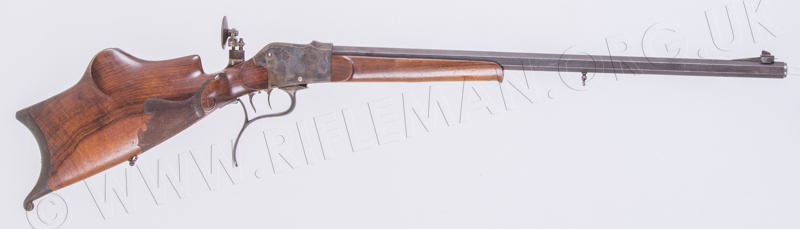
A Zimmer Schützen 'saloon' practice rifle in 4mm. calibre.
These winter practice rifles had very short barrels fitted as sleeves from the muzzle of an otherwise full-sized rifle,
with a breech opening under the heavy barrel about eight inches rearwards of the crown, into which the tiny cartridge was loaded, requiring the use of the special loading-tool previously illustrated.
 ...............
The under-barrel 'loading bay', with breech closed and open.
the 'bolt' is marked with the German Patent/Registration number beneath the initials D.R.G.M
which stand for "Deutsches Reichs Gebrauchs Muster", translating literally as 'German empire usage pattern'.
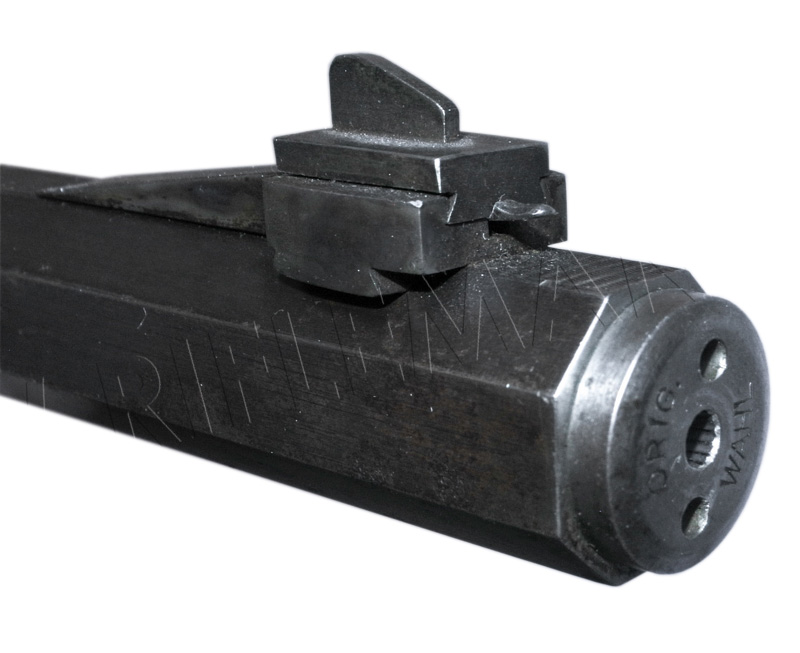 ...................
The screw-in sleeved barrel shown at the muzzle,
with the unusal form of 14-groove rifling reminiscent of the Metford system.
The popularity of these low-powered indoor rifles and pistols was self-evident, being accompanied by excellent economy and convenience.

The blank-topped Martini-like set-triggered action has no falling block,
just a long striker leading to the breech only 7 inches from the muzzle.
However, there are always those who seek greater things, particularly in North America, where the next logical extension to the system was in the length of the cartridge. Flobert also achieved this, in the form of his 6mm copper-cased rimfire cartridge.
Additionally, an American named Palmer, who had once been the backer of a not entirely successful pair of gunsmiths endeavouring to produce a reliable repeating rifle, then employed Messrs. Horace Smith and Daniel Wesson, of Smith & Wesson fame, to design a cartridge that would achieve his original aim.
A previous method of priming each cartridge used a tape that, when struck by the hammer, fired sparks through a hole in the base of the cartridge. To put not too fine a point on it, this was extremely hit and miss in a repeating rifle.
It was seen by Smith and Wesson that the Flobert cartridge could provide the means to their end, so, to circumvent Flobert’s 1846 and 1849 patents, a disc was fitted into the cartridge-case as an anvil against which the rifle’s hammer compressed the fulminate compound set in the base of the interior of the case. This proved tricky to manufacture, and it was 1857 before further serious experimentation took place, with the end of that year bringing into being what became known as the .22 Short rimfire cartridge. This was the first of a whole series of small-bore cartridges that provided both civilians and armed forces around the World with a comparatively cheap supply of ammunition for target shooting and rifle training. It was not long before obsolete service weapons were being converted to use these small and economic cartridges that could even be fired indoors at short range with 40 grain bullets.
It should be borne in mind that, in the mid Nineteenth Century, a small-bore rifle was deemed to be one, such as the .451 calibre Whitworth, which afforded a significant reduction in bore from the .700 of the Brown Bess flintlock and the .577 of the Pattern 1853 Enfield rifle. Once almost all infantry weaponry calibres had fallen below the .450 of the Martini-Henry, finally reaching the .300 American and British Service bore sizes, the term small-bore became redundant in that sense. The wording that represented smaller bore target and training arms became “miniature calibre”; thus was the “Miniature Rifle” born. Such was the Government initiated “War Office 1906 Pattern Miniature Rifle” designed by the Royal Small Arms Factory at Enfield, and manufactured by the Birmingham Small Arms Company and the London Small Arms Company in both .22inch rimfire and .297/.230inch Morris centre-fire calibres. For comparison, a .577 Whitworth hexagonal cross-sectioned rifle bullet could weigh up to 800 grains – twenty times that of a normal ‘miniature-calibre’ bullet.
A multitude of 'miniature' cartridges were developed over the years, used either for sporting or military purposes; of centre-fire there were the Morris long and short cartridges, the long 1885 Winchester .22 'WCF' round, used in the early 1885 single-shot Winchester cadet musket, the 1890 Winchester 'WRF' (Rimfire) cartridge, and larger bore but shorter cased rounds such as the .300 rook and .310 cadet ammunition, these being some notably used in British and American training rifles prior to the introduction of the .22 Long and Long Rifle ammunition. Reduced load full-bore ammunition was tried, although not proving particularly successful, (note that the so-called Snider 'cadet' cartridge in a shortened case was actually a sporting round loaded with 5 grains more powder than the service round, and its nickname is a modern misnomer). Designs abounded of adapters to fire obscure small cartridges in the full-bore service weapons, but coverage of these in a short general article such as this would be impracticable.
Below is a representative (but far from comprehensive) listing of miniature-calibre cartridges, many of which have been used throughout the British Commonwealth and within the U.K. since before the turn of the 19th., and through much of the 20th. Centuries. A few other significant British projectiles and cartridges have been added, to afford an opportunity of comparison with the miniature calibres.
.
..1 .................. Bulleted Breech Cap - 20 grain round-nosed bullet
...2 ................. Bulleted Breech Cap - 20 grain conical bullet
...3 ................. Short Rifle - copper case, 29 grain copper plated bullet
...4 ................. Short Rifle - plated case, 29 grain plain round-nosed bullet
...5 ................. Short Rifle - copper case, 29 grain plain round-nosed bullet
...6 ................. Short Rifle - brass case, 29 grain plain round-nosed bullet
...7 ................. Long - copper case, 29 grain plain (short) bullet
...8 ................. Long Rifle - copper case, 40 grain round-nosed bullet
...9 ................. Long Rifle - plated case, 40 grain hollow-pointed sporting bullet
.10 ................. Long Rifle - plated case, 40 grain round-nosed bullet
.11 ................. Long Rifle - brass case, 40 grain round-nosed bullet - Eley Club or Match
.12 ................. Long Rifle - brass case, 40 grain flat-nosed bullet - Eley current Tenex
.12a ............... Extra Long - copper case, 40 grain round-nosed bullet
.13 ................. Winchester Rimfire - 37/40 grain tapered ogive flat-nosed bullet
.14 ................. Winchester Magnum Rimfire - 40 grain jacketed soft nosed bullet
.15 ................. French Flobert 6mm - two component case - approx. 35 grain bullet

The above are but a small proportion of the many rimfire cartridges that have been made in .22 calibre alone.
Equivalent cartridges have been manufactured up to the American Civil War Spencer rifle's .56 inch calibre. There have also been many in-between calibres produced in the U.S.A., mainly for sporting purposes but, again, these are beyond the remit of this necessarily rather general article and are, in any case, more than adequately covered in detail by such tomes as "Cartridges of the World".
Remaining with the "Twenty-two", but diverging for a moment from the training theme, the market has not been solely for the solid-bulleted cartridge; blank-firing and shot-shells have also been produced - the former for starting pistols and target launchers - perhaps very loosely connected with training - and the latter for small vermin control.
16................. Paper cased shot-cartridge with copper head
17................. Brass-cased necked shot-cartridge
18 ................. Copper-cased necked shot-cartridge
19................. Brass-cased blank cartridge for Webley Target Launcher ( Empty drinks cans)..
20 ................. Copper-cased blank cartridge for use with Webley Target Launcher....
21................. Copper-cased blank cartridge for use with 'junior' starting pistols

Below are some cartridges of larger calibre, but still technically of "Miniature calibre".
22................. .297/230" Morris Short - 40 grain bullet - Centre-Fire - training sans-serif...
23................. .297/230" Morris Long - 40 grain bullet - Centre-Fire - training ..
24................. .297/250" Rook - 80-90 grain round nosed bullet - Centre-Fire - sporting .....
25................. .303" - rare rimfire cartridge for the Kynoch Lee-Enfield adapter unit
26.................9 mm Copper-cased Bulleted-Breech type - Rimfire ...
27................. .300" Rook Rifle - 80-90 (Sherwood 140-150) grain round nosed bullet - Centre-Fire - sporting ....
28................. .310" Cadet Rifle - 110-120 grain round nosed bullet - Centre-Fire - training ....
29................. .357" - .380" unusual Police Paint-ball current pistol training round

The final illustrations are of well-known projectiles and cartridges for size and type comparison.

30........ nominal .75 inch calibre Brown Bess musket ball - 1790 to 1850
31......... .577" inch calibre Enfield Pattern 1853 Rifled musket
32......... .577" inch "Snider" breech-loading conversion of above - ca 1867
33........ .577/.450 calibre Martini Henry - rolled brass case - ca 1871
34........ .303 inch British Lee-Enfield - dummy training round - ca 1888 to 1957
Ironically, one of the earliest British arms to which the term “Cadet” was attributed, was the Snider Cadet Carbine, ca. 1900. The Snider was initially a muzzle-loading Pattern ’53 or ’56 Enfield rifle converted to breech-loading by the removal of a few inches of the barrel’s rear end, and the screwing in place of a breech section designed by Snider, whose modification won a competition set by the British Government for such an adaptation. This cadet carbine remained in .577 calibre, was considerably lighter than the rifle from which it was converted, and would certainly have pained the average young shooter when fired with the issue cartridge.
Some of the most common modifications of service rifles to a “miniature calibre” for training purposes have been made to the entire range of Enfield and Lee-Enfield rifles; barely a single type, past its useful service life, has not been the subject of a conversion or adaptation of some kind or another, most usually to .22 rimfire.
The Martini-Henry, Metford and Enfield rifles were all either sleeved, rebarrelled, or retro-fitted with Morris caliber “Aiming tubes”. Lee-Enfields of all persuasions were similarly treated, and the then ‘new’ 7.62mm NATO rifle of the 1970s – the FN SLR (Self –Loading Rifle) could be fitted with a .22RF adapter unit for indoor and short-range practice.
Whilst the follow-on British “Individual Weapon” – the SA80 - was initially graced with its own straight-pull, single-shot General Purpose Enfield designed Cadet Rifle version in the full-bore 5.56mm calibre, the automatic service weapon - SA80 in L85A1 or A2 form, could also be fitted with a .22RF adapter unit, with its own breech-block, short barrel sleeve, and .22 magazine, affording semi-automatic fire on a small-bore range.
From 1948 up until 2016 the mainstay of cadet small-bore shooting was the specifically designed Rifle No.8, built using No.5 “Jungle Carbine” .303inch lightened actions fitted with a heavy .22RF target barrel, adjustable trigger mechanism, and shortened bolt to reduce lock-time. These rifles gave sterling service over an extraordinarily unprecedented near seventy years.
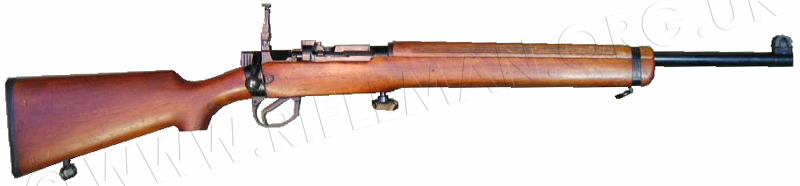
The standard issue No.8 Rifle that was approved for service on the 7th. September 1950,
and was gradually withdrawn once the L144A1 was being introduced from 2016.
In addition to modified service weapons for cadet use, there have been a number of civilian target rifles suitably modified and accepted into service with the military for training and target shooting. For full-bore 7.62mm cadet shooting there has been the L81A2, stemming from a Parker-Hale target rifle, but for small-bore practice and competition the stalwart No.8 rifle has been replaced since 2016 with a North American civilian rimfire rifle in the form of a Savage Arms FVT .22 model with adjustable butt-length - the L144A1. We must needs wait to see how it will perform over the ensuing seventy years.

The Savage based L114 British Cadet Small-bore Rifle (C.S.B.R.) introduced in 2016.
The term “cadet” has afforded different meanings over time; indeed, these meanings varied between nations. A quick internet search will tell you all you wish to know, whilst, strangely, an equivalent delving into old copies of the Encyclopædia Brittanica will avail you nothing; such is progress!
In its most common usage, the term ‘cadet’ was applied to a young officer in training within the Armed Forces, but in Great Britain the term also came to represent a young person being introduced to the military, albeit still as a civilian, and usually at school or in an apprenticeship. The first formation of cadet units, often within schools themselves, was late in the Nineteenth Century. The Boys Brigade, with a Christian basis and military methods, had already been founded by Sir William Alexander Smith in 1883, and by 1890 was widely supported in Britain, as well as abroad, although not specifically aimed at the inculcation of soldierly ways and the use of arms.
The short First Boer War in South Africa (1880-81) gave the British Government a foretaste of the shortcomings of British military infantry tactics and arms. The following Second Boer War (1899-1902) added insult to injury, with Boer marksmen out-manoeuvering and out-shooting the British infantry and cavalry to a point after which some senior British commanders deemed it expedient , quite apart from reassessing training within the military, to better prepare and familiarise the general populace in the use of firearms; and particularly the rifle.
One such commander was the Viceroy of India, Lord Roberts of Kandahar, who implored Government to encourage the uptake of rifle shooting by the Nation’s youth. Roberts was instrumental in the formation of rifle clubs and associations of all kinds throughout the country, and 1902 saw the drawing together of societies such as the Association of Working Mens’ Clubs, (whose members used air rifles in target shooting competitions in the back rooms of public houses), into the Society of Miniature Rifle Clubs which, in 1947, became the National Small-bore Rifle Association of today.
Thus, early in the 20th. Century, young men everywhere were being encouraged to shoot, much as had been those back as far as the 13th. Century to practice archery. Schools were putting together their own shooting facilities, miniature ranges, on which their pupils could hone their rifle shooting skills. To assist in training for the use of arms, it was also necessary to teach drill and infantry practice of all kinds, leading to the formation of internal military, or Cadet, units. The costs of the required training and equipment could not be entirely borne by schools, clubs and associations, necessitating the support of Government. The training and supply of military equipment was best organized through the armed forces, to whom many trainees were to eventually find their way, and it was not long before most privately run school units were to fall under the umbrella of the Service to which they were most closely allied; either the Army or the Navy at that time. The already longstanding Volunteer units should not here be forgotten, and their numbers were significantly swelled by the intake of qualified cadets moving to the next stage of the natural progression within civilian based military circles. The Royal Navy, or rather the Admiralty, initiated support of a Volunteer Cadet Corps from 1901.
The expediency of all this effort and expense was thoroughly evidenced a few short years later with the commencement of hostilities against the Kaiser in 1914. That so many young men joined up with a good basic understanding of the use of the rifle gained from cadet training had a significant bearing on the remarkable efficiency of Lord Kitchener’s “New Army”, which had to be raised to supplement the limited and slim regular forces of the time.
The arrival of the aeroplane in the theatre of war brought into being a third armed force, the Royal Flying Corps, which was transformed into the Royal Air Force in 1917, the relevance of which will become clear in due course.
Between the wars, it was becoming obvious, certainly by the early 1930s, that all was still not well within Europe. The military training of civilians was expensive, and had been much reduced after 1918, in a climate that was in economic stricture, and carried a feeling that all had just suffered what they hoped would prove to be “the War to end all Wars”. This was not to be, and the need to prepare for a further conflict was well apparent in certain higher echelons of Government; regrettably not an opinion shared by all. “Cadet” units in both Germany and Italy had by this time reached an almost unbelievable apex of development, but Britain was slow to react. The circumstances are well documented.
With the end of the War in Europe in 1945, servicemen were still widely spread around the World. It would be some years before many could return home. Some areas of the World were still in considerable turmoil, including Malaya and Palestine. That Britain could not afford to be complacent a third time in the Twentieth Century was apparent. To maintain the necessary military capabilities, National Service was introduced. Young men of eligible age and position were obliged to spend two years in one or other of the Armed Forces, where they could be, and were, deployed almost anywhere in the World. This conscription was ended in Britain in 1963, but can to this day be applicable in one or two European countries.
Even before the anticipated ending of conscription, to subsequently help feed the necessary manpower into the system, the three individual Cadet Forces, the Army, Navy and Air Force, were considerably expanded. To reduce the complexity of the organization of three separate forces, a major centralisation was undertaken, resulting in the formation of the Combined Cadet Force. Thousands of young men, and eventually even a very small number of young ladies, were inducted into Cadet Units either within their schools, or into locally run individual units. The latter autonomous units were often associated with their nearby Drill Halls, the bases of the Territorial Army units that were derived from the Volunteer Regiments of old. Royal Naval Cadet Units usually found their homes near water, either on the coast or inland. The Royal Air Force units could, like those of the Army, could be located practically anywhere, but the fortunate ones were within striking distance of an active Royal Air Force station, or with the greatest of fortune, a base that was home to a University Air Squadron and its allotted aircraft.
The 21st. Century has seen an enormous shift in public opinion. Belief in National defence, or at least its enormous cost, has hitherto waned, and there also appeared a more notable aversion to British military involvement in the affairs of other Nations, almost regardless of the behavior of those of the more aggressive, disturbed and warlike of their nationals. The latter feeling is in many ways understandable, but history has warned time and again that neglect of National defence will almost certainly lead to grief in times to come, however peaceable a life we may wish to lead.
Nowadays, along with the Armed Forces in toto, the Combined Cadet Force is at but fraction of the level it attained between 1950 and 1960. Nonetheless, it is still a critically important part of the British military. Not only does it provide today’s youth with a wonderful opportunity for character development, it also teaches discipline in many areas, and particularly that required in the employment and respectful use of firearms. However, the organisation’s most important raison d’être remains the recruitment of personnel into the British Armed Forces, and includes their training in the use of the rifle; long may it remain successful in that aim.
The Council for Cadet Rifle Shooting is the organisation which, by agreement with the Ministry of Defence, currently undertakes that rifle shooting training for all four of the Cadet Forces - now including that for the Royal Marines in addition to the Sea Cadet Corps. The CCRS also coordinates and arranges sponsorship for the three National Cadet shooting teams; respectively the UK Cadet Rifle Team (under 17), the British Cadet Rifle Team (under 18 and known as The Athelings) and the Great Britain Under 19 Rifle Team.
This article was the basis for a page on the reference website- www.rifleman.org.uk
Additional notes on miniature ammunition can be found at
https://www.rifleman.org.uk/Miniature_Calibre_Cartridges.html
Intended only for a separate website page covering this Zimmer Schützen rifle.
The next image can be rotated and zoomed, either as initially loaded or full-screen for higher definition.
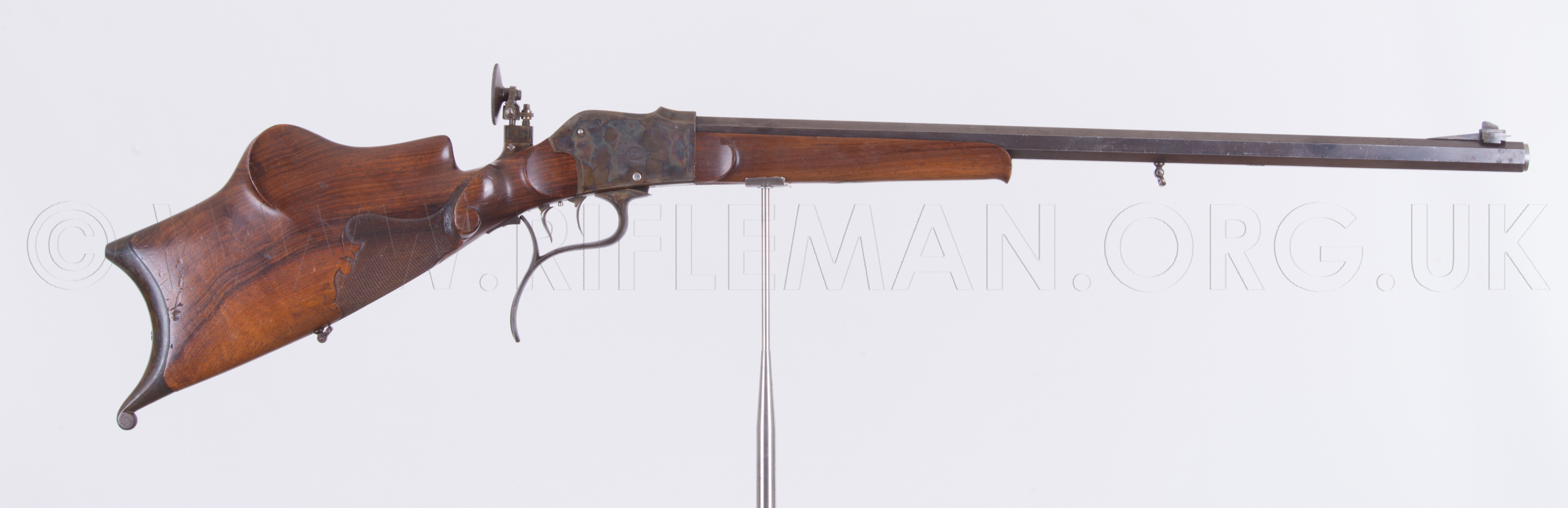
This is a single-shot Zimmer Schützen (saloon) target 'practice' rifle, produced circa 1930, with a heavy octagonal 25in. dummy 'barrel', the last 8in. of which is fitted with a separate screw-in, 14-groove barrel of the type of Stiegele's patent system.
The action body has a matted top flat imitating the falling-block of the full-bore version on which this rifle is based. The rifle has colour-hardened border -line engraved 'receiver' body with central panels of scroll. It is fitted with an interchangeable ramp and pillar fore-sight, and the rear-sight is a vernier pillar aperture model with diopter mounted to the top-tang.
The furniture is of figured walnut, in 'Tyrolean' half-stock style, with a schnabel fore-end tip, and finely chequered at the wrist. The butt is formed with a substantial colour-hardened 'Swiss-style' hooked heel-plate.
Beneath the dummy receiver is the scrolled, colour-hardened trigger-guard bow, engraved with border-lines, with a finger-spur and double set-triggers. The rifle is complete with its loading tool, which is an absolute necessity for loading the tiny bulleted-breech cartridges into the barely accessible breech beneath the dummy octagonal barrel.
The only markings on the rifle, apart from the D.R.G.M. number on the breech block, are the letters "ORIG. WAHL" stamped on the upper left-hand side corner of the action body and again on the crown of the muzzle's barrel locking block; there is no visible serial number.
The rifle may well somewhere have a full-bore counterpart, as many Tyrolean shooters had a matching pair - affording Summertime use of the main rifle in outdoor competition, but permitting practice with an equivalent rifle to continue indoors through the Winter.
Return to: TOP of PAGE
See this website's Raison d'être